
For many SMEs and midmarket companies, operational strain does not come from lack of demand. It comes from internal overload. Finance, HR, data administration, and operational reporting quietly consume time, attention, and leadership bandwidth. When these functions compete with growth priorities, momentum slows. This is often the point where leaders begin evaluating back office outsourcing services, yet many hesitate longer than they should.
That hesitation is rarely based on firsthand experience. More often, it comes from outdated assumptions that no longer reflect how outsourcing works today. These myths delay decisions, stretch internal teams further, and create unnecessary friction at critical growth stages. Understanding what is true, versus what is assumed, allows leaders to move forward with clarity and confidence.
Below are seven common myths that continue to slow decision-making, along with the practical realities business leaders should consider instead.
Myth 1: Outsourcing Means Losing Control
A frequent concern among executives is that outsourcing shared services and back office functions means surrendering oversight. Control is often equated with proximity, so the idea of remote teams raises immediate red flags.
In reality, modern back office outsourcing services are built around structure, documentation, and transparency. Control does not disappear. It becomes formalized. Clear workflows, approval hierarchies, and service-level expectations are defined before work transitions.
- Process ownership remains with the client
- Reporting cycles are scheduled and standardized
- Performance metrics are visible and trackable
When governance is designed properly, leadership gains more clarity into operations than they often have with fragmented in-house teams.
Myth 2: Quality Declines When Work Is Outsourced
Quality concerns usually stem from early outsourcing models that focused on cost above all else. Those models created understandable skepticism that still lingers today.
Professional back office outsourcing services now prioritize role alignment and process accuracy. Teams are hired for specific functions, trained on client systems, and evaluated against agreed performance benchmarks.
- Dedicated teams replace shared resource pools
- Quality assurance is embedded into workflows
- Feedback loops are continuous, not reactive
Quality outcomes depend on management discipline and process design, not physical location.
Myth 3: Outsourcing Is Only a Cost-Saving Tactic
Some leaders dismiss outsourcing because they associate it only with expense reduction. This narrow view limits strategic evaluation and often delays adoption.
While cost efficiency is a benefit, back office outsourcing services deliver broader operational value. They stabilize execution, reduce bottlenecks, and free internal teams to focus on higher-impact initiatives.
- Leadership time shifts from oversight to strategy
- Internal teams regain focus on customer-facing work
- Operations scale without organizational strain
Cost savings matter, but operational leverage is what sustains growth.
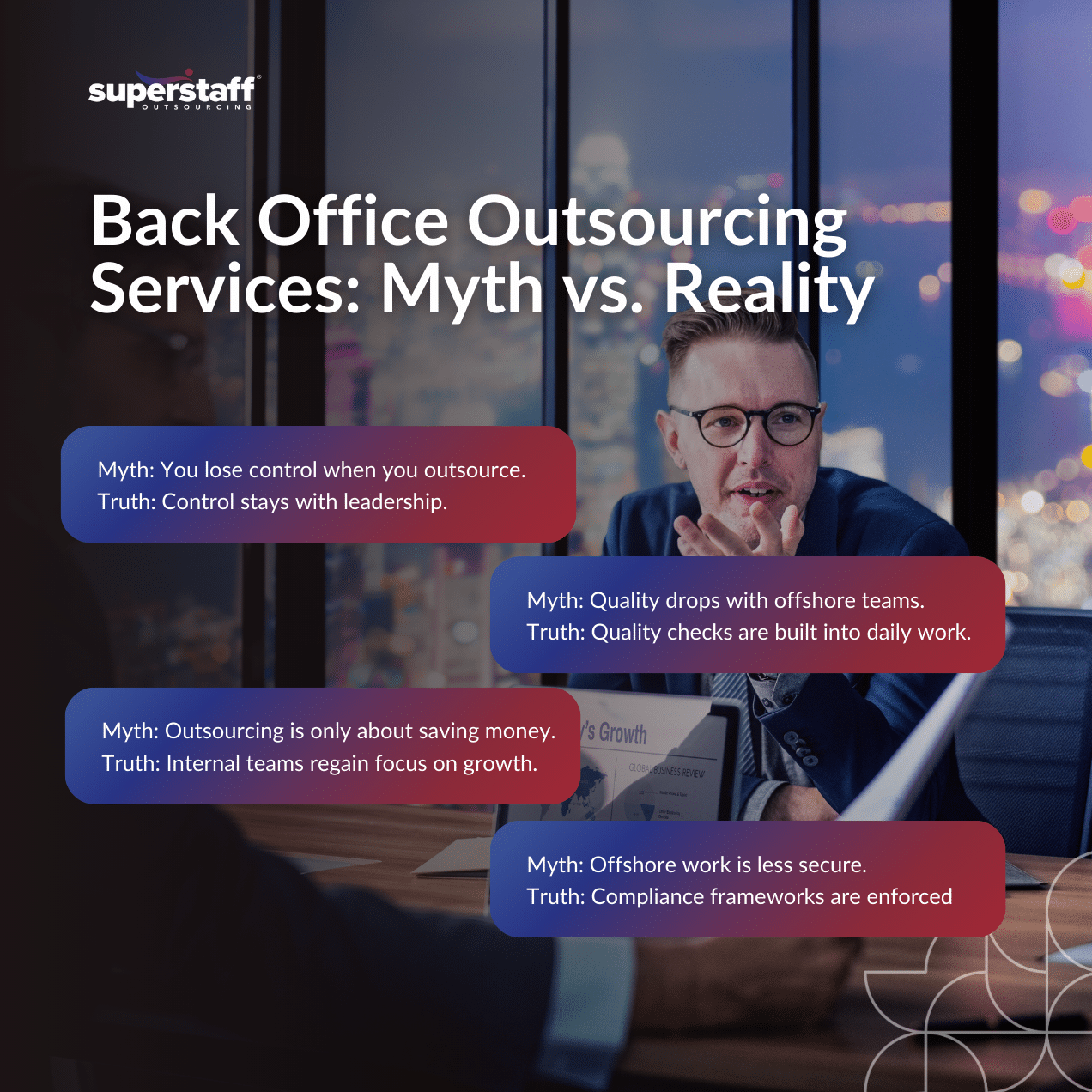
Myth 4: Offshore Teams Increase Security Risk
Data security is a legitimate concern, particularly for finance, healthcare, and compliance-driven industries. However, risk is often incorrectly tied to geography rather than process rigor.
Established back office outsourcing services operate under strict security frameworks because their credibility depends on it. Access controls, system permissions, and audit protocols are central to service delivery.
- Role-based access limits data exposure
- Secure infrastructure supports client requirements
- Internal audits reinforce compliance standards
Security failures usually result from weak internal controls, not offshore execution.
Myth 5: Transition Disrupts Business for Too Long
Another common fear is that outsourcing takes too long to implement and creates operational disruption. This belief often comes from poorly planned transitions or rushed handovers.
Well-run back office outsourcing services rely on phased transitions. Responsibilities move gradually, with parallel processing to maintain continuity and accuracy.
- Knowledge transfer follows structured documentation
- Internal teams remain involved during early stages
- Performance benchmarks guide each transition phase
Short-term planning effort prevents long-term inefficiencies and repeated rework.
Myth 6: Outsourced Teams Cannot Understand the Business
Some leaders believe external teams will never fully grasp company context or priorities. This assumption usually reflects inadequate onboarding rather than a structural limitation.
Strong back office outsourcing services emphasize immersion. Teams are trained on industry context, internal workflows, and decision-making expectations.
- Process documentation captures institutional knowledge
- Dedicated team models build continuity over time
- Regular reviews keep alignment intact
Understanding develops through consistency and communication, not physical proximity.
Myth 7: Outsourcing Reduces Flexibility
There is a persistent belief that outsourcing locks companies into rigid contracts that limit future change. This fear often prevents leaders from exploring options early.
In practice, modern back office outsourcing services are designed for adaptability. Engagement models allow for scope adjustments as business needs evolve.
- Staffing levels scale with demand
- Service coverage expands or contracts as needed
- Partnership models emphasize long-term fit
Flexibility improves when operational capacity is not tied solely to internal headcount.
Why These Myths Continue to Slow Decisions
Now that we’ve finished debunking outsourcing myths for business leaders, let’s discuss why these myths persist and how they impact operational agility.
These myths persist because outsourcing decisions are often made under pressure. Leaders default to familiar assumptions rather than current operating realities. As a result, evaluation stalls.
Meanwhile, internal teams continue juggling administrative work that pulls attention away from growth. Leaders spend time managing execution instead of guiding strategy. Opportunities are delayed, not because they lack merit, but because outdated beliefs go unchallenged.
Recognizing these patterns allows decision-makers to shift from hesitation to informed evaluation.
How to Reframe the Outsourcing Conversation
A more productive approach starts with asking different questions. Instead of focusing solely on perceived risks, leaders should assess operational sustainability.
Back office outsourcing services should be evaluated based on how well they support long-term execution. Consider where internal teams are stretched thin. Identify processes that require consistency rather than constant reinvention. Look for areas where scale is limited by internal capacity.
This perspective reframes outsourcing as an operational decision, not a cost-driven one.
What Strong Partnerships Actually Look Like
Successful outsourcing relationships are built on alignment, not transactions. Back office outsourcing services work best when they are integrated into the organization’s operating rhythm.
This means shared goals, clear accountability, and regular communication. It also means treating offshore teams as part of the broader organization rather than an external add-on.
When this alignment exists, outsourcing becomes a stabilizing force rather than a perceived risk.
Get in Touch With a Reliable Provider of Back Office Outsourcing Services
Delaying decisions based on outdated assumptions carries its own cost. Internal inefficiencies compound quietly. Leadership attention stays divided. Growth initiatives slow without an obvious cause.
Back office outsourcing services provide a practical way to restore focus and execution discipline when designed correctly. SuperStaff works with SMEs and midmarket companies to build offshore back office teams that operate as true extensions of their organizations. Our teams in the Philippines are trained, accountable, and aligned with U.S. business expectations.
If myths have slowed your decision-making, it may be time to reassess with a clearer lens. Explore how back office outsourcing services through SuperStaff can help your business operate with greater consistency, focus, and confidence. Start the conversation and see what operational clarity can unlock.