
Global hiring decisions no longer depend on cost alone. Leaders now weigh collaboration, risk, scalability, and customer experience when building distributed teams. Because of this shift, the debate around offshore vs onshore outsourcing continues to shape modern workforce strategies. Each model offers clear advantages, yet both come with limitations that affect long term growth.
Many companies struggle to choose the right direction. Onshore outsourcing offers familiarity and ease of communication. Offshore outsourcing delivers stronger cost savings. However, both options often require tradeoffs. This is where nearshoring enters the conversation. Colombia is gaining attention as a destination that helps businesses rethink the traditional offshore vs onshore decision.
Why the Offshore vs Onshore Debate Still Exists
The offshore vs onshore comparison remains relevant because companies still face competing priorities. Businesses want lower costs, but they also want speed and control. Balancing these factors is rarely simple.
Onshore outsourcing keeps operations within the same country or region. As a result, teams share the same language, regulations, and working hours. Communication becomes easier, and onboarding tends to be faster. Despite these advantages, higher labor costs can limit scalability.
Offshore outsourcing takes a different approach. Companies move operations to distant regions to reduce expenses and access larger talent pools. This outsourcing model supports rapid expansion, especially for back office and support roles. Still, geographic distance can introduce friction.
Typical offshore challenges include:
- Limited overlap in working hours
- Longer feedback cycles
- Cultural and communication gaps
These realities explain why the offshore vs onshore conversation continues across industries.
The Rise of Nearshoring as a Third Option
Instead of choosing between proximity and savings, businesses are now exploring nearshoring. This model involves outsourcing to nearby countries that offer cost advantages without significant operational barriers. Colombia has emerged as a strong contender in this space.
Nearshoring changes how leaders approach the offshore vs onshore discussion. Rather than selecting one extreme, companies can adopt a blended strategy that supports both efficiency and collaboration.
Colombia stands out because it offers:
- Geographic proximity to North America
- Compatible time zones
- Strong bilingual talent
These factors allow businesses to preserve alignment while maintaining financial flexibility.
How Colombia Bridges Offshore vs Onshore Gaps
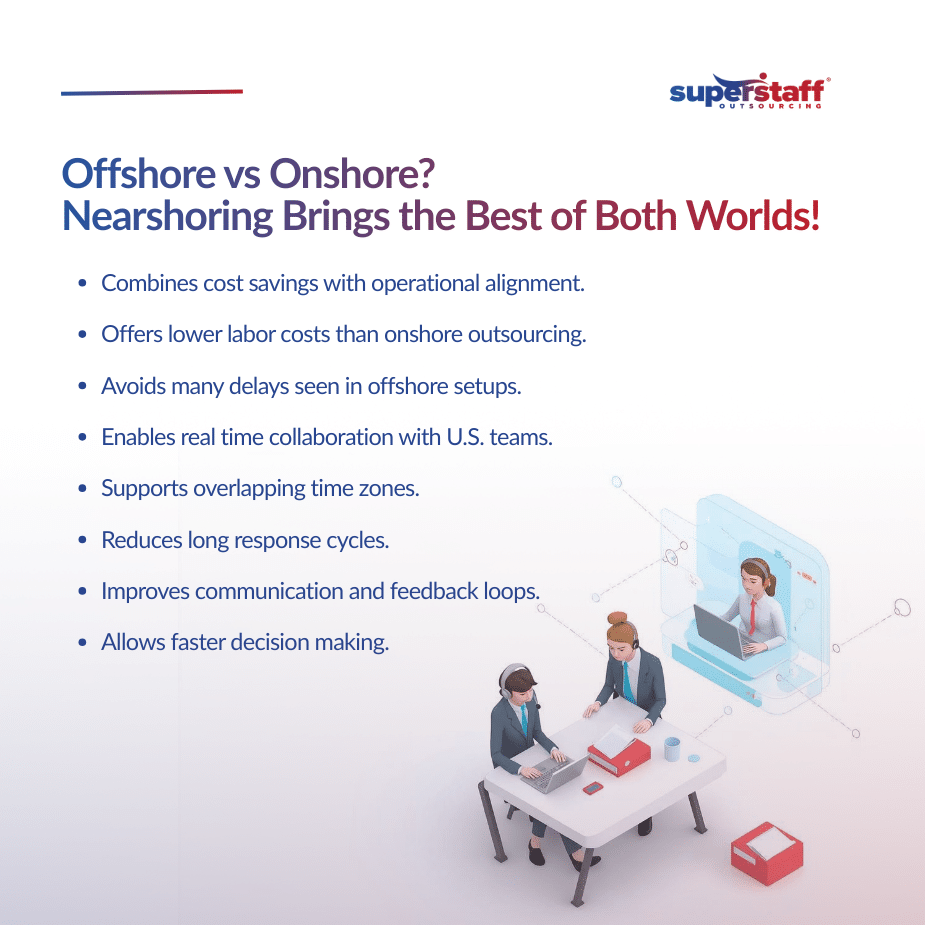
Nearshoring to Colombia works because it addresses the weaknesses of both models. The country provides meaningful savings compared to onshore outsourcing. At the same time, it avoids many of the coordination issues tied to offshore operations.
When evaluating offshore vs onshore outcomes, three areas often matter most. These include communication, cost stability, and cultural compatibility. Colombia performs well across all three.
Real time collaboration becomes easier because working hours overlap with U.S. schedules. Managers can hold meetings, resolve issues, and approve deliverables without waiting overnight. As a result, productivity improves across departments.
Time Zone Alignment Creates Faster Workflows
Time zone compatibility plays a major role in outsourcing success. Delays caused by non overlapping schedules can slow projects and affect service quality. This is one of the biggest concerns in the offshore vs onshore debate.
Colombia operates within North American business hours. This alignment allows teams to work simultaneously with U.S. counterparts. Consequently, response times improve and handoffs become smoother.
Shorter turnaround times benefit:
- Customer support operations
- Software development cycles
- Finance and compliance reviews
These improvements directly affect business performance.
Cost Efficiency Without Sacrificing Control
Budget pressure remains one of the main drivers behind outsourcing. Companies often choose offshore providers to lower expenses. However, hidden costs such as delays, rework, and miscommunication can reduce savings.
Nearshoring to Colombia provides a more predictable financial model. Labor costs remain lower than onshore markets, yet operational alignment minimizes inefficiencies. This combination strengthens the value proposition within the offshore vs onshore framework.
Financial benefits often include:
- Reduced payroll overhead
- Lower infrastructure costs
- Faster onboarding timelines
Over time, these advantages create sustainable savings rather than short term reductions.
Cultural Compatibility Supports Stronger Collaboration
Workplace culture affects productivity and team dynamics. Misalignment can lead to misunderstandings and slower adoption of processes. This factor is often overlooked in the offshore vs onshore discussion.
Colombia offers strong cultural compatibility with North American business norms. Communication styles tend to align with Western expectations. In addition, many professionals have experience working with global clients.
This cultural familiarity leads to:
- Smoother onboarding experiences
- Higher retention rates
- Improved customer interactions
Ultimately, collaboration becomes more natural and efficient.
Access to Skilled and Adaptable Talent
Talent availability remains a key factor in outsourcing decisions. Companies evaluating offshore vs onshore models often look for regions with strong education systems and growing professional communities.
Colombia has invested heavily in workforce development. Universities produce graduates in fields such as engineering, business administration, and information technology. Many professionals are fluent in English and trained in international service delivery standards.
This talent base supports a wide range of functions, including:
- Customer experience support
- Technical development roles
- Financial operations
- Administrative services
Because of this diversity, nearshoring enables companies to scale without narrowing their hiring options.
Better Visibility and Operational Oversight
Leadership teams often hesitate to outsource due to visibility concerns. Maintaining oversight becomes harder when operations move far from headquarters. This concern frequently appears in the offshore vs onshore debate.
Nearshoring improves transparency through geographic accessibility. Travel between the United States and Colombia is relatively short, which supports in person visits and stronger partnerships. Leaders can conduct audits, training sessions, and strategic planning meetings more easily.
Additionally, real time collaboration allows managers to monitor progress during the same workday. This level of access builds trust and accountability across teams.
Supporting Hybrid Workforce Models
Modern organizations rarely rely on a single workforce model. Many combine in-house teams with outsourced partners to create flexible structures. The offshore vs onshore decision often becomes part of a broader hybrid strategy.
Nearshoring supports this blended approach. Companies can retain onshore leadership while expanding delivery teams in Colombia. This structure allows businesses to maintain strategic control while scaling execution capacity.
Hybrid models provide:
- Faster expansion into new markets
- Greater operational resilience
- Balanced cost structures
These benefits help organizations remain competitive in changing economic conditions.
Reduced Risk in a Changing Global Landscape
Risk management remains a top priority for executives. Economic shifts, regulatory changes, and geopolitical factors all influence outsourcing strategies. This makes the offshore vs onshore decision more complex than ever.
Nearshoring reduces exposure by keeping operations closer to primary markets. Geographic proximity allows faster adjustments when business conditions change. It also simplifies legal and compliance coordination.
Companies that prioritize stability often view nearshoring as a practical safeguard against uncertainty.
Torn Between Offshore vs Onshore vs Nearshore? Consider a Hybrid Outsourcing Strategy
The offshore vs onshore conversation continues to evolve as companies refine global workforce strategies. While both models offer value, nearshoring provides a practical middle ground that aligns cost savings with operational efficiency.
SuperStaff Colombia represents a strong example of how nearshoring can deliver balanced outcomes. Businesses gain access to skilled talent, aligned time zones, and predictable costs without sacrificing collaboration.
Organizations that want flexibility without excessive tradeoffs should consider expanding beyond the traditional offshore vs onshore mindset. Nearshoring opens the door to scalable growth, stronger partnerships, and more responsive operations.
Companies that adapt early often gain a structural advantage. By exploring nearshoring in Colombia, leaders can build global teams that support performance, resilience, and long term success. Contact us today to get started.