U.S. insurance carriers continue to face growing claims backlogs driven by documentation volume, verification requirements, and unpredictable surge events.
Many carriers now outsource insurance claims functions to Colombia to restore processing speed and operational control. This decision is not about cost reduction. It is about designing a workflow that can handle volume without slowing resolution.
Claims backlogs are operational problems, not staffing problems
Carriers experience delays because claims processing involves repetitive documentation review, validation, and coordination. Internal teams often juggle intake, review, and follow ups at the same time.
Surge periods after natural disasters and seasonal spikes create workload that exceeds internal capacity. Fatigue and errors increase when teams work extended hours. Leaders begin to realize they need to outsource insurance claims tasks to separate volume work from decision work.
Why carriers look outside the U.S. for claims support
Hiring claims processors in the U.S. takes time. Training takes longer. Attrition in administrative roles remains high. Many carriers cannot build stable teams fast enough to match claims inflow.
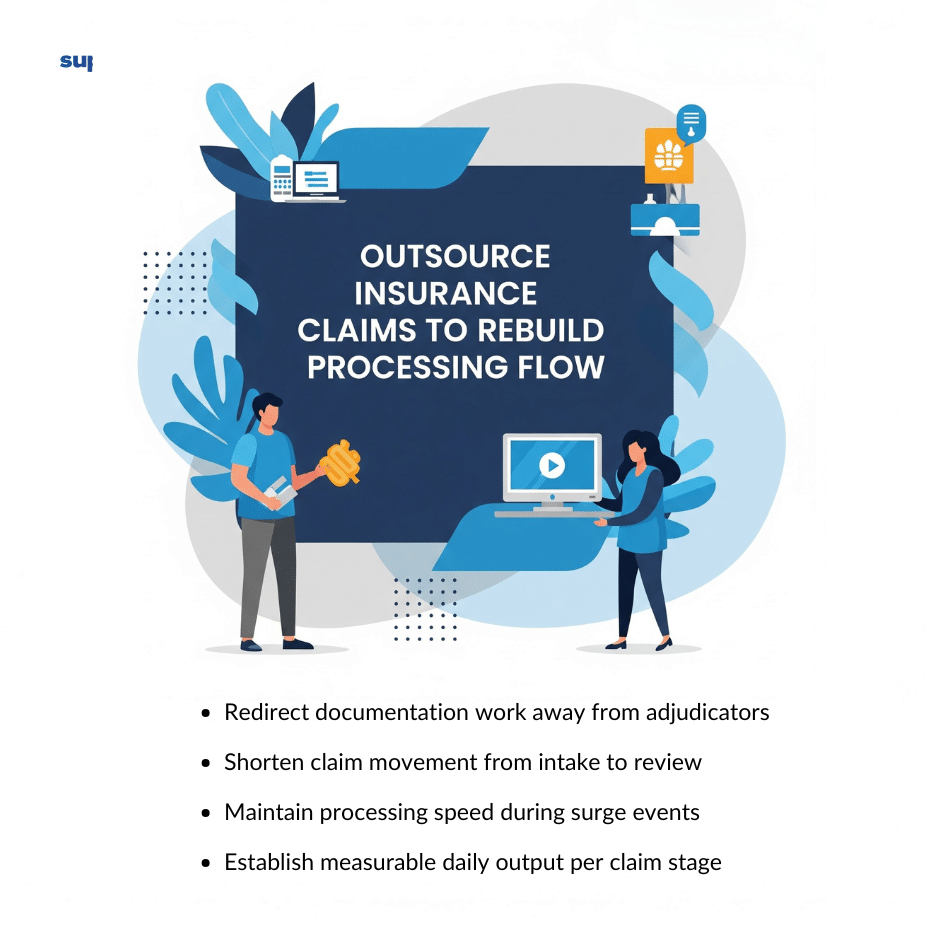
This is where insurance operations outsourcing becomes a practical solution. External teams focus exclusively on documentation and validation work while internal staff handle adjudication and exceptions. This structure allows carriers to outsource insurance claims work without losing oversight.
Colombia’s education system aligns with claims documentation work
Colombia produces graduates trained in legal, administrative, and analytical disciplines. These skills translate directly to claims documentation review and verification.
English proficiency and attention to detail make Colombian teams effective for outsourced claims management. Carriers find that when they outsource insurance claims work to Colombia, documentation accuracy improves alongside speed.
Time zone alignment changes claims cycle speed
Colombia operates in a time zone closely aligned with the United States. This allows real time communication between carrier teams and offshore processors.
Questions get resolved the same day. Escalations do not wait overnight. Carriers that outsource insurance claims to Colombia notice fewer delays caused by handoffs and email backlogs.
Structured outsourced claims management improves accountability
Dedicated teams follow defined SLAs and quality control processes. Each claim passes through documented checkpoints.
This structure is central to outsourced claims management. Leaders can measure output, accuracy, and turnaround times daily. Carriers gain visibility when they outsource insurance claims into structured environments rather than ad hoc support.
Improving turnaround time in insurance claims through outsourcing
Teams handle intake validation, documentation review, and follow up coordination in sequence. Work moves through a clear pipeline instead of sitting in individual inboxes.
This is how carriers achieve improving turnaround time in insurance claims through outsourcing. The goal is steady processing rather than rushed completion. Many carriers outsource insurance claims specifically to restore predictable cycle times.
Regulatory discipline and data handling standards
Colombian outsourcing environments follow strict access controls, audit trails, and secure documentation practices. These mirror the compliance expectations of U.S. carriers.
When carriers outsource insurance claims, they require secure environments that support regulatory audits and documentation tracking. These standards are now common within Colombia based claims teams.
Scalability during catastrophe events and seasonal spikes
Claims volume is unpredictable. Catastrophe events can double or triple workloads overnight. Internal teams cannot scale quickly enough.
Nearshore teams provide elasticity. Carriers can increase processing capacity without long hiring cycles. This flexibility is one of the main reasons carriers outsource insurance claims to Colombia.
Cost predictability supports long term planning
Overtime, temporary staffing, and burnout carry hidden costs. Predictable team structures in Colombia provide stable monthly operational costs.
Leaders gain forecasting control when they outsource insurance claims work into defined teams with measurable output. Budget planning becomes easier when variability is reduced.
Why nearshore insurance operations outsourcing is becoming standard practice
Faster claims resolution improves customer satisfaction and agent productivity. Delays hurt brand perception and policyholder trust.
For this reason, many carriers now view insurance operations outsourcing as a standard component of their operating model. The decision to outsource insurance claims is tied directly to competitive performance in the market.
Why Colombia Helps Carriers Regain Claims Control
Carriers are not outsourcing to reduce headcount. They are outsourcing to redesign how claims move through the system. Teams in Colombia provide the structure, scalability, and alignment needed to eliminate backlogs and restore processing speed.
SuperStaff supports U.S. carriers with nearshore teams trained for documentation accuracy, compliance, and turnaround discipline.
Explore how SuperStaff can help you outsource insurance claims and regain operational control.