
Live chat has evolved from a convenience into a core customer experience channel. Buyers now expect immediate responses, conversational tone, and seamless handoffs across platforms. When support operations fall behind these expectations, brand perception can shift quickly. Many growing companies choose to outsource chat support to maintain responsiveness without overloading internal teams.
Understanding when to make that move is critical. Below are seven practical signs that signal your organization may be ready to shift toward a more scalable model.
1. Response Times Are Slipping
Speed defines the success of chat support. Customers initiate live chat because they expect real-time answers. If wait times stretch beyond a few minutes, satisfaction drops and abandonment increases.
Organizations that outsource chat support often regain control over response metrics. Dedicated agents are trained specifically for high-volume environments and can maintain faster turnaround times across multiple conversations. Filipino teams, in particular, are known for strong written English and clarity in digital interactions, making them well-suited for real-time engagement.
2. Your Internal Teams Are Overextended
Many businesses launch chat support using existing staff. Sales reps, account managers, or support specialists absorb chat duties on top of their primary roles. Over time, this approach creates fragmented focus and operational fatigue.
When leaders outsource chat support, they create space for internal teams to concentrate on strategic work. Product teams can prioritize innovation, while customer success leaders can deepen relationships instead of managing constant chat queues. This separation of responsibilities often improves both internal productivity and external experience.
3. You Are Scaling Faster Than Your Hiring Model
Growth introduces complexity. As customer bases expand, chat volumes rise unpredictably. Hiring locally to match demand can be slow and costly, especially in competitive labor markets.
Companies that outsource chat support gain access to flexible staffing models. Offshore partners can ramp headcount faster than traditional hiring cycles allow. This adaptability is valuable for fast-growing startups and midmarket firms that need elasticity without long-term overhead commitments.
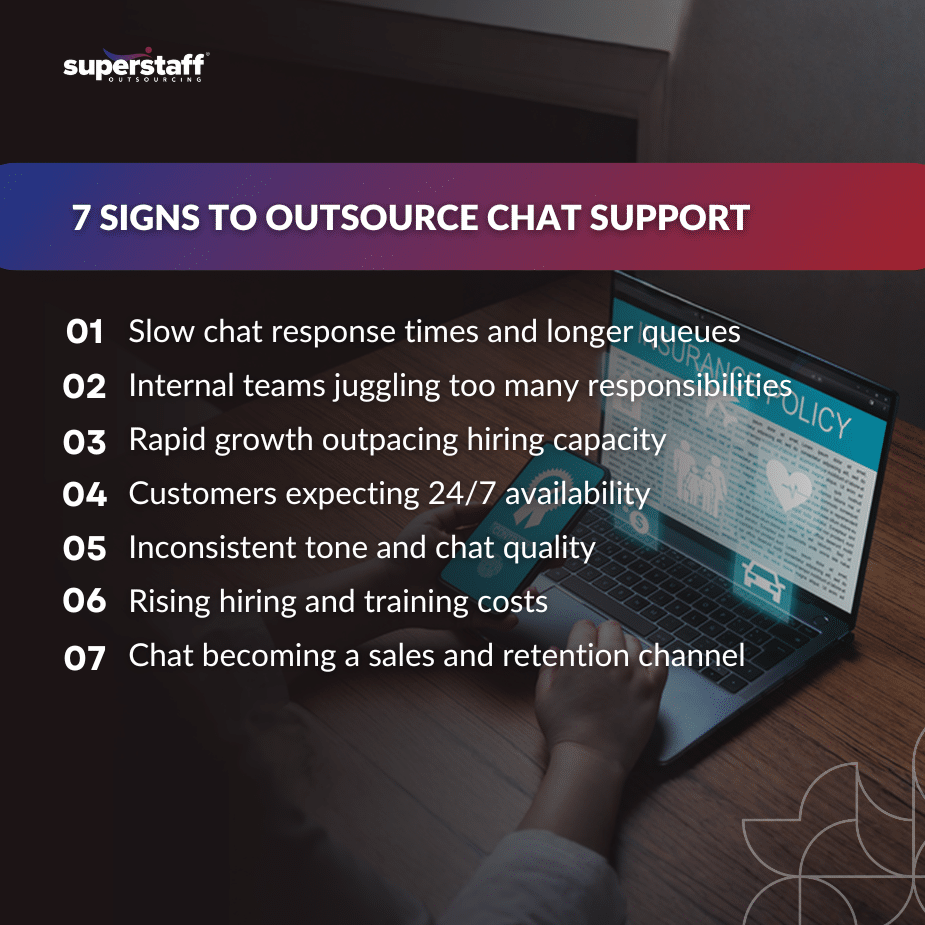
4. Customers Expect 24/7 Availability
Digital-first buyers interact with brands at all hours. Whether they are browsing late at night or shopping from different regions, they expect support that matches their schedule.
Many organizations outsource chat support to enable true round-the-clock coverage. Philippine-based teams operate across multiple shifts and are deeply experienced in supporting North American time zones. This structure allows businesses to maintain continuity without requiring internal overnight staffing.
5. Customer Experience Is Becoming Inconsistent
Consistency is one of the most overlooked elements of chat support. Customers expect uniform tone, accurate information, and smooth interactions regardless of when they reach out.
Businesses that outsource chat support often benefit from standardized delivery frameworks. Dedicated teams operate under structured quality assurance programs and centralized knowledge bases. This helps maintain consistent messaging and reduces the variability that often appears in hybrid in-house setups.
6. Hiring and Training Costs Are Increasing
The true cost of building a chat support team goes beyond salaries. Recruiting pipelines, onboarding programs, training infrastructure, and retention strategies all contribute to operational spend.
Leaders who outsource chat support can streamline these cost centers. Offshore partners manage talent sourcing, onboarding systems, and ongoing upskilling. This allows companies to convert fixed hiring costs into more predictable service investments while maintaining quality benchmarks.
7. Chat Is Becoming a Revenue Driver
Live chat is no longer purely reactive. It plays a growing role in pre-sales engagement, upselling, and retention strategies. Businesses that treat chat as a revenue lever often outperform those that view it solely as support.
Organizations that outsource chat support frequently unlock this potential faster. Experienced agents can guide hesitant buyers, recommend products, and resolve objections in real time. Filipino teams are especially effective in balancing service tone with subtle sales awareness, helping brands increase conversion without sounding scripted.
Why Filipino Chat Support Teams Continue to Lead
The Philippines remains one of the most trusted destinations for customer experience outsourcing. For U.S. SMEs and midmarket firms, the alignment goes beyond cost efficiency.
Filipino professionals bring a strong command of conversational English and familiarity with Western communication styles. Cultural alignment with American customers reduces friction in tone and phrasing, which is especially important in text-based channels. The country also has a mature BPO ecosystem, producing talent that is already trained in omnichannel support.
Another key differentiator is empathy. Chat interactions rely heavily on tone interpretation. Filipino agents are widely recognized for patience and attentiveness, helping ensure conversations feel human even when handled remotely.
Moving From Tactical Fix to Strategic Advantage
Outsourcing decisions are shifting from tactical to strategic. Instead of reacting to cost pressures, leaders now evaluate outsourcing through the lens of resilience and scalability.
Companies that outsource chat support gain structural flexibility. They can expand hours, add language capabilities, or support new product lines without rebuilding internal teams from scratch. This flexibility becomes a competitive advantage during seasonal spikes, product launches, or market expansions.
Offshore chat teams also support experimentation. Businesses can pilot proactive chat strategies, expand into social messaging, or test new service models without committing to permanent internal restructuring.
Addressing Common Concerns
Despite growing adoption, some executives still carry legacy concerns about outsourcing quality. Modern outsourcing models, however, offer far more transparency than earlier iterations.
Reputable providers implement clear service level agreements and measurable KPIs. Leadership teams retain visibility into performance through dashboards and regular reporting. This ensures outsourcing relationships remain accountable and aligned with business goals.
Brand voice is another frequent concern. With structured onboarding and calibration sessions, offshore agents can replicate tone guidelines effectively. Many companies find that outsourced chat teams become indistinguishable from in-house support once properly integrated.
Evaluating Organizational Readiness
Recognizing readiness requires honest evaluation. Companies that see chat volumes rising while internal capacity remains static are often approaching a tipping point.
Consider asking the following questions internally:
- Are chat wait times affecting customer satisfaction scores?
- Is hiring lagging behind demand growth?
- Are key team members spending excessive time managing chat queues?
- Do customers expect support outside traditional working hours?
If several of these resonate, it may indicate the need for a more scalable delivery model.
Planning a Smooth Transition
Successful outsourcing transitions are built on clarity and collaboration. Organizations that approach outsourcing as a partnership tend to see stronger outcomes.
Start by defining clear objectives. Establish expectations around response times, tone alignment, and escalation workflows. Then invest in onboarding and knowledge transfer to ensure agents understand your products and customer personas.
Ongoing alignment also matters. Regular calibration sessions and shared performance reviews help maintain quality over time. These practices strengthen trust and ensure the outsourced team evolves alongside your business.
Outsource Chat Support to the CX Professionals at SuperStaff
Knowing when to outsource chat support can redefine how your business delivers customer experience at scale. As expectations continue to rise, scalable support models are becoming essential for companies that want to remain competitive and responsive.
SuperStaff helps U.S. SMEs and midmarket companies build reliable, high-performing chat teams in the Philippines. If your organization is ready to improve responsiveness, support growth without operational strain, and elevate customer experience, now is the right time to outsource chat support with SuperStaff and build a support model designed for long-term success.