Business volatility is no longer a temporary condition. It is the environment companies must work within every day. Leaders are expected to stay agile while protecting margins, maintaining service levels, and keeping customers satisfied.
These pressures are pushing organizations to rethink how work gets done, which is why the service delivery model has taken center stage as a critical component of operational strength.
Traditional outsourcing approaches that once felt sufficient are giving way to more flexible frameworks that can respond to sudden shifts in demand, workforce capacity, or regulatory conditions.
The reality is that companies now need structures that can move as fast as the market itself. This blog explores how an adaptive approach gives businesses the stability, control, and resilience they expect while navigating constant change.
Why Volatility Redefined Outsourcing Expectations
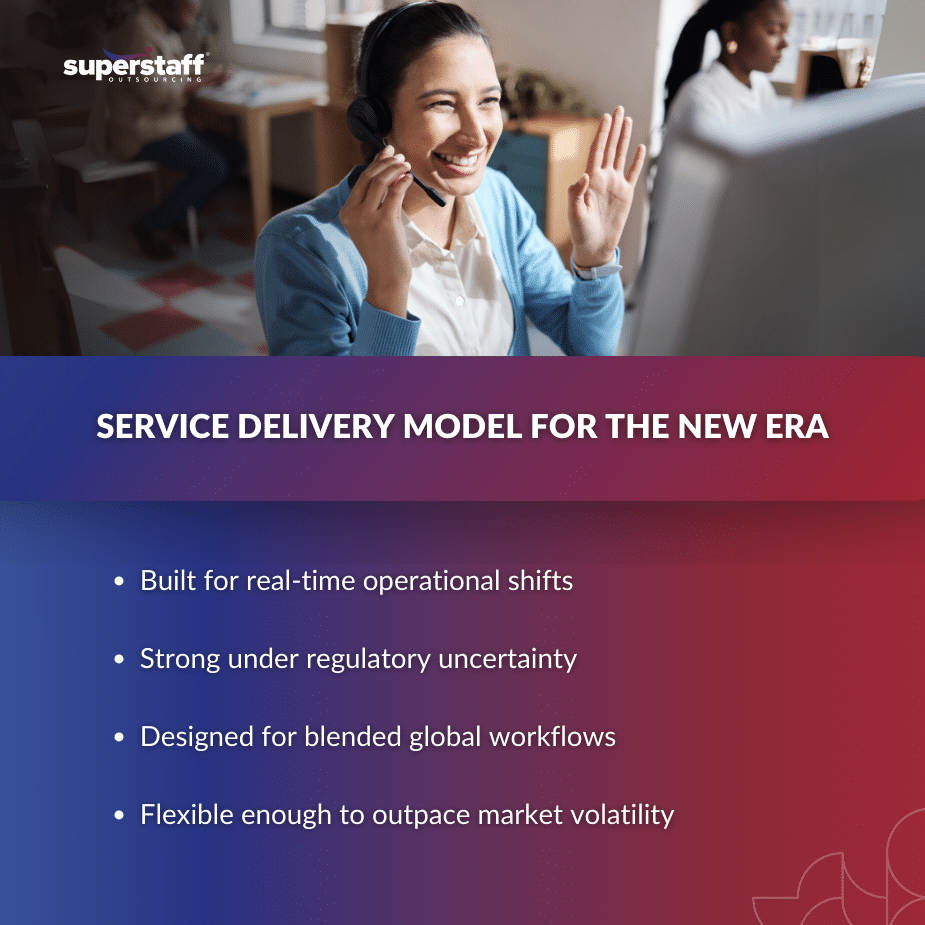
The last few years taught leaders that operational stability cannot be taken for granted. Global supply chain adjustments, rising inflation, talent shortages, and evolving customer expectations continue to reshape decision making. U.S. companies face added pressure from policy uncertainty, shifting regulations, and unpredictable demand cycles.
These influences have pushed businesses to look beyond providers who offer only labor support. They want partners capable of evolving with them, adjusting workflows quickly, and protecting customer experience at all times.
This shift reveals why the service delivery model must evolve with the realities of the modern market, creating a clear path toward more adaptive structures that can carry companies through turbulent periods.
In many ways, the need for a more responsive service delivery model has become unavoidable for organizations that want to thrive.
What an Adaptive Delivery Model Looks Like in Practice
An adaptive approach works because it treats outsourcing as a living system rather than a fixed arrangement. Cross-trained teams, multi-site redundancy, and scalable staffing capacity allow companies to realign support based on real-time needs.
This flexibility becomes even more powerful when paired with dynamic workflows that shift tasks between teams depending on volume, specialization, or priority. Technology also plays a key role by enabling seamless collaboration, quality monitoring, and workflow automation.
The combined effect is a service delivery model that keeps moving even when usual routines are disrupted. Businesses gain the confidence that their operations will not stall during periods of stress.
This model sets the stage for deeper resilience and improved performance across the entire outsourced ecosystem.
How Adaptive Outsourcing Enables Operational Resilience
The ability to adjust quickly is now essential to protecting productivity. Flexible outsourcing structures allow companies to reroute tasks, balance workloads, and maintain service continuity even during spikes or unexpected interruptions.
Providers that embrace an adaptive outsourcing model create built-in safeguards by enriching skills continuously and preparing teams to shift functions without causing service gaps. Multi-site flexibility also ensures that work can flow between offshore and nearshore locations whenever needed.
For U.S. companies, this resilience minimizes the risk of downtime and keeps operations moving without compromising quality or customer trust.
It becomes easier to navigate challenging conditions when the foundation of delivery is designed to bend rather than break. A well-designed service delivery model becomes the anchor that supports long-term operational durability.
The Strategic Advantages of Adaptive Delivery for U.S. Companies
Competitive advantage today comes from the ability to respond more quickly than the market changes.
An adaptive approach makes this possible by establishing predictable costs, improving customer experience, and allowing teams to scale without sacrificing service quality. Companies benefit from shorter response cycles, tighter controls, and a more efficient use of global talent.
These strengths become especially valuable when facing policy changes, sudden regulatory shifts, or seasonal swings. The service delivery model must act as a stabilizer, and the adaptive outsourcing model delivers exactly that. U.S. SMEs and midmarket firms gain the capacity to stay agile even when external pressures rise.
With the right service delivery model in place, it becomes easier to maintain both performance and visibility during uncertain periods.
How SuperStaff Builds and Sustains Adaptive Delivery Systems
SuperStaff aligns its operational structure with what businesses need most during times of uncertainty. With multi-site operations in the Philippines and Colombia, the company creates built-in redundancy and flexibility for clients who require uninterrupted service.
SuperStaff strengthens the service delivery model by developing blended teams that can move across functions, scale with demand, and support both voice and non-voice operations. The company also maintains a strong culture of continuous improvement, supported by cross-training, leadership stability, and technology that makes workflow shifts seamless.
These capabilities bring the principles of adaptive outsourcing to life and help clients thrive in unpredictable conditions.
This approach becomes even more impactful when leaders apply a checklist for implementing an adaptive delivery model in outsourcing and tailor it around their unique goals. Over time, this allows the service delivery model to mature into a true strategic asset.
Strengthening Growth Through an Adaptive Service Delivery Model
The need for resilience has made adaptive delivery the new blueprint for modern outsourcing. Volatility reshaped expectations, and companies now recognize the value of providers who can move with them rather than behind them.
This blog outlined how the model works, why it matters, and why it has become essential for U.S. companies that want stability and competitive strength. SuperStaff helps clients build flexible global teams that support continuity, improve performance, and deliver a steady foundation in unpredictable environments.
If you are ready to explore how an adaptive outsourcing model can protect your operations and help you scale with confidence, SuperStaff is prepared to partner with you and design a solution built for long-term resilience.