
Hiring, training, and managing people takes time. It also takes budget, structure, and constant attention. Many companies struggle to keep up with these demands as they grow. That is where BPO human resources comes in.
Instead of building large internal HR teams, many business leaders now rely on external partners. This shift helps them manage people better while staying focused on core operations. As a result, companies see measurable returns in cost savings, efficiency, and employee performance.
Understanding the ROI of BPO human resources is no longer optional. It is now a key part of scaling a business the right way.
Why BPO Human Resources Matters for Growing Companies
Growth creates pressure on internal teams. Hiring increases. Compliance becomes more complex. Employee needs also expand.
This is where BPO human resources plays a strong role.
Companies use BPO HR services to manage these demands without overloading internal teams. Instead of reacting to HR issues, they operate with structure and support.
Key functions often include:
- Recruitment and onboarding
- Payroll and benefits administration
- Employee relations and engagement
- Compliance and documentation
- Performance management support
Each function contributes to better workforce management. As a result, businesses gain stability while continuing to grow.
1. Cost Efficiency That Directly Impacts ROI
Labor costs remain one of the largest business expenses. Building an internal HR department requires salaries, tools, training, and office space.
With an outsourced human resources BPO firm, companies reduce these fixed costs.
Here is how BPO human resources teams help lower expenses:
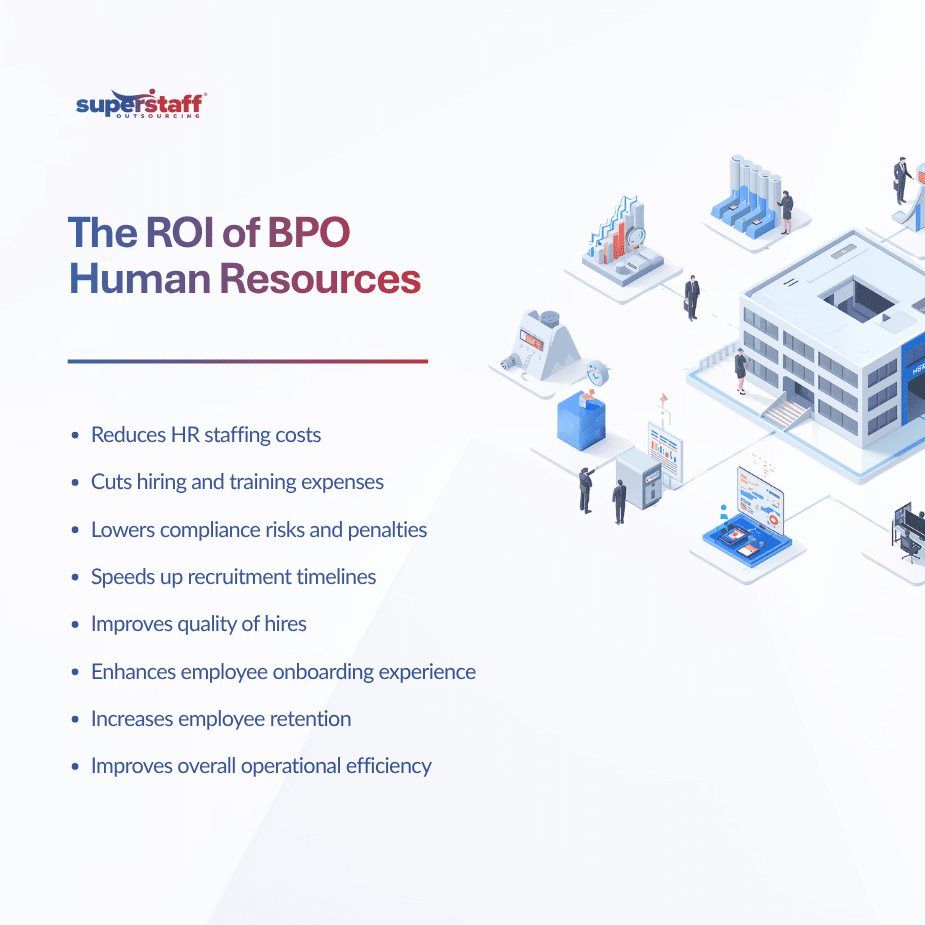
- Eliminates the need for large in-house HR teams
- Reduces hiring and training costs for HR staff
- Provides access to ready systems and tools
- Limits compliance risks that lead to penalties
These savings are clear and measurable. More importantly, they allow leaders to allocate budget to revenue-driving areas.
That is exactly how BPO human resources reduce business costs in a practical way.
2. Faster Hiring and Better Talent Acquisition
Delays in hiring can slow down operations. Open roles create gaps that affect productivity and customer service.
BPO human resources improves hiring speed through structured recruitment processes.
Key advantages include:
- Access to pre-screened talent pools
- Faster sourcing and shortlisting
- Streamlined interview coordination
- Consistent onboarding processes
With BPO HR services, companies reduce time-to-hire. At the same time, they improve the quality of candidates.
This leads to stronger teams and better long-term retention.
3. Improved Employee Experience and Retention
Employees expect support, clarity, and growth opportunities. When HR processes are weak, employee satisfaction drops.
BPO human resources helps create a better employee experience through consistent support.
This includes:
- Clear onboarding journeys
- Timely payroll and benefits handling
- Structured feedback and performance reviews
- Accessible HR support channels
When employees feel supported, they stay longer. Retention improves. Turnover costs decrease.
That is another direct return driven by BPO human resources.
4. Compliance and Risk Management Made Simple
HR compliance is complex. Rules change across regions. Documentation must be accurate and up to date.
Mistakes can lead to fines or legal issues.
With an outsourced human resources BPO, companies gain access to compliance expertise.
Benefits include:
- Updated knowledge of labor laws
- Proper documentation and record keeping
- Standardized HR policies
- Reduced legal exposure
Instead of reacting to problems, businesses operate with confidence.
This reduces risk and protects long-term operations.
5. Scalable HR Support for Business Expansion
Growth often comes in waves. Hiring needs can increase quickly, then stabilize.
Internal HR teams may struggle to adjust at the same pace.
BPO human resources offers flexibility that matches business needs.
Companies can:
- Scale HR support up during hiring surges
- Adjust services based on workforce size
- Expand into new markets with HR guidance
- Maintain consistency across locations
This scalability ensures that HR support never becomes a bottleneck.
Instead, it supports growth at every stage.
6. Access to HR Technology Without Heavy Investment
Modern HR requires systems for tracking, reporting, and employee management.
Building these systems internally can be expensive.
BPO HR services provide access to these tools without large upfront costs.
These tools often include:
- Applicant tracking systems
- Payroll and benefits platforms
- Performance management dashboards
- Employee data analytics
With BPO human resources, companies benefit from technology that improves decision-making.
At the same time, they avoid the cost of building and maintaining these systems.
7. Data-Driven HR Decisions That Improve Performance
Data plays a key role in workforce management. Leaders need insights into hiring trends, turnover rates, and employee performance.
BPO human resources provides structured reporting and analytics.
This allows businesses to:
- Identify hiring gaps
- Track employee performance trends
- Monitor retention rates
- Improve workforce planning
Better data leads to better decisions. Over time, this improves productivity and overall business outcomes.
8. Focus on Core Business Priorities
HR tasks require attention to detail. However, they can distract leaders from strategic goals.
By using BPO human resources, companies free up internal teams.
This allows leaders to focus on:
- Revenue growth
- Customer experience
- Product development
- Market expansion
Operations become more efficient because responsibilities are clearly divided.
That shift creates long-term value beyond cost savings.
9. Consistent HR Processes Across the Organization
Inconsistent HR processes lead to confusion. Employees may receive different experiences across teams or locations.
BPO human resources ensures standardization.
This includes:
- Unified onboarding processes
- Consistent policy implementation
- Clear communication channels
- Standard performance evaluation methods
Consistency improves trust within the organization. It also supports a stronger company culture.
10. Long-Term ROI Beyond Immediate Savings
The value of BPO human resources goes beyond short-term cost reduction.
Over time, companies see:
- Stronger workforce stability
- Better employee performance
- Lower turnover rates
- Reduced compliance risks
- Improved operational efficiency
Each of these contributes to long-term ROI.
When combined, they create a more resilient and scalable business.
Turning HR Into a Strategic Advantage
Many companies still view HR as a support function. However, with the right approach, it becomes a growth driver.
BPO human resources transforms HR into a structured and strategic operation. It supports hiring, improves employee experience, and reduces risks.
At the same time, it allows leaders to focus on what matters most.
If your organization is looking to improve efficiency and reduce costs, now is the time to explore BPO human resources.
SuperStaff offers reliable BPO HR services designed to support your workforce and business goals. Our team helps you build strong HR processes without adding complexity.
Contact us today to learn how BPO human resources reduce business costs while improving performance across your organization.