For years, large enterprises had the advantage when it came to operational scale. They had bigger budgets, larger internal teams, and greater access to technology investments. That gap is starting to narrow as ai business solutions become more accessible to SMEs and midmarket companies.
Smaller and growing businesses are no longer trying to match enterprise headcount. They are building leaner operations supported by outsourced teams, AI-assisted workflows, and smarter resource allocation. The focus has shifted toward operational efficiency, faster execution, and sustainable growth.
Lean Businesses Need Smarter Infrastructure
Many growing companies reach a point where internal teams become overloaded. Customer inquiries increase. Administrative work expands. Reporting becomes more complex. Hiring delays begin affecting productivity.
This is where ai business solutions are helping businesses rethink operational structure.
Instead of continuously expanding internal departments, companies are identifying which workflows can be automated, outsourced, or supported through AI-enhanced systems. This creates more room for leadership teams to focus on growth initiatives rather than operational bottlenecks.
Businesses that operate lean often move faster because decision-making becomes more streamlined. AI-supported outsourcing strengthens that flexibility even further.
AI Business Solutions Help Teams Handle More Without Burnout
Workforce pressure remains one of the biggest operational concerns for growing businesses. Teams are expected to manage higher workloads while maintaining quality and responsiveness.
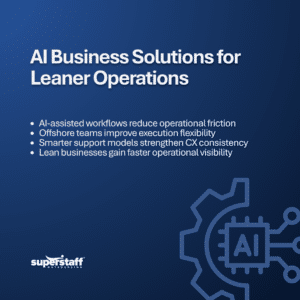
Strong ai business solutions reduce unnecessary manual work that slows employees down. AI tools can organize tickets, summarize customer interactions, assist with documentation, and support workflow prioritization.
This creates better operational balance for both internal and offshore teams.
Customer support agents spend less time searching for information. Back-office staff handle fewer repetitive administrative tasks. Managers gain better visibility into workflow trends and performance issues.
The result is a more manageable operational environment without immediately increasing headcount.
Outsourcing Makes AI Adoption More Practical
Many companies want to integrate AI into operations but struggle with implementation capacity. Internal teams are often already focused on daily responsibilities, leaving limited bandwidth for process redesign and technology adoption.
This challenge is pushing businesses toward outsourcing partners that already understand AI-supported operations.
Experienced offshore teams can help companies manage:
- AI-assisted customer support
- CRM updates and maintenance
- Workflow coordination
- Data processing
- Documentation support
- Reporting management
Businesses gain operational support while gradually introducing new systems into existing workflows.
This approach reduces disruption and allows leadership teams to focus on business priorities instead of handling every implementation detail internally.
Customer Expectations Continue to Rise
Consumers have become more demanding about speed, consistency, and accessibility. Slow response times and disconnected service experiences can quickly damage customer trust.
Many ai business solutions are designed to improve responsiveness without sacrificing service quality.
For example, AI-assisted routing systems can direct inquiries to the most appropriate support representative faster. Automated summaries allow agents to continue conversations more efficiently. Knowledge management tools reduce delays during live customer interactions.
Outsourced support teams in the Philippines are often well-positioned for these environments because many already operate within structured customer experience frameworks.
Combining trained offshore talent with AI-assisted workflows helps companies maintain high service standards while managing operational costs more effectively.
AI Business Solutions Strengthen Operational Visibility
One of the biggest operational problems for growing businesses is limited visibility into daily workflows. Leaders often lack real-time insights into customer issues, operational delays, or workforce performance trends.
Modern ai business solutions provide stronger reporting capabilities that help leadership teams make faster decisions.
Businesses can monitor:
- Customer service patterns
- Ticket resolution trends
- Workflow completion rates
- Quality assurance performance
- Workforce productivity indicators
Better visibility helps organizations identify inefficiencies before they affect customer experience or operational stability.
This becomes especially valuable for SMEs that may not have large analytics departments internally.
Lean Growth Requires Flexible Workforce Models
Economic uncertainty continues to influence how businesses approach hiring and expansion. Many organizations want operational flexibility without committing to large internal workforce increases too early.
This is why outsourced support models remain highly relevant even as AI adoption expands.
AI improves efficiency, but companies still need people to manage escalations, oversee workflows, and maintain customer relationships. Businesses that combine offshore staffing with ai business solutions often create more adaptable operational structures.
Flexible support models allow companies to:
- Extend customer support coverage
- Scale operations during growth periods
- Reduce pressure on internal teams
- Improve turnaround times
- Support multichannel communication
This flexibility can help businesses remain competitive without overextending operational budgets.
Businesses Are Prioritizing Execution Over Hype
Many executives are becoming more cautious about technology investments that promise broad transformation without clear operational value.
Decision-makers want practical ai business solutions that solve real business problems.
Companies are focusing more on:
- Faster workflow execution
- Reduced manual workload
- Better customer responsiveness
- Improved reporting accuracy
- Operational scalability
This shift toward practical implementation is changing how outsourcing partnerships are structured as well.
Businesses increasingly expect outsourcing providers to contribute operational expertise, workflow support, and technology readiness instead of simply supplying labor.
Offshore Teams Support Long-Term Operational Stability
Operational consistency matters just as much as innovation. Businesses need support structures that can maintain quality even during periods of growth, restructuring, or changing customer demand.
Offshore support teams provide an additional layer of operational resilience when integrated properly with AI-supported workflows.
Many ai business solutions improve process efficiency, but stable execution still depends on trained professionals who understand customer interaction, workflow management, and service continuity.
This balance between technology and human oversight is becoming a major operational advantage for growing companies.
Organizations that build flexible support ecosystems now are often better prepared to handle future operational changes without major disruption.
AI Business Solutions Work Best When Operations Stay Human
Businesses are moving toward leaner and more adaptive operating models. The companies gaining momentum are often the ones combining strong workforce strategies with practical ai business solutions that improve efficiency without losing operational oversight.
Technology can accelerate workflows, but long-term success still depends on people who understand customer experience, execution, and business continuity. That balance is becoming increasingly important for SMEs and midmarket companies managing growth in competitive markets.
Organizations exploring outsourced support are also becoming more intentional about choosing partners that can adapt alongside evolving workflows and operational demands. AI adoption is no longer a standalone technology conversation. It is becoming part of how businesses structure customer support, back-office operations, and long-term scalability.
SuperStaff works with companies looking to build more flexible support models through experienced offshore teams and AI-supported operational strategies. For businesses evaluating how ai business solutions fit into their growth plans, the right operational partnership can make implementation more practical, scalable, and sustainable over time.