Supply chains are under pressure from every direction. Customer expectations are higher. Shipping timelines are tighter. Operational costs continue to fluctuate. For many growing companies, managing logistics internally has become difficult to sustain without sacrificing service quality or speed.
That is why more businesses are reevaluating how they approach third-party logistics. The conversation is no longer focused only on warehousing and transportation. Companies now need operational support systems that keep communication moving, reduce delays, and improve customer visibility across the supply chain.
For SMEs and midmarket businesses in the United States, outsourcing support operations to the Philippines has become a practical way to strengthen logistics performance without overextending internal teams.
Why logistics operations are becoming more complex
Modern logistics operations involve more moving parts than ever before. Businesses are managing supplier relationships, inventory updates, delivery coordination, customer inquiries, returns, and real-time shipment tracking simultaneously.
As companies scale, these responsibilities increase quickly. Internal teams often become overloaded handling repetitive but critical administrative tasks.
This is where third-party logistics providers and outsourced support teams create operational value.
Companies need support staff who can manage:
- Shipment status inquiries
- Order processing
- Track and trace coordination
- Appointment scheduling
- Carrier communication
- Returns management
- Customer support across multiple channels
- Data entry and documentation
These tasks may appear operational, but they directly influence customer satisfaction and retention.
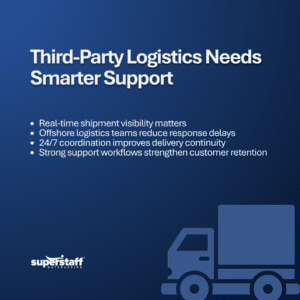
Customer experience now affects logistics performance
Customers no longer separate logistics from customer service. They expect accurate updates, fast responses, and clear communication throughout the delivery process.
When communication breaks down, customer trusut declines quickly.
Businesses working with third-party logistics partners often discover that operational bottlenecks are not always caused by transportation issues. Delays frequently happen because support workflows are fragmented or understaffed.
Examples include:
- Missed customer follow-ups
- Slow response times during shipment disruptions
- Backlogs in dispatch coordination
- Inaccurate order updates
- Delayed proof-of-delivery verification
Operational support teams help reduce these friction points before they impact customers.
Why outsourcing logistics support makes business sense
Outsourcing logistics support allows businesses to improve operational continuity without significantly increasing overhead costs.
Philippine-based teams are often used to support:
- Logistics customer service
- Dispatch operations
- Back-office coordination
- Shipment monitoring
- Documentation processing
- Billing support
- Transportation scheduling
This structure gives U.S. businesses flexibility during periods of growth, seasonal demand spikes, or staffing shortages.
Third-party logistics operations benefit when support functions are centralized under dedicated offshore teams with clear workflows and accountability.
Many midmarket companies prefer this approach because it allows internal leadership to focus on strategic planning instead of administrative volume.
The operational gap many companies overlook
Many businesses invest heavily in transportation systems and warehouse infrastructure but underestimate the operational demands behind customer communication.
A delayed shipment creates operational stress. A delayed response creates customer frustration.
Strong support teams help bridge the gap between logistics execution and customer expectations.
For example, a growing e-commerce company may already have reliable shipping partners. However, if customers wait too long for updates or cannot reach support quickly, satisfaction levels decline regardless of delivery performance.
Third-party logistics requires operational visibility across every stage of fulfillment. Support teams help maintain that visibility through consistent communication and process management.
The role of offshore teams in logistics scalability
Scalability is one of the biggest concerns for logistics-heavy businesses.
Rapid growth creates immediate pressure on customer support teams, dispatch operations, and order management functions. Hiring internally fast enough to meet demand is often difficult and expensive.
Offshore teams provide a more flexible staffing structure.
Companies can scale support functions based on:
- Seasonal shipping demand
- Market expansion
- New client acquisition
- Increased order volume
- Extended service hours
This flexibility is particularly important for businesses operating across multiple time zones.
Third-party logistics environments often require support coverage outside standard business hours. Philippine outsourcing teams are well-positioned to support 24/7 operations because the country has long experience supporting U.S.-based businesses.
Communication consistency matters in logistics
Operational consistency becomes harder to maintain as logistics networks grow.
Different carriers, vendors, customers, and internal departments all require coordination. Miscommunication can quickly create delays, duplicate work, or customer complaints.
Outsourced support teams help standardize communication processes.
This includes:
- Escalation management
- Ticket handling workflows
- Shipment documentation
- Customer response protocols
- Delivery confirmation tracking
Businesses that treat logistics support as a strategic function often improve operational efficiency over time because communication becomes more organized and measurable.
Third-party logistics success increasingly depends on how quickly businesses can respond to operational issues in real time.
Why SMEs are adopting outsourced logistics support
Large enterprises have used offshore operational support for years. SMEs and midmarket companies are now adopting similar strategies because operational demands are becoming harder to manage internally.
Smaller businesses often face:
- Lean internal staffing
- Rising labor costs
- Difficulty hiring logistics coordinators
- Limited after-hours support coverage
- High administrative workloads
Outsourcing helps close these operational gaps without forcing businesses to build large in-house departments.
This approach also supports faster adaptation during market changes.
For example, businesses managing supply chain disruptions may need temporary support increases to handle shipment inquiries or delivery rescheduling. Offshore teams provide flexibility without long-term hiring pressure.
Choosing the right support partner for logistics operations
Businesses evaluating logistics outsourcing support should look beyond cost considerations alone.
Operational alignment matters more over the long term.
Key factors to evaluate include:
Industry familiarity
Support teams should understand logistics terminology, workflows, and escalation processes.
Communication quality
Clear communication is essential when managing customers, drivers, carriers, and internal teams simultaneously.
Process adaptability
Support structures should adapt as logistics operations evolve.
Reporting visibility
Businesses need clear performance tracking and operational transparency.
Workforce stability
Consistent staffing helps maintain service quality and process continuity.
Third-party logistics support functions work best when offshore teams operate as integrated operational partners rather than isolated vendors.
The future of logistics support operations
Logistics operations will continue evolving alongside customer expectations and supply chain demands.
Businesses are expected to provide faster updates, greater transparency, and stronger service responsiveness while controlling operational costs.
That balance is difficult to maintain without scalable support structures.
Outsourcing logistics support allows businesses to strengthen operational resilience while maintaining customer experience standards.
It also creates room for leadership teams to focus on expansion, partnerships, and long-term supply chain strategy instead of day-to-day administrative overload.
Third-party logistics is becoming increasingly connected to customer experience, operational communication, and business continuity. Companies that strengthen these support layers early are often better positioned for long-term growth.
Build stronger logistics support operations with SuperStaff
As logistics operations become more demanding, businesses need support structures that improve responsiveness, coordination, and scalability. Third-party logistics success depends on more than transportation alone. Strong communication and operational support now play a major role in customer retention and operational efficiency.
SuperStaff helps U.S. businesses build dedicated offshore support teams in the Philippines for logistics customer service, dispatch coordination, back-office support, shipment monitoring, and administrative operations.
Explore how SuperStaff can help your business strengthen logistics operations with flexible offshore support solutions built for growth.