For many small and midmarket companies, payroll administration starts as a routine finance task. Someone tracks hours, calculates wages, processes deductions, answers employee questions, and makes sure payments go out on time. When the company is small, that setup may work.
But as headcount grows, payroll becomes more complex. More employees mean more schedules, more benefits, more tax rules, more documentation, and more room for error. For U.S. companies expanding quickly, payroll is no longer just an internal back-office function. It becomes a business continuity issue.
A delayed paycheck can affect employee trust. An incorrect deduction can create frustration. A missed compliance step can lead to operational risk. This is why many SMEs are now reassessing how payroll work is managed, who owns the process, and whether their internal teams have enough capacity to keep up.
Why Payroll Administration Becomes Harder as Companies Grow
Growth does not only add more employees. It adds more variation.
A company may start with a small team of full-time employees, then expand into hourly staff, remote workers, seasonal hires, contractors, or multi-state teams. Each group may require different documentation, approvals, and support workflows.
This is where payroll administration can become time-consuming for lean finance and HR teams. The work itself may be repetitive, but the consequences of getting it wrong are serious.
Common pressure points include:
- Collecting accurate timekeeping data
- Managing employee records
- Handling payroll-related inquiries
- Coordinating changes in pay, benefits, and deductions
- Preparing reports for leadership
- Supporting compliance documentation
- Tracking approvals across managers and departments
These tasks often compete with higher-value work. Finance teams need time for forecasting and cost control. HR teams need time for hiring, engagement, and retention. Operations leaders need visibility into labor costs without chasing multiple spreadsheets.
When payroll administration takes up too much internal capacity, leadership has to decide whether to keep stretching the same team or create a stronger support structure.
The Business Cost of Payroll Gaps
Payroll problems often look small at first.
An employee asks why their hours are missing. A manager forgets to approve overtime. A benefits update does not reflect on time. A payroll report comes in late before a leadership meeting.
Individually, these issues may seem manageable. Together, they create friction across the business.
Poor payroll administration can affect:
- Employee confidence
- Manager productivity
- HR response times
- Financial reporting accuracy
- Compliance readiness
- Leadership visibility
For SMEs, the bigger issue is not just the mistake itself. It is the time spent correcting the mistake. Every payroll correction requires investigation, communication, documentation, and follow-through.
That time adds up.
A stronger payroll support model helps companies reduce avoidable back-and-forth. It also gives internal leaders cleaner data, clearer ownership, and more predictable workflows.
Why Many SMEs Need More Than Payroll Software
Payroll platforms are valuable. They can automate calculations, store records, generate reports, and support compliance workflows. But software still needs people behind it.
Someone has to check inputs. Someone has to follow up on missing data. Someone has to answer employee questions. Someone has to coordinate with HR, finance, and operations when something changes.
This is why payroll administration cannot rely on technology alone.
For example, a payroll platform may flag missing information, but a trained support team must chase the update. A system may process approved hours, but managers still need reminders before deadlines. A report may be available, but someone must prepare it in a format leadership can use.
The best setup combines reliable tools with organized human support. This is especially important for SMEs that want enterprise-level consistency without building a large internal back-office team.
Where Outsourced Support Fits Into Payroll Operations
Outsourcing does not mean giving up control. It means giving the right tasks to a trained team so internal leaders can focus on decisions, strategy, and oversight.
For payroll administration, an outsourced team can support the operational layer of the process. This includes data gathering, record updates, report preparation, employee inquiry routing, and coordination across departments.
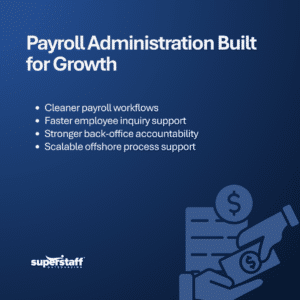
A well-structured outsourced payroll support team can help with:
- Timekeeping follow-ups
- Payroll data validation
- Employee information updates
- Benefits and deduction coordination
- Payroll ticket management
- Report preparation
- Document organization
- Internal deadline tracking
- Manager reminders
- Administrative support for payroll cycles
The goal is not to replace the finance or HR leader. The goal is to remove repetitive work from their plate so they can manage exceptions, review risks, and make better decisions.
This is where offshore support in the Philippines can give U.S. SMEs a practical advantage. Companies can build dependable back-office capacity while keeping internal ownership of policies, approvals, and final payroll decisions.
Payroll Administration Requires Accuracy and Consistency
Payroll work rewards discipline.
The process must be repeatable. Deadlines must be clear. Documentation must be organized. Employees must receive timely answers. Managers must know what they need to approve and when.
A strong payroll administration workflow usually includes:
- Clear ownership for each task
- Standardized data collection steps
- Defined escalation paths
- Regular quality checks
- Secure handling of employee information
- Consistent reporting formats
- Documented procedures for recurring issues
These basics matter because payroll touches trust. Employees may not see the complexity behind the process, but they notice when something goes wrong.
For leadership, consistency also improves planning. Clean payroll data helps decision-makers understand labor costs, staffing patterns, overtime trends, and department-level spending. Without organized support, those insights can arrive too late or require too much manual cleanup.
Why the Philippines Is a Strong Fit for Payroll Support
The Philippines has a long track record in back-office outsourcing, customer support, finance support, HR support, and administrative services. For U.S. companies, the country offers a strong combination of English proficiency, service orientation, process discipline, and cost-efficient staffing.
Payroll administration also requires careful communication. Employees may ask sensitive questions about pay, deductions, benefits, or missing information. A support team must be professional, discreet, and accurate.
Filipino offshore teams are well-suited for this environment because many are trained to work with U.S. business processes, service expectations, and documentation standards. With the right BPO partner, SMEs can create a payroll support function that is structured, responsive, and scalable.
This matters for growing companies that cannot afford payroll delays, but also cannot keep adding internal headcount for every administrative bottleneck.
What SMEs Should Look for in a Payroll Support Partner
Not every outsourcing partner is built for payroll-related work. The right provider should understand that payroll support requires confidentiality, process control, and clear communication.
Before outsourcing payroll administration support, SMEs should evaluate whether the provider can offer:
- Back-office experience
- Strong data handling practices
- Clear onboarding and training processes
- Secure systems and access controls
- Documentation discipline
- Reliable team supervision
- Flexible staffing options
- Transparent reporting
- Experience supporting U.S. business operations
The provider should also know how to work with the company’s existing payroll tools and internal teams. The goal is to strengthen the process, not disrupt it.
A good partner will help define roles clearly. Internal teams should still own policies, approvals, compliance decisions, and strategic oversight. The outsourced team should support the repeatable administrative work that keeps payroll moving smoothly.
Payroll Support Helps Leaders Protect Internal Capacity
For many SMEs, the real value of payroll administration support is not only lower cost. It is better use of internal talent.
When finance and HR teams spend too much time on manual follow-ups, they have less time for strategic work. They become reactive. They fix issues instead of improving systems.
Outsourced support helps create breathing room. It gives internal teams more capacity to focus on:
- Workforce planning
- Compensation strategy
- Employee retention
- Financial forecasting
- Compliance review
- Leadership reporting
- Process improvement
This is especially valuable for midmarket companies that are entering a new growth phase. The business needs stronger structure, but leadership may not want to build a large in-house administrative department.
A scalable support model allows companies to increase capacity without overextending internal teams.
How SuperStaff Supports Smarter Payroll Operations
SuperStaff helps SMEs and midmarket companies build offshore support teams in the Philippines for critical business functions, including back-office, finance, HR, and administrative support.
For payroll administration, SuperStaff can provide trained offshore professionals who support the process with accuracy, consistency, and service discipline. These teams can help organize records, manage recurring tasks, coordinate updates, handle inquiries, and keep payroll workflows moving with fewer delays.
What makes the model effective is structure. SuperStaff does not simply provide people. It helps companies build support systems that align with their operating needs, internal tools, and leadership expectations.
For U.S. businesses, this creates a practical way to strengthen payroll operations while preserving control over sensitive decisions.
Build a Payroll Function That Can Keep Up With Growth
Growth exposes weak processes. Payroll is one of the first areas where those weaknesses become visible.
A company can have strong leadership, strong demand, and strong employees, but still struggle if payroll workflows remain manual, understaffed, or inconsistent. Payroll administration deserves a support model that matches the pace and complexity of the business.
SuperStaff helps U.S. SMEs and midmarket companies build reliable offshore teams that support payroll, back-office, and administrative operations from the Philippines. If your internal teams are spending too much time on payroll follow-ups, reporting gaps, and recurring support tasks, it may be time to explore a more scalable model.
Explore SuperStaff’s outsourcing services and see how the right offshore team can help your business run cleaner, faster, and with greater confidence.