
Contracts keep businesses running smoothly. They support vendor agreements, employee terms, customer partnerships, and service commitments. However, many companies still manage contracts through spreadsheets, emails, and manual tracking. At first, that setup may seem manageable. Yet as operations expand, contract-related tasks quickly become harder to control.
Small mistakes often lead to delayed approvals, missed renewals, and compliance risks. Additionally, overloaded teams may struggle to monitor every document properly. Because of this, many businesses now turn to contract management outsourcing to improve accuracy and reduce operational pressure. A structured outsourcing solution helps companies stay organized while improving productivity across departments. At the same time, better contract systems support stronger customer relationships and smoother business operations.
Signs Your Business Needs Better Contract Support
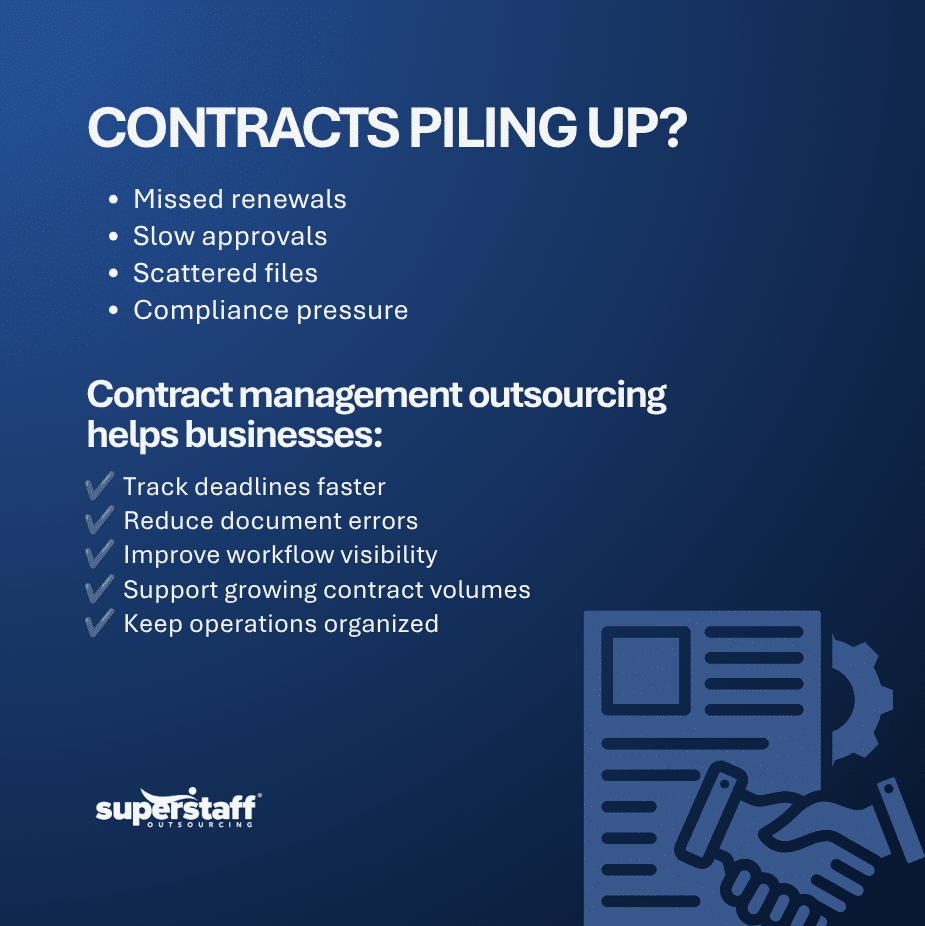
As businesses grow, contract management becomes more demanding. Delays and disorganized processes can slow operations and affect customer experience. Fortunately, contract management outsourcing helps companies regain control before problems increase.
1. Your Contract Volume Keeps Growing
More clients and vendors usually mean more contracts to manage. However, internal teams may struggle to organize every agreement properly. As a result, important details can get overlooked.
Contract management outsourcing helps businesses handle increasing workloads through organized systems and dedicated support teams. Companies dealing with growing administrative workloads can also consider back-office outsourcing services to move repetitive processes away from internal teams.
2. Deadlines and Renewals Get Missed
Missed renewals can create financial losses and service disruptions. In some cases, expired agreements may also create legal or compliance concerns.
Contract management outsourcing improves deadline tracking and renewal monitoring. Additionally, support teams can maintain schedules, provide status updates, and flag upcoming dates so responsible employees have enough time to take action.
3. Your Internal Team Feels Overloaded
Administrative staff and operations managers already manage multiple responsibilities daily. When contract-related work increases, employees may struggle to keep up with both operational and administrative tasks.
Contract management outsourcing removes suitable repetitive document work from internal teams. Because of this, employees can focus more on customer service, sales support, operations, and other core responsibilities.
4. Contract Errors Keep Happening
Small contract mistakes can create larger business issues. Incorrect information, missing terms, incomplete records, and approval delays may lead to disputes or operational setbacks.
Contract management outsourcing can introduce standardized workflows and quality checks for administrative contract processes. These controls can improve consistency and make errors easier to identify before documents move to the next stage.
5. Compliance Requirements Keep Changing
Many industries must follow legal, regulatory, and internal requirements when managing contracts. Companies need reliable processes for storing agreements, controlling access, documenting approvals, and maintaining records.
The U.S. National Archives and Records Administration provides records management guidance and resources covering the creation, maintenance, use, and disposition of business and government records.
Contract management outsourcing can support administrative compliance processes, but companies should keep qualified legal and compliance professionals responsible for interpreting requirements and making related decisions.
How Contract Management Outsourcing Improves Operations
Businesses need efficient systems to keep contracts moving through each stage. Contract management outsourcing can support these workflows while reducing repetitive administrative work.
1. Faster Contract Processing
Slow approvals can delay projects, payments, procurement, and client onboarding. Manual processes may also create bottlenecks when documents need to move between several departments.
External teams can support document preparation, data entry, status tracking, and administrative approval workflows. Clear procedures can reduce unnecessary delays while keeping the appropriate internal employees responsible for final decisions.
2. Better Document Organization
Disorganized files make contract retrieval difficult. Employees may waste time searching through emails, shared folders, or outdated spreadsheets.
Contract management outsourcing can support centralized recordkeeping and defined naming, storage, and retrieval procedures. This makes it easier for authorized employees to locate the correct version of an agreement.
Businesses facing similar document workloads can also explore legal process outsourcing for additional support with document-intensive and administrative legal processes.
3. Improved Collaboration Across Teams
Contracts may involve finance, legal, operations, sales, procurement, and other departments. Without proper coordination, communication gaps can delay approvals and updates.
Structured workflows can show where a contract is in the process, which team is responsible for the next action, and whether additional information is required.
4. Lower Administrative Costs
Hiring and training additional internal employees can increase operational expenses, especially when contract workloads change throughout the year.
Contract management outsourcing gives businesses another staffing option. Companies can assign defined administrative processes to external teams while maintaining internal control over negotiations, legal review, approvals, and other sensitive decisions.
Businesses evaluating this approach can learn more about the outsourcing services available through SuperStaff.
5. Stronger Risk Management
Poor contract management can create operational, financial, compliance, and legal risks. Missing documents, outdated versions, incomplete records, and missed dates can make agreements harder to manage.
External teams can support recordkeeping, tracking, and document control according to established company procedures. Internal legal and management teams can then focus on reviewing terms, assessing risks, and making decisions.
What to Consider Before Outsourcing Contract Management
Businesses should evaluate their needs carefully before shifting contract-related processes to an external provider. A clear strategy can determine which tasks are appropriate to outsource and which should remain internal.
1. Review Your Current Workflow
Start by identifying delays, bottlenecks, repeated errors, and time-consuming tasks. Review how contracts move from creation and review through approval, execution, storage, renewal, and expiration.
This gives the business a baseline for measuring whether contract management outsourcing improves the process.
2. Identify High-Volume Tasks
Some contract activities require legal expertise, while others are mainly administrative.
Common support tasks that may be suitable for outsourcing include:
- Contract data entry
- Document organization
- Renewal tracking
- Status monitoring
- Record maintenance
- Administrative reporting
- Document formatting and processing
Legal interpretation, negotiations, risk decisions, and final approvals should remain with appropriately qualified and authorized professionals.
3. Set Clear Performance Goals
Businesses should establish measurable goals before outsourcing contract management tasks. These may include shorter processing times, fewer administrative errors, better record accuracy, or improved renewal tracking.
Service-level expectations should also define responsibilities, turnaround times, escalation procedures, quality standards, and reporting requirements.
4. Choose an Experienced Outsourcing Partner
Not every outsourcing provider offers the same capabilities. Businesses should evaluate industry experience, data security, employee training, quality controls, technology, and communication practices.
The provider should also have clear procedures for handling confidential business information and limiting access to authorized employees.
5. Focus on Long-Term Scalability
Contract workloads may increase as a company gains customers, works with more vendors, expands into new markets, or introduces new services.
Contract management outsourcing can provide additional capacity as administrative workloads change. However, businesses should confirm how staffing, pricing, service levels, and workflows can be adjusted before choosing a provider.
Build Better Contract Processes With SuperStaff
Managing contracts can become difficult when growing workloads, missed deadlines, and repetitive administrative tasks place pressure on internal teams. Contract management outsourcing provides another way to organize documentation, monitor contract activity, and add operational capacity.
The best outsourcing structure keeps responsibilities clear. External teams can handle defined administrative tasks, while internal legal, compliance, procurement, and management teams maintain authority over decisions that require company knowledge or professional judgment.
SuperStaff provides outsourcing solutions for businesses that need additional support with document management, back-office operations, and other administrative processes. Teams can be structured around your existing workflows and operational requirements.
Ready to improve your contract management workflow? Contact SuperStaff to discuss the support your business needs.