Growth can create new opportunities, but it can also expose problems that were easier to manage when a company was smaller. Hiring gaps become more noticeable, teams take on heavier workloads, costs increase, and processes that once worked may no longer support the business.
A business growth strategist helps companies prepare for these changes instead of simply reacting to them. They assess where the business stands, identify barriers to expansion, and develop practical plans for improving operations, staffing, customer experience, and resource use. With a clearer direction, companies can pursue growth without losing control of the systems that support daily operations.
What a Business Growth Strategist Actually Does
Business growth involves more than increasing sales. A company also needs the people, processes, technology, and resources required to support a larger operation. A strategist looks at these areas together to determine what needs to change.
1. Finds Real Growth Opportunities
Not every opportunity deserves the same amount of time or investment. A strategist reviews customer demand, business performance, market conditions, and existing capabilities before recommending where the company should focus.
For example, a business may have an opportunity to expand into a new market, offer another service, or increase sales to existing customers. The goal is to identify opportunities that match the company’s resources and long-term plans rather than pursuing growth without enough preparation.
2. Finds Operational Bottlenecks
Processes that work for a small company can become inefficient as transaction volumes, customers, and employees increase.
A business growth strategist can examine where work slows down, which tasks take too much time, and where teams repeatedly experience problems. The company can then simplify processes, automate suitable tasks, or assign additional resources where they are needed.
3. Plans Workforce Needs Around Growth
Expansion often requires more people, but adding employees without a clear plan can increase costs without solving the underlying workload problem.
Strategists assess which skills and roles the business needs next. They may also identify work that can remain in-house, become automated, or move to an outsourcing partner. This allows staffing decisions to follow actual operational requirements.
4. Prepares Companies for New Markets
Entering another city, state, or country introduces new customers, competitors, costs, regulations, and staffing requirements.
A strategist evaluates these factors before the company commits significant resources. This preparation can include market research, competitor analysis, customer research, staffing plans, budgets, and performance targets.
5. Connects Short-Term Actions With Long-Term Goals
Short-term growth can create problems when companies do not consider what happens next. A sudden increase in customers, for example, may put pressure on customer support, fulfillment, accounting, or technical teams.
A strategist connects immediate expansion plans with longer-term capacity. This gives companies a clearer idea of what systems, employees, and resources they will need as the business becomes larger.
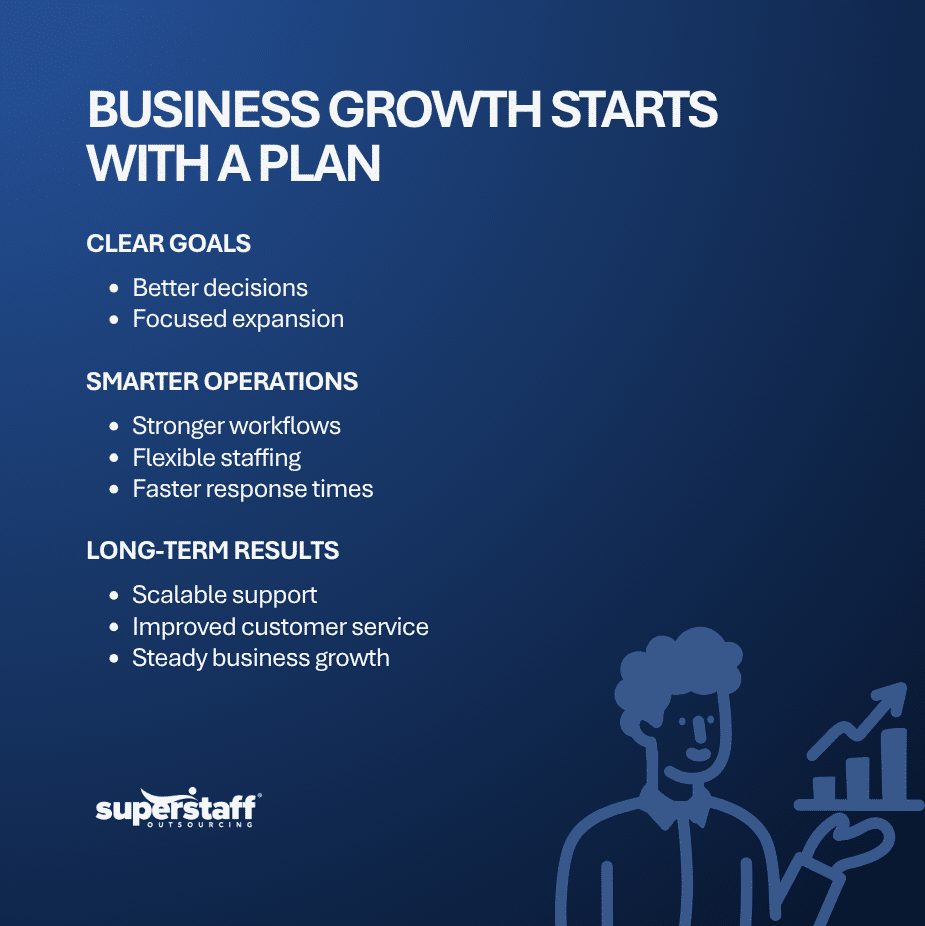
How Strategic Planning Can Speed Up Expansion
Faster expansion does not simply mean doing more work in less time. It means reducing delays that prevent a business from acting on a good opportunity.
1. Turns Growth Goals Into Specific Actions
Goals such as “increase sales” or “enter new markets” do not explain what teams need to do next.
A business growth strategist can turn broad goals into defined projects, responsibilities, timelines, budgets, and performance measures. This gives departments a common plan and makes progress easier to track.
2. Directs Resources Where They Matter Most
Growing companies usually have limited budgets and employees. Spending too much in one area can leave another department without enough resources.
Strategists assess where additional people, technology, or funding can have the greatest operational effect. Companies can then prioritize investments instead of spreading resources across too many projects.
3. Protects Customer Experience During Growth
More customers mean more emails, calls, orders, requests, complaints, and account activity. If support capacity does not increase with demand, service quality can decline.
A strategist can review customer-facing processes and identify where additional customer service support may be required. This allows the company to plan for higher demand before existing teams become overloaded.
4. Uses Performance Data to Guide Decisions
Growth decisions become harder when leaders cannot clearly see what is working. Useful measures may include revenue growth, customer acquisition costs, retention, conversion rates, response times, productivity, and operating expenses.
Instead of relying only on assumptions, strategists use relevant business data to identify problems and measure whether changes are producing the expected results.
5. Plans for Risks Before Expansion
Rapid growth can expose weaknesses in staffing, cash flow, supply chains, technology, and customer support.
Strategists identify these risks before expansion moves forward. They can then develop backup plans, set limits, or recommend changes that reduce the chance of operational problems affecting customers and employees.
Where a Business Growth Strategist Can Make a Difference
The value of strategic support often becomes clearer when a company reaches a point where its existing systems cannot easily support its next stage.
1. Hiring Cannot Keep Up With Demand
A company may win new accounts but lack enough employees to deliver the work. Rushed recruitment can then create another problem if hiring decisions are made without considering long-term workforce needs.
A strategist can connect projected demand with a staffing plan and determine whether the company needs permanent employees, temporary capacity, specialized contractors, or recruitment support.
2. Teams Are Busy but Growth Remains Slow
A full workload does not always mean a productive operation. Employees may spend large amounts of time on repetitive administration, unnecessary approvals, or processes that could be simplified.
Strategists look at how work moves through the company and identify tasks that consume resources without providing enough business value.
3. Departments Are Working Toward Different Priorities
Expansion can become difficult when sales, marketing, operations, finance, and customer support follow separate priorities.
A business growth strategist creates clearer links between company goals and departmental plans. Teams can then understand what they are responsible for and how their work contributes to the broader growth plan.
4. Operating Costs Are Rising Too Quickly
Growth naturally creates additional expenses, but costs should not increase without clear business value.
A strategist can review staffing, technology, suppliers, workflows, and other operating expenses to identify where the company may be using resources inefficiently. This can also reveal functions where business process outsourcing could be considered alongside other operating models.
5. Leaders Have Too Many Competing Priorities
Business owners and senior leaders often have several possible growth projects but limited resources to pursue them.
Strategic planning creates a way to compare those opportunities based on factors such as expected demand, required investment, available capacity, risks, and alignment with company goals. Leaders can then decide what to prioritize and what can wait.
Signs Your Company May Need Strategic Support
Companies do not need to wait until growth stops completely. Several operational problems can indicate that the existing approach needs to be reviewed.
Common signs include:
- Teams regularly struggle with increasing workloads
- Customer response or delivery times are getting longer
- Operating costs are rising faster than expected
- Departments have conflicting priorities
- Hiring cannot keep pace with business needs
- Leaders are unsure which expansion opportunities to pursue
- Existing processes cannot handle higher volumes
- Growth plans lack clear timelines or performance measures
When several of these problems appear together, a business growth strategist can help determine whether the issue comes from staffing, processes, resources, market strategy, or a combination of factors.
Turn Growth Plans Into Scalable Operations
Expansion works better when the systems behind the business can support it. Companies need enough people, clear processes, useful performance data, and a realistic plan for managing higher demand. A business growth strategist brings these areas together so leaders can make informed decisions about where and how to expand.
Strategy alone, however, does not provide the additional capacity a growing company may need. SuperStaff provides scalable outsourcing solutions for customer support, back-office operations, recruitment, and other business functions. Companies can use external teams to add capacity where needed while keeping their internal resources focused on core priorities.
Reach out to SuperStaff to learn how outsourcing can support the operational side of your business growth strategy.