Expanding into a new country creates opportunities for growth. However, it also brings important decisions that can affect costs, compliance, hiring speed, and long-term operations. One of the first choices many companies face is whether to use an Employer of Record (EOR) or establish their own legal entity in the target market.
The debate around EOR vs. local entity has become increasingly relevant as businesses look for flexible ways to enter global markets. While both options allow companies to hire employees in other countries, they work very differently. Therefore, understanding the advantages and limitations of each approach can help business leaders make informed decisions that support their goals.
Understanding the Two Expansion Models
Before making a decision, it helps to understand how each model works and what responsibilities it involves.
1. What Is an Employer of Record?
An Employer of Record serves as the legal employer of workers on behalf of another company. The EOR manages payroll, taxes, employment contracts, benefits, and local employment requirements.
Businesses can use Employer of Record services to hire employees in markets where they do not have their own legal entity. Meanwhile, the client company continues to direct the employee’s daily responsibilities and performance.
2. What Is a Local Entity?
A local entity is a company that establishes its own legal business presence in another country. The business becomes the direct employer of its workforce.
Because of this structure, the company takes responsibility for employment compliance, taxes, payroll management, benefits, and government reporting requirements. The exact requirements vary by jurisdiction and business structure.
3. How Hiring Works Under Each Model
With an EOR, companies can usually begin the hiring process without first establishing their own local entity because the EOR already has the employment infrastructure in place.
Meanwhile, establishing a local entity involves registration, tax, banking, employment, and other requirements that depend on the country. Consequently, businesses looking for faster market entry may consider the EOR route first.
4. Ownership and Control Differences
Companies that establish a local entity gain direct control over employment processes and local business operations. They can manage policies, benefits, payroll, and HR systems internally.
On the other hand, an EOR handles many legal and administrative employment functions, while the client company generally manages the employees’ daily work, responsibilities, and performance.
5. When Businesses Usually Choose Each Option
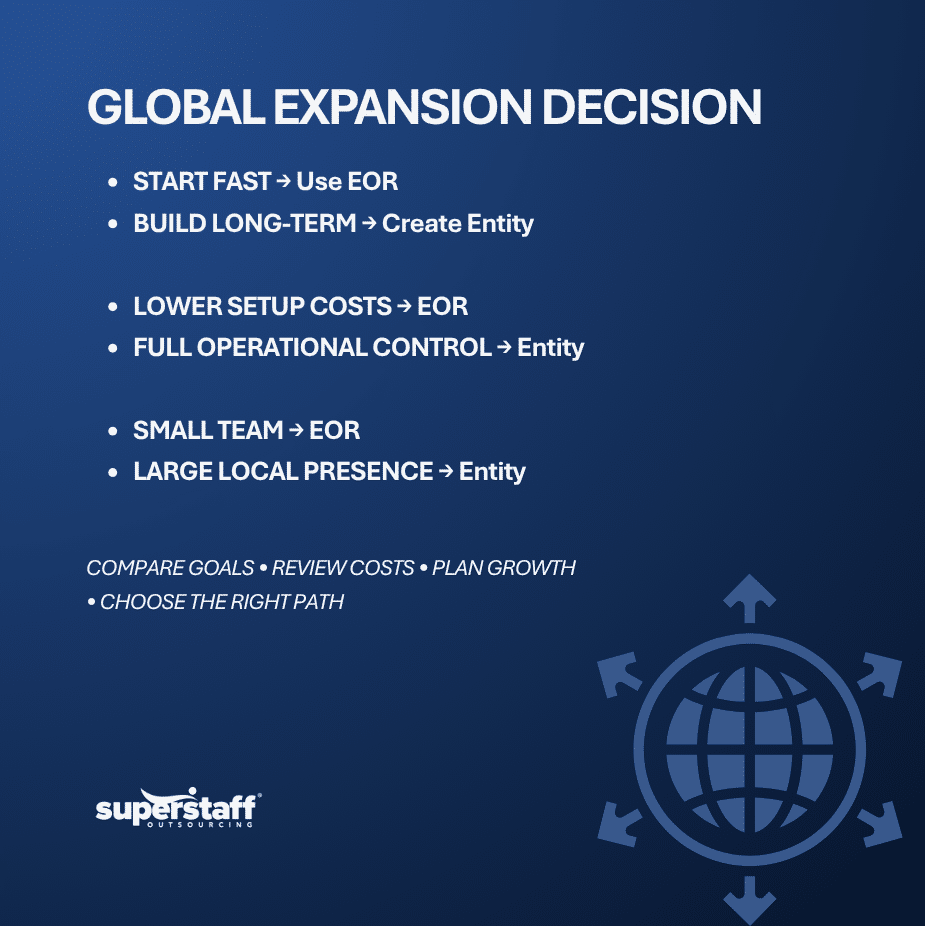
Many companies consider an EOR when testing a new market, hiring a small team, or expanding without immediately establishing a permanent legal presence.
Companies planning larger or more permanent operations may consider setting up their own entity. Businesses can also use recruitment process outsourcing when they need support sourcing, screening, and onboarding employees while retaining a direct employment model.
Comparing Costs and Operational Requirements
Cost considerations often play a major role when evaluating expansion strategies. However, businesses should look beyond startup expenses alone.
1. Initial Setup Costs
An EOR generally avoids many of the upfront costs associated with forming a new entity because the provider already has an employment structure in the target market.
Meanwhile, establishing a local entity may involve registration fees, legal services, accounting support, licenses, banking arrangements, and other setup expenses.
2. Ongoing Administrative Expenses
The EOR provider charges service fees for managing employment-related responsibilities. These costs can change based on factors such as workforce size, location, and service requirements.
Companies with local entities, however, need resources for payroll, HR administration, accounting, legal support, and compliance. Therefore, businesses should compare the total ongoing cost of both models rather than looking only at initial expenses.
3. Compliance Management
Compliance requirements vary from country to country. Labor laws, tax regulations, statutory benefits, and employee protections may also change over time.
When evaluating EOR vs. local entity, businesses should determine who will monitor and manage these responsibilities. An EOR handles many local employment requirements, while a company operating through its own entity must build or obtain the expertise needed to manage them directly.
The U.S. International Trade Administration provides country-specific information that businesses can use when researching foreign markets, including commercial conditions and considerations related to international expansion.
4. Time Investment
Setting up a local entity can require documentation, registrations, approvals, and coordination with local authorities and professional advisers.
By comparison, an EOR can reduce the amount of setup required before hiring begins. This can be useful when a company needs employees in a new market before it is ready to establish its own entity.
5. Scalability Considerations
An EOR can support companies that want to add employees in new markets without immediately building local HR and employment infrastructure.
Businesses can also explore different global workforce solutions as their staffing requirements change. However, companies with large, permanent operations may eventually determine that direct local infrastructure better matches their long-term plans.
Factors That Should Guide Your Decision
Choosing between these models depends on business goals, timelines, workforce requirements, and growth strategies.
1. Market Entry Speed
Companies often prioritize speed when entering new markets. If hiring must begin before the company can establish a legal entity, an EOR can provide an alternative employment structure.
As a result, organizations can begin building their workforce while deciding whether a larger local investment makes business sense.
2. Workforce Size
A small team may not justify the cost and administrative work of establishing a local entity. Therefore, some businesses use an EOR during the early stages of expansion.
However, as the workforce grows, companies should compare EOR service costs with the expenses and responsibilities associated with operating their own entity.
3. Risk Tolerance
Employment requirements differ across markets. Mistakes involving payroll, contracts, benefits, or labor regulations can create financial and legal problems.
Companies should review how responsibilities are divided under an EOR agreement and obtain appropriate legal or tax advice for the countries where they plan to hire.
4. Long-Term Growth Plans
When discussing EOR vs. local entity, future business goals should remain a key consideration. Companies planning permanent operations, local offices, major investments, or broader commercial activities may eventually require their own legal entity.
Meanwhile, businesses exploring a market can use an EOR to build a workforce without immediately making the same level of infrastructure commitment.
5. Available Internal Resources
Building and managing a local entity requires HR expertise, legal knowledge, payroll capabilities, and financial oversight. Therefore, companies should assess whether they have the resources needed to manage these responsibilities.
If internal capabilities are limited, an EOR can take responsibility for many employment administration functions while the business develops its international operations.
Common Situations Where an EOR Makes Sense
Many businesses consider an EOR in specific expansion scenarios.
- Testing demand in a new market before making a larger investment
- Hiring remote employees in countries where the company has no legal presence
- Building an international team before establishing local infrastructure
- Recruiting specialized talent from different regions
- Reducing the internal administrative work involved in international employment
These situations often require flexibility, speed, and simpler employment administration.
Common Situations Where a Local Entity Makes Sense
A local entity may be considered when a company:
- Plans to establish a long-term presence
- Intends to open offices or facilities
- Expects significant workforce growth
- Requires direct control over local employment infrastructure
- Plans broader commercial activities that require a local legal presence
In these cases, the additional investment required to establish and maintain an entity may align with broader business objectives.
Expand Globally With Confidence and Flexibility
Choosing between EOR vs. local entity depends on your business goals, hiring plans, budget, target country, and expansion timeline. An EOR can provide a faster route to international employment without first creating a local entity, while establishing an entity gives the company direct responsibility for its local employment structure and operations.
SuperStaff supports companies exploring international workforce expansion through Employer of Record services, recruitment, and other workforce solutions. Whether you are comparing EOR vs. local entity or preparing to hire employees in a new market, the right structure should match both your immediate needs and long-term plans.
Ready to discuss your international hiring requirements? Reach out to SuperStaff and explore a workforce solution based on your expansion goals.