Fintech leaders know growth can create pressure fast. More users, more transactions, more vendors, more documentation, and more regulatory scrutiny can stretch internal teams before leadership sees the warning signs. That is why fintech compliance outsourcing has become a practical path for U.S. companies that need stronger operational control while keeping their core teams focused on product, customers, and revenue.
For fintech firms serving banks, lenders, payment platforms, insurers, investment users, or digital wallet customers, compliance work is no longer a back-office formality. It affects trust, speed, customer onboarding, risk exposure, and partner readiness.
The challenge is simple. Compliance needs consistency. Growth needs speed. Internal teams often have to manage both at once.
That is where SuperStaff’s Colombia office creates a strategic advantage for U.S. fintech companies. With nearshore alignment, strong English proficiency, cultural compatibility, and scalable support teams, Colombia gives fintech leaders access to trained operational talent in a time zone that supports real collaboration.
Why Fintech Compliance Outsourcing Is Becoming A Boardroom Priority
Fintech companies operate in a high-accountability environment. Even when the product feels simple to the customer, the work behind it is complex.
Teams must monitor customer information, transaction records, account updates, documentation requests, support tickets, vendor files, and internal workflows. Each task may look routine, but each one can affect compliance quality.
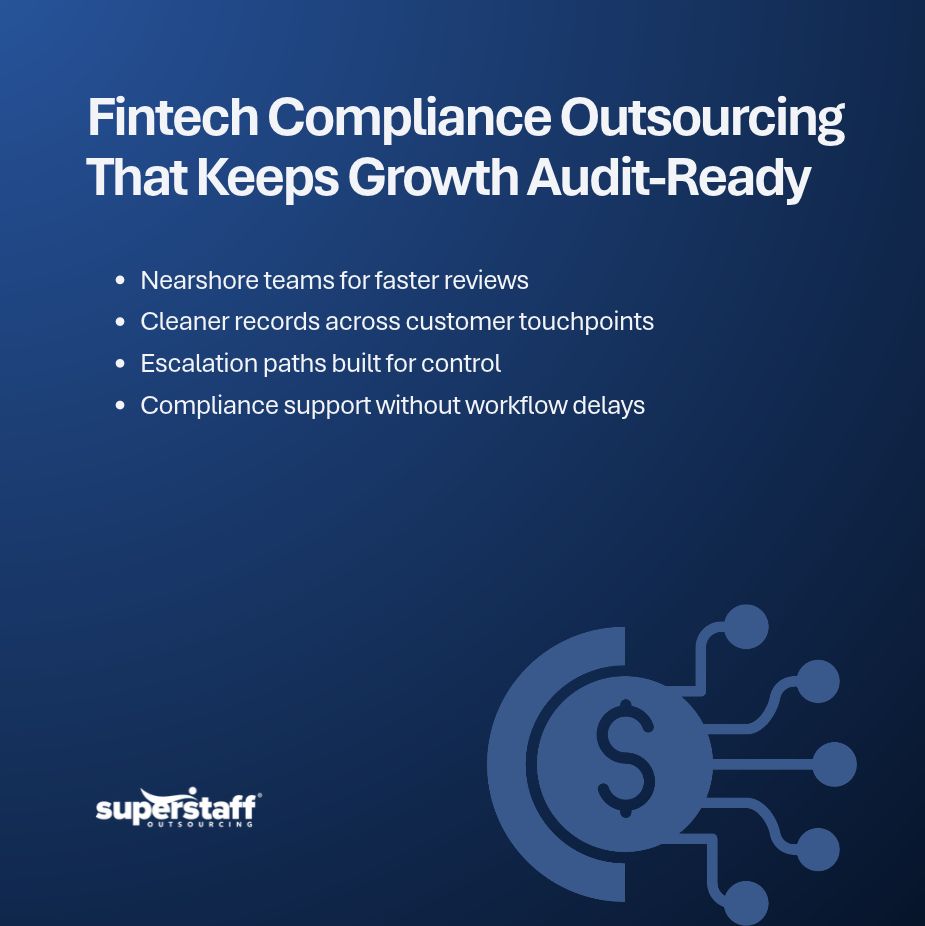
Fintech compliance outsourcing helps companies organize these recurring tasks with more discipline. It gives internal compliance leaders added capacity without forcing them to hire, train, and manage every support role in-house.
For SMEs and midmarket fintech firms, this matters because compliance demands do not wait until the company is fully staffed. A growing fintech may need to support more customers, respond to more documentation requests, and maintain cleaner records before its internal team has the bandwidth to scale.
A nearshore partner can help cover that gap with structured support.
Common compliance-related functions that can be supported include:
- Customer information review
• KYC document collection support
• Account verification assistance
• Transaction monitoring support
• Case documentation
• Compliance ticket management
• Data entry and record updates
• Customer support for compliance-related requests
• Quality checks for process adherence
These roles do not replace legal counsel or licensed compliance officers. They support the operational layer that helps compliance leaders stay organized, responsive, and prepared.
The Real Risk Is Operational Backlog
Many fintech firms do not struggle because they lack compliance awareness. They struggle because the work piles up.
A customer uploads the wrong document. A support ticket needs follow-up. A transaction review requires additional notes. A vendor file is missing details. A customer asks why verification is delayed.
One unresolved task can become ten. Ten can become a pattern.
Fintech compliance outsourcing addresses this problem at the workflow level. It gives companies dedicated support for the repetitive but important tasks that keep compliance operations moving.
For example, a U.S. lending technology company may have a small compliance team reviewing customer documentation. As application volume increases, internal reviewers may spend too much time chasing missing files, updating records, and responding to customer questions.
A Colombia-based SuperStaff team can support those surrounding tasks. Internal compliance leaders can then focus on judgment-based reviews, escalations, policy interpretation, and risk decisions.
That division of work creates better focus. It also helps companies protect service quality during busy periods.
Why Colombia Makes Sense For U.S. Fintech Teams
Location matters in compliance support. Fintech companies need clear communication, fast escalation, and reliable coordination with internal teams.
Colombia gives U.S. fintech companies a strong nearshore option because teams can work closely with U.S. business hours. This makes fintech compliance outsourcing more practical for functions that require timely follow-up.
When a compliance manager in the U.S. needs a case updated, a file reviewed, or a customer issue escalated, nearshore alignment reduces delays. Conversations happen during the same workday. Training sessions are easier to schedule. Team leaders can join regular stand-ups, coaching calls, and performance reviews.
That is especially useful for fintech companies that cannot afford long gaps between customer action and internal response.
The Colombia market also gives companies access to support professionals who can serve U.S. customers with a strong service mindset. For fintech brands, that customer-facing layer matters. Compliance requests can feel frustrating for users. A trained support team can keep the experience clear, respectful, and consistent.
What To Outsource First In Fintech Compliance
Fintech leaders should not outsource everything at once. The strongest approach starts with repeatable tasks that are process-driven, measurable, and easy to document.
Fintech compliance outsourcing works best when companies begin with high-volume workflows that slow internal teams down but do not require final compliance judgment.
Good starting points include:
- KYC support
• Document collection and follow-up
• Customer identity record updates
• Compliance inbox management
• Case tagging and routing
• Basic transaction support documentation
• Customer service for account verification questions
• Quality assurance checks against approved scripts
This approach gives the internal team breathing room while keeping sensitive decision-making under the right leaders.
It also helps the outsourcing partner learn the client’s process, tone, tools, and escalation rules before expanding into more complex support areas.
For U.S. fintech companies, this matters because compliance work must be structured carefully. The goal is not to move responsibility away from leadership. The goal is to build a stronger operating model around leadership.
The SuperStaff Advantage For Fintech Support
SuperStaff understands that fintech clients need more than staffing. They need process discipline, agent accountability, and a team that can work within strict operating guidelines.
That is why fintech compliance outsourcing should be built around clear workflows from the beginning. Every task needs defined steps. Every escalation should have an owner. Every customer touchpoint should follow approved language. Every record update should be traceable within the client’s system.
SuperStaff’s Colombia office can support U.S. fintech companies with nearshore teams trained around:
- Customer service excellence
• Back-office accuracy
• Process documentation
• Team lead supervision
• Performance coaching
• Quality monitoring
• Escalation discipline
• Brand-aligned communication
This is important because fintech customers often interact with compliance processes during sensitive moments. They may be opening an account, correcting information, submitting proof of identity, or trying to resolve a blocked transaction.
A rushed or unclear response can create frustration. A trained outsourced team can help make the process smoother without weakening compliance standards.
Building A Strong Compliance Support Model
A successful fintech compliance outsourcing program needs structure before scale.
Companies should begin with a clear scope of work. This includes the tasks the outsourced team will handle, the tasks that remain with the internal team, and the moments that require escalation.
Training should cover more than tools. It should include brand voice, customer scenarios, prohibited actions, documentation rules, privacy expectations, and response standards.
Quality assurance should also be built into the program early. Leaders should review sample cases, call notes, chat responses, email replies, and turnaround times. This helps the outsourced team improve while giving the client visibility into performance.
A strong model usually includes:
- Documented workflows
• Clear role boundaries
• Approved customer scripts
• Escalation paths
• Regular calibration sessions
• Quality scorecards
• Performance reviews
• Data privacy expectations
This kind of structure allows SuperStaff to support fintech clients with discipline and consistency. It also gives internal leaders better visibility into how work is being handled.
Why Nearshore Support Helps Fintech Brands Move Faster
Fintech companies compete on speed, trust, and experience. Customers expect fast onboarding, clear communication, and quick issue resolution. Business partners expect strong controls and reliable documentation.
Fintech compliance outsourcing helps companies protect both sides of that equation.
With the right Colombia-based team, a fintech company can reduce internal workload, improve follow-up speed, and keep customer-facing compliance tasks organized. Internal teams can spend less time chasing routine updates and more time handling strategy, risk, audits, policy alignment, and partner requirements.
This is where outsourcing becomes a practical operating decision. It helps fintech companies support growth without letting compliance work become reactive.
For SMEs and midmarket firms, that can be the difference between a team that is constantly catching up and a team that has room to lead.
Choose A Nearshore Partner Built For Fintech Support
Fintech compliance outsourcing works best when it is designed with clear roles, strong training, and close collaboration. It should not feel distant from the business. It should function as an extension of the internal team.
SuperStaff’s Colombia office gives U.S. fintech companies nearshore support that is aligned with their workday, customer expectations, and operational goals. With trained teams across customer experience and back-office support, SuperStaff helps fintech firms strengthen the daily workflows that keep compliance operations moving.
If your fintech team is growing and compliance support is becoming harder to manage internally, it may be time to build a more scalable model. Explore SuperStaff’s Colombia outsourcing services and see how a nearshore team can help you improve compliance support, protect customer trust, and move with greater control.