Businesses handle large amounts of information every day. Customer records, product details, financial reports, forms, and transactions all require proper organization. When internal teams manage these tasks alongside their regular responsibilities, backlogs and data entry errors can become common problems. This is why many companies turn to data processing outsourcing to manage routine information-related tasks.
With the help of trained specialists, businesses can process, organize, and update large volumes of information without placing additional pressure on their internal employees. This approach also helps maintain consistent workflows and gives teams more time to focus on business priorities. Understanding the benefits of outsourcing can help companies decide which data tasks to delegate and how external support can improve daily operations.
Why Businesses Use Data Processing Outsourcing Services
Managing business information requires time, attention to detail, and clear procedures. As data volumes increase, internal teams may struggle to keep records updated while meeting other operational responsibilities.
Outsourcing provides access to professionals who handle repetitive data tasks based on established instructions and quality standards. Companies can assign specific responsibilities, set completion schedules, and monitor results without having to expand their internal departments.
Businesses can also combine data processing with other back-office support solutions and data entry outsourcing to manage administrative workloads more effectively.
7 Key Benefits of Data Processing Outsourcing
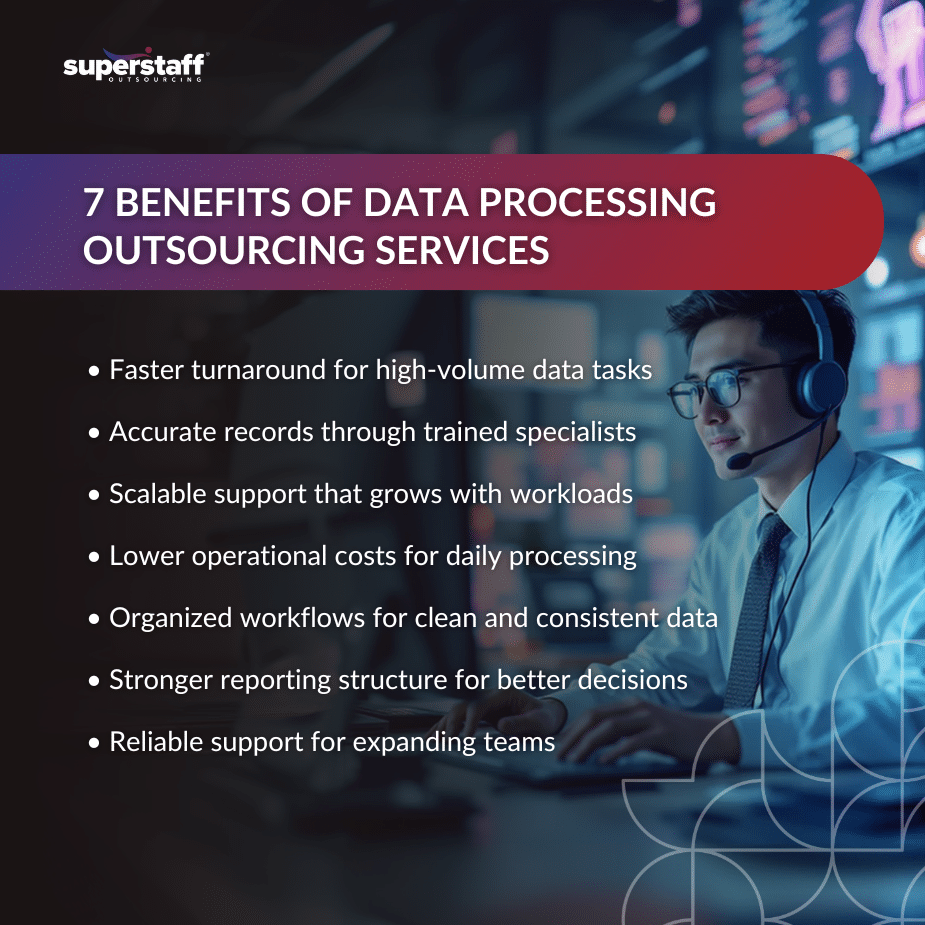
Outsourcing offers several advantages for companies that depend on accurate information and organized records. Here are seven ways it can support business operations.
1. Lower Operational Costs
Maintaining an in-house data processing team involves recruitment, employee training, salaries, equipment, and software expenses. These costs can increase as the volume of work grows.
Data processing outsourcing gives businesses access to external specialists without requiring them to build a larger internal department. Companies can assign specific tasks based on their workload and operational requirements. This helps control staffing expenses while maintaining the support needed to manage daily data activities.
2. Improved Data Accuracy
Incorrect information can affect reports, customer records, inventory updates, and financial transactions. Even small mistakes may require additional work to identify and correct.
Outsourced specialists follow defined procedures for data entry, verification, and validation. They can check information against source documents, identify missing details, and flag inconsistent records for review.
These practices help businesses maintain reliable information. The Government of Canada’s guidance on data quality also highlights accuracy, completeness, consistency, and reliability as important dimensions of good data management.
3. Faster Data Processing and Turnaround Times
Large volumes of documents and records can take considerable time to process, especially when internal employees have other responsibilities. Delays may affect reporting schedules, customer updates, and other business activities.
Outsourced teams can handle assigned tasks through organized workflows and agreed deadlines. With dedicated staff working on data-related responsibilities, companies can process information more consistently and reduce backlogs.
Businesses that need additional administrative support can also consider outsourcing data entry for streamlined operations, particularly when routine updates and document handling take up too much employee time.
4. Greater Flexibility as Workloads Change
Data processing requirements are not always consistent. Some businesses experience higher workloads during seasonal periods, product launches, promotional campaigns, or major system updates.
Outsourcing allows companies to adjust their support based on changing requirements. They can assign additional resources during busy periods or maintain a smaller team when processing demands decrease.
This flexibility helps businesses manage temporary increases in work without making permanent staffing decisions for every change in demand.
5. More Time for Core Business Activities
Employees often spend hours updating spreadsheets, checking customer information, organizing documents, and entering transaction details. Although these tasks are necessary, they can take time away from responsibilities that require specialized knowledge and decision-making.
Delegating repetitive data activities gives internal employees more time to handle customer relationships, business planning, financial reviews, and other important responsibilities.
Managers can also focus on improving existing processes instead of spending much of their time addressing routine data backlogs.
6. Better Data Organization and Accessibility
Business information becomes difficult to manage when records are stored in different formats, systems, and locations. Duplicate entries, incomplete fields, and inconsistent naming conventions can make information harder to retrieve.
Data processing specialists can organize records according to company guidelines. Their responsibilities may include updating databases, standardizing formats, categorizing documents, and identifying duplicate entries.
Consistent documentation makes it easier for authorized employees to locate information and use it for reporting, customer support, and internal reviews.
7. Access to Specialized Skills and Technology
Data processing involves different responsibilities, from basic data entry to document verification, database maintenance, and information management. Some tasks require familiarity with specific software and established procedures.
Outsourcing gives businesses access to professionals who already have experience handling these activities. Depending on the provider, teams may also use collaboration platforms, data validation tools, and reporting systems to support daily operations.
This allows companies to benefit from specialized support without having to develop every skill or purchase additional resources internally.
Common Tasks Businesses Can Outsource
Data processing outsourcing can support different departments and industries. Companies can delegate individual activities or combine several tasks based on their operational needs.
1. Customer Information Management
Outsourced teams can enter new customer details, update existing profiles, verify contact information, and organize records. Accurate customer information supports sales, marketing, and customer service activities.
2. Product and Inventory Data Updates
Retailers and e-commerce businesses handle product descriptions, pricing, stock quantities, and catalog information. Outsourced specialists can update these details across approved systems to maintain consistent product records.
3. Document Digitization and Processing
Businesses with large volumes of physical documents can assign scanning, file conversion, categorization, and data extraction tasks to external teams. This makes records easier to store and retrieve.
4. Transaction and Form Processing
Financial institutions, insurance companies, and other service providers process applications, invoices, payment records, and customer forms. Outsourced professionals can capture information, check required fields, and flag incomplete submissions.
5. Survey and Report Management
Companies that collect customer feedback, employee responses, or market research data need organized records for analysis. Data processing teams can categorize responses, consolidate information, and prepare datasets for internal review.
How to Choose a Data Processing Outsourcing Partner
Choosing a provider requires more than comparing service rates. Businesses should consider the provider’s experience, quality standards, security practices, and ability to handle changing workloads.
1. Review Quality Assurance Procedures
Ask how the provider checks completed work, identifies errors, and handles corrections. Clear validation procedures help maintain consistent results.
2. Check Data Security Measures
Data processing may involve confidential business records and personal information. Review access restrictions, encryption practices, employee training, and data handling policies before sharing company information.
3. Confirm Turnaround Time
Discuss expected completion times, reporting schedules, and procedures for urgent requests. The provider should be able to meet deadlines without compromising accuracy.
4. Evaluate Scalability
Choose a partner that can adjust staffing and workflows as data volumes change. This is especially important for businesses with seasonal demands or expanding operations.
5. Establish Clear Communication and Reporting
Regular progress updates help businesses monitor assigned tasks and address issues early. Agree on reporting formats, communication channels, performance measures, and escalation procedures before starting the engagement.
How Data Processing Outsourcing Supports Better Business Operations
Organized information helps companies manage daily activities and make informed decisions. However, businesses need consistent processes to ensure that records remain accurate, complete, and accessible.
Data processing outsourcing helps establish these processes by assigning routine information management tasks to trained specialists. With fewer manual responsibilities, internal employees can spend more time on planning, customer service, and other work that supports business goals.
SuperStaff provides data entry and back-office support services for businesses that need assistance with data management, document processing, and record maintenance. Its support teams in the Philippines and Colombia can help companies manage assigned workloads through structured processes.
Build a More Efficient Data Management Process
Data processing outsourcing helps businesses control operating costs, improve accuracy, manage larger workloads, and maintain organized records. By assigning repetitive information-related tasks to trained professionals, companies can reduce pressure on internal employees and improve their daily workflows.
The right outsourcing arrangement should match the company’s data requirements, security standards, and expected workload. SuperStaff helps businesses identify suitable back-office support based on their operational needs.
If your team needs additional support with data entry, document processing, or information management, contact SuperStaff to discuss your requirements and possible outsourcing arrangements.