Fast fulfillment has become central to brand performance. For direct-to-consumer companies, delivery speed, order accuracy, returns management, and customer communication now influence loyalty as much as product quality.
That shift is why many brands are reevaluating their operating models and investing in a stronger direct to consumer fulfillment solution strategy.
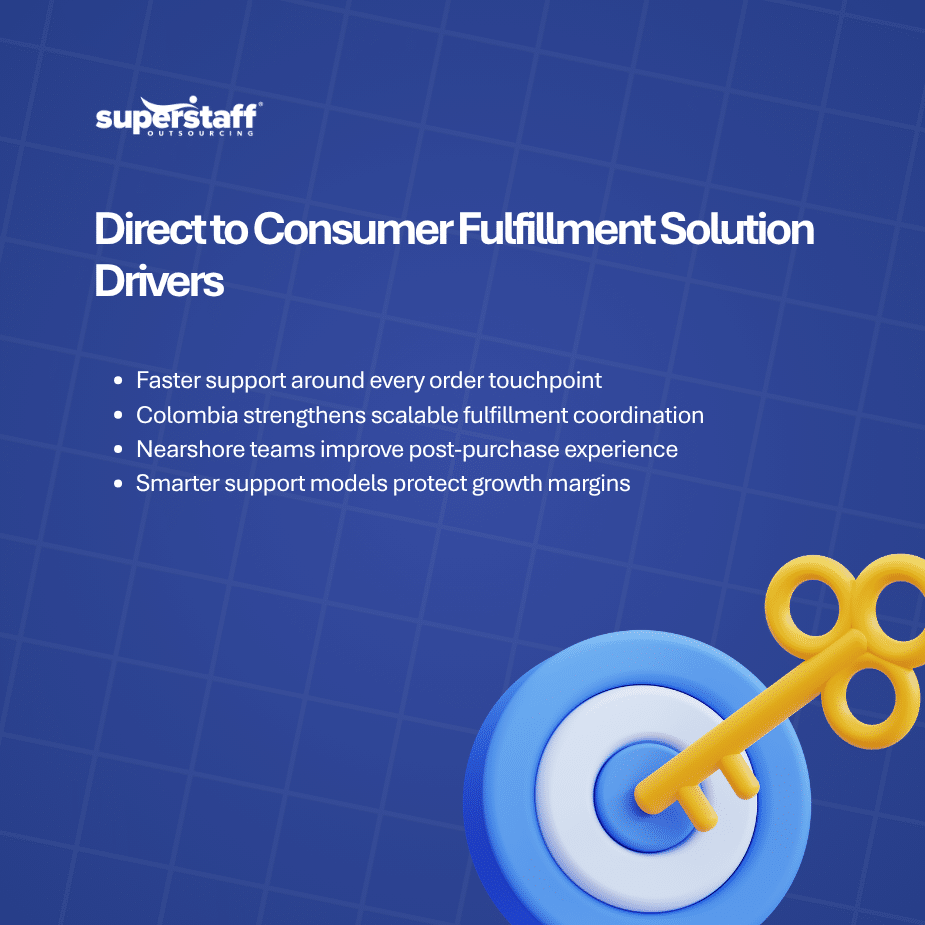
As fulfillment expectations rise, businesses need support models that can scale without increasing internal complexity. Colombia is emerging as a practical answer. Its proximity to North America, strong talent base, and growing support infrastructure are helping brands strengthen fulfillment-related operations while controlling cost and maintaining service quality.
For SMEs and midmarket businesses, this matters. Many need operational support without building large in-house teams, and Colombia is increasingly becoming part of that equation.
Why Fulfillment Support Now Extends Beyond Warehousing
Many leaders still associate fulfillment primarily with warehouses and transportation, but that view no longer captures how modern operations work. Fulfillment performance also depends on what happens before and after a package ships.
Order management support, inventory coordination, customer care, fraud screening, returns processing, and shipment exception handling all influence whether the customer experience succeeds.
A strong direct to consumer fulfillment solution increasingly includes these support layers. This is where outsourcing can create measurable operational value. Support teams can help manage order flow, resolve disruptions, improve delivery communication, and reduce pressure on internal teams.
For growing brands, this creates stability during demand fluctuations while improving responsiveness across the customer journey. Colombia is gaining traction because it supports this broader and more operational view of fulfillment.
Colombia Supports Time Sensitive DTC Operations
Geography remains an important part of support design. For U.S. companies, Colombia offers time zone alignment that improves responsiveness and allows support teams to collaborate in real time with North American operations.
This becomes especially important when businesses are managing inventory exceptions, shipment escalations, and customer inquiries tied to active orders.
A direct to consumer fulfillment solution supported through Colombia can improve coordination between merchants, carriers, customer support teams, and back-office functions. Instead of treating fulfillment issues as isolated events, companies can manage them through a coordinated operating model.
That often leads to faster issue resolution, fewer service disruptions, and stronger customer trust, especially in direct-to-consumer environments where fulfillment issues often become customer experience issues.
Back Office Support Is Becoming Critical in Fulfillment
Many fulfillment bottlenecks are administrative rather than logistical. Order verification, inventory reconciliation, returns approvals, marketplace updates, refund processing, and vendor communication often create friction long before warehouse performance becomes the problem.
These activities consume time and can slow growth when handled internally without sufficient scale.
This is where a direct to consumer fulfillment solution supported by offshore or nearshore teams can create efficiency. Colombia has become attractive for these processes because companies can build dedicated support teams that operate as extensions of internal operations.
This model is especially relevant for ecommerce brands expanding across multiple sales channels while trying to maintain lean structures. Rather than increasing domestic overhead, businesses can expand support capacity through specialized teams built around process consistency and operational discipline.
Customer Support and Fulfillment Are Converging
Customers do not separate fulfillment from service, which is why the line between customer support and fulfillment continues to blur. If an order is late, damaged, or missing, customers do not view it as a warehouse issue. They view it as a brand issue. If tracking updates are unclear or returns are difficult, the impact is often measured in satisfaction, retention, and repeat purchase behavior.
An effective direct to consumer fulfillment solution increasingly includes customer support integrated with order operations. Colombia is well positioned for this model, particularly for multilingual support and omnichannel service.
Support teams can assist with shipment inquiries, delivery exception handling, returns support, order status communication, marketplace interactions, and post-purchase issue resolution.
This integration reduces friction for customers while improving visibility for brands. It also helps support teams contribute directly to retention rather than functioning as a reactive service layer.
Colombia Offers Scalable Support for Growth Phases
Growth often introduces operational strain before companies realize support models need to evolve. A brand can move from hundreds of daily orders to thousands faster than systems and staffing models can adjust. Promotional surges, subscription growth, and international expansion can quickly overwhelm lean internal teams.
A flexible direct to consumer fulfillment solution supported through Colombia allows companies to scale support resources with demand rather than hiring reactively.
This matters during peak periods, product launches, and channel expansion when service consistency can become difficult to maintain. Businesses often need support models that expand without major structural disruption, and this is where outsourced teams can contribute strategic flexibility.
Colombia is increasingly part of that conversation because businesses are looking for scalable support, not simply outsourced labor.
Cost Efficiency Matters But Operating Resilience Matters More
Cost still matters, but resilience is becoming a more important driver of outsourcing strategy. Supply disruptions, labor shortages, rising customer expectations, and margin pressure are pushing businesses to rethink operating risk. Many are now evaluating support models based on continuity as much as efficiency.
A strong direct to consumer fulfillment solution helps address those risks through distributed support capacity. Rather than concentrating critical processes in a single internal team, businesses can create redundancy across support functions.
That strengthens continuity when order volumes spike or service exceptions rise. For midmarket firms especially, resilience can become a competitive advantage. Support models built to reduce fragility often outperform those designed only around labor savings.
Data Visibility Is Improving Through Fulfillment Support Teams
Fulfillment generates large amounts of operational data, but many businesses struggle to turn those signals into action. Returns patterns, delivery exceptions, support contacts tied to shipping issues, and inventory discrepancies all reveal opportunities for improvement when properly managed.
A modern direct to consumer fulfillment solution increasingly includes support teams helping organize and act on this information.
Teams may contribute to exception reporting, order trend analysis, escalation tracking, and service feedback loops that improve decision-making. Support teams are not replacing analytics tools, but they often help operationalize the information those tools generate.
That distinction matters because execution often depends on disciplined people and process management, not technology alone.
DTC Brands Need Flexible Operating Models
Consumer behavior changes quickly, and rigid operating models often struggle to keep pace. Demand channels evolve, delivery expectations rise, marketplaces expand, and social commerce introduces new layers of complexity. Businesses increasingly need operating structures built around adaptability.
A direct to consumer fulfillment solution designed for flexibility allows support structures to align with changing business priorities. Colombia offers an attractive support environment for this approach. Teams can be structured around specific workflows, dedicated programs, or blended service models depending on business needs.
That allows companies to align support design with growth stage, channel mix, and customer expectations. For leadership teams, this kind of flexibility often supports smarter scaling decisions.
Colombia Is Becoming Strategic for More Than Nearshoring
Nearshoring is often framed as a labor cost discussion, but many businesses are approaching it differently. The conversation has shifted toward operational partnership. Companies are evaluating talent quality, business continuity, language capabilities, process discipline, and long-term scalability as part of broader operating decisions.
That is why Colombia is gaining attention. A direct to consumer fulfillment solution supported from Colombia can align with broader strategic goals, not simply transactional outsourcing needs. This matters for businesses looking beyond short-term support models. It reflects a different outsourcing mindset, one centered on operational enablement and sustainable growth support.
Support Models Work Best When Built Around Process Design
Outsourcing does not fix broken processes, which is why fulfillment support works best when built around strong workflow design. Clear ownership, defined escalation paths, integrated systems, and measurable service expectations all shape performance outcomes.
A direct to consumer fulfillment solution is strongest when support teams are embedded into process thinking rather than added as reactive labor. This is where experienced outsourcing partners make a difference.
Support should improve execution, not introduce complexity. Businesses that approach outsourcing strategically often see stronger results than those treating it only as staffing support. That is especially true in fulfillment operations where coordination often determines performance.
Building a Smarter Fulfillment Support Strategy
Many businesses reach a point where fulfillment complexity begins limiting growth. Orders increase, service expectations rise, and internal teams get stretched. That is often the point where operating models need to evolve.
Colombia is gaining relevance because it helps businesses address those pressures through scalable support, real-time responsiveness, and operational flexibility.
For many growing brands, a stronger direct to consumer fulfillment solution is becoming part of growth strategy, not simply back-office planning. The question is less whether support should evolve and more how businesses want to structure that evolution.
Partners like SuperStaff help businesses design support models that combine process discipline, skilled talent, and scalable service delivery. SuperStaff also applies AI across workflows to improve efficiency and visibility, while keeping human expertise central to execution and customer experience.
If your business is evaluating how to strengthen fulfillment support while scaling sustainably, explore how SuperStaff can help build a more resilient operating model.