For U.S. SMEs and midmarket companies, choosing quality outsourcing services is no longer only about lowering operating costs. It is about building a reliable extension of the business that can protect customer relationships, support internal teams, and improve operational consistency as demand changes.
Many companies reach a point where internal teams are capable but stretched. Customer inquiries increase. Administrative work piles up. Sales support becomes inconsistent. Back-office delays begin affecting the customer experience.
At that stage, leaders face a practical question. Should they keep adding local headcount, or should they build a smarter support model through outsourcing?
For companies that need nearshore alignment, bilingual talent, and closer collaboration with U.S. teams, SuperStaff Colombia offers a strong answer.
Why quality matters more than low cost
Outsourcing decisions often start with cost pressure. That is understandable. Labor, training, technology, and management expenses continue to rise for U.S. businesses.
However, the lowest-cost provider is rarely the best long-term choice. Poor execution can create missed follow-ups, weak documentation, inconsistent customer handling, and more work for internal managers.
Quality outsourcing services solve a different problem. They help companies create structure, accountability, and continuity across essential functions.
That means businesses can delegate work without losing visibility. They can expand support without weakening standards. They can improve customer responsiveness while keeping internal teams focused on strategy, revenue, and service improvement.
Your Content Goes Here
What U.S. businesses should expect from a reliable outsourcing partner
A strong outsourcing partner should do more than provide people. It should help leaders build a working system.
For SMEs and midmarket companies, that system should include clear workflows, trained agents, performance tracking, escalation paths, and regular communication with client stakeholders.
Quality outsourcing services should also adapt to the client’s business model. A healthcare company may need careful handling of patient support and documentation. A logistics firm may need real-time coordination. A retail company may need customer service that can scale during peak periods.
The service should fit the operation, not force the operation to adjust to the provider.
A dependable partner should provide:
- Clear onboarding and role alignment
- Process documentation and training support
- Transparent reporting and performance reviews
- Skilled team leads and account management
- Strong communication between offshore, nearshore, and client teams
These elements matter because outsourcing works best when responsibilities are clearly defined from the start.
Where SuperStaff Colombia fits in the outsourcing strategy
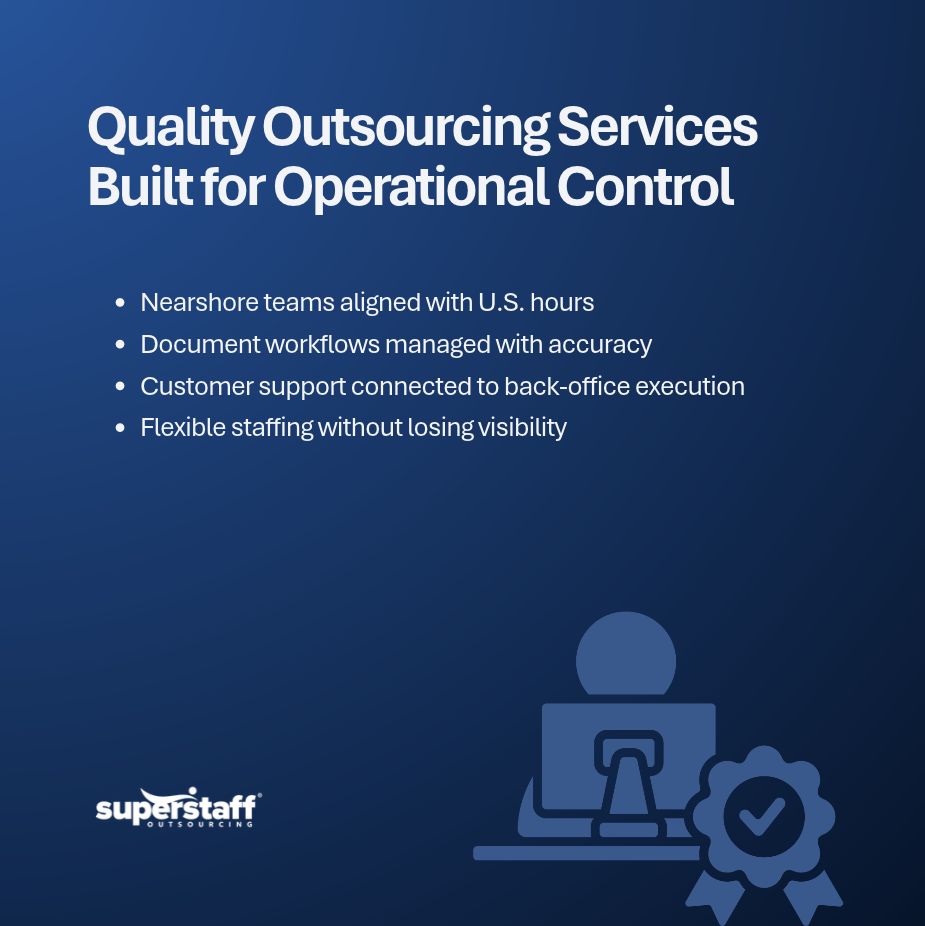
SuperStaff Colombia is built for U.S. companies that need strong operational support with closer time-zone alignment. This nearshore advantage allows teams to collaborate during U.S. business hours, respond faster, and stay connected with client managers.
Quality outsourcing services from Colombia can support customer-facing and back-office functions where communication, speed, and accuracy matter.
For U.S. businesses, Colombia is especially valuable when teams need more real-time coordination. A nearshore team can join daily huddles, participate in live coaching, handle urgent requests, and work closely with U.S.-based supervisors.
This makes the model useful for companies that want flexibility without sacrificing control.
Document-heavy operations need stronger support
Many growing businesses struggle with document-heavy workflows. These tasks may look simple on paper, but they often affect billing, compliance, customer experience, and internal reporting.
This is where outsourced document management services can help.
Companies with large volumes of forms, records, claims, invoices, contracts, applications, or customer files need organized support. Internal teams often spend valuable hours checking details, updating systems, tagging files, and following up on incomplete records.
Quality outsourcing services can help businesses manage those repetitive but important tasks with more consistency.
For example, a growing healthcare provider may need help organizing patient records and intake forms. A logistics company may need support with proof of delivery files. A finance team may need help processing invoices and account documents.
These workflows require accuracy, confidentiality, and clear escalation rules. They also require people who understand why each document matters to the larger business process.
Why document processing is a business continuity issue
Business document processing outsourcing is valuable because document delays can slow down entire departments.
When paperwork is incomplete, billing slows down. When records are misfiled, customer support takes longer. When teams lack visibility, managers spend more time solving avoidable issues.
Quality outsourcing services can reduce that operational drag. The goal is not only to move documents faster. The goal is to create cleaner workflows that help teams make decisions with better information.
For SMEs, this can be especially important. A lean internal team may not have the capacity to manage every document queue while also handling strategy, client relationships, and growth planning.
Outsourcing gives them added capacity without requiring them to build a full in-house department.
How to outsource document management with confidence
Many leaders ask how to outsource document management for businesses without losing control of sensitive workflows.
The answer starts with structure.
Before moving tasks to an outsourcing partner, companies should identify which document types are involved, who currently owns each step, what systems are used, and where delays commonly happen.
Quality outsourcing services work best when the client and provider agree on the process before hiring begins. That includes access rules, naming conventions, approval workflows, turnaround expectations, and escalation procedures.
A practical outsourcing plan should define:
- Which documents the team will process
- Which systems the team will access
- What quality checks are required
- What errors need escalation
- What reports leadership needs to see
This approach helps prevent confusion and gives the outsourced team a clear operating standard.
Customer experience still depends on the back office
Many companies separate customer service from back-office work. In practice, they are connected.
A customer support agent cannot resolve an issue quickly if the customer’s file is incomplete. A billing team cannot answer questions accurately if documents are missing. A sales team cannot move fast if administrative follow-ups are delayed.
Quality outsourcing services help connect these functions.
When customer support, documentation, and back-office processes work together, customers receive faster and clearer answers. Internal teams also spend less time chasing information.
This is why outsourcing should be viewed as an operating model, not only a staffing solution. The right partner helps create smoother handoffs across the business.
Why SMEs and midmarket companies need flexible support
SMEs and midmarket companies often face unpredictable growth. Demand may rise after a new contract, product launch, seasonal campaign, or market expansion.
Hiring locally for every increase in workload can be expensive and slow. It can also create long-term cost pressure if demand later changes.
Quality outsourcing services give leaders more flexibility. They can add support for specific functions, expand teams as volume grows, and refine roles as the business matures.
This flexibility is especially useful for companies that want to protect service levels while keeping internal teams lean.
A nearshore team in Colombia can support U.S. operations with stronger schedule alignment. A Philippine offshore team can provide deep operational scale. Together, these models can give companies broader coverage and smarter workforce planning.
The right partner protects your standards
Outsourcing requires trust, but trust should not rely on promises alone. It should be built through process, governance, training, and measurable performance.
Quality outsourcing services should give leaders confidence that work is being handled properly. That means regular updates, documented expectations, quality monitoring, and clear accountability.
A provider should also understand the client’s brand standards. Agents and back-office teams represent the business in every interaction, every file, and every completed task.
For U.S. decision-makers, the best outsourcing partner is one that can combine people, process, and management discipline.
That is where SuperStaff’s model stands out.
Build a stronger support model with SuperStaff
Growth becomes harder when internal teams spend too much time managing repetitive work, delayed documentation, and rising customer demand. The right outsourcing partner helps companies regain focus without losing operational control.
SuperStaff helps U.S. businesses build quality outsourcing services through nearshore support in Colombia and offshore expertise in the Philippines. From customer service to back-office support and document-heavy workflows, SuperStaff creates teams that are trained, managed, and aligned with your business goals.
Explore SuperStaff services today and see how a flexible outsourcing team can help your company improve support, protect service quality, and scale with greater confidence.