For U.S. SMEs and midmarket companies, customer experience teams are no longer support functions sitting at the edge of the business. They shape retention, protect revenue, and influence how customers perceive the brand after every interaction. When these teams are built well, they do more than answer calls or resolve tickets. They create consistency, speed, and trust across the full customer journey.
This is where SuperStaff Colombia brings a strong advantage. With nearshore support from Colombia, U.S. companies can extend service coverage, improve responsiveness, and build specialized teams that work closely with internal departments. The goal is not to replace the company’s brand voice. The goal is to strengthen it with trained professionals who understand urgency, accountability, and customer expectations.
Why Customer Experience Teams Matter More Now
Customer expectations have become more specific. Buyers want fast answers, clear communication, and personalized support without long wait times. They also expect companies to remember previous interactions and resolve issues without making them repeat the same information.
Strong customer experience teams help businesses meet these expectations across multiple touchpoints. They manage inbound calls, live chat, email, help desk tickets, order concerns, billing questions, appointment scheduling, account updates, and follow-ups.
For growing companies, the challenge is capacity. Internal teams often carry too much work. Leaders may want to improve service quality, but hiring, training, and managing a full team in-house can take time and resources away from core growth priorities.
Nearshore outsourcing offers a practical path forward.
How Nearshore Support Improves Customer Coverage
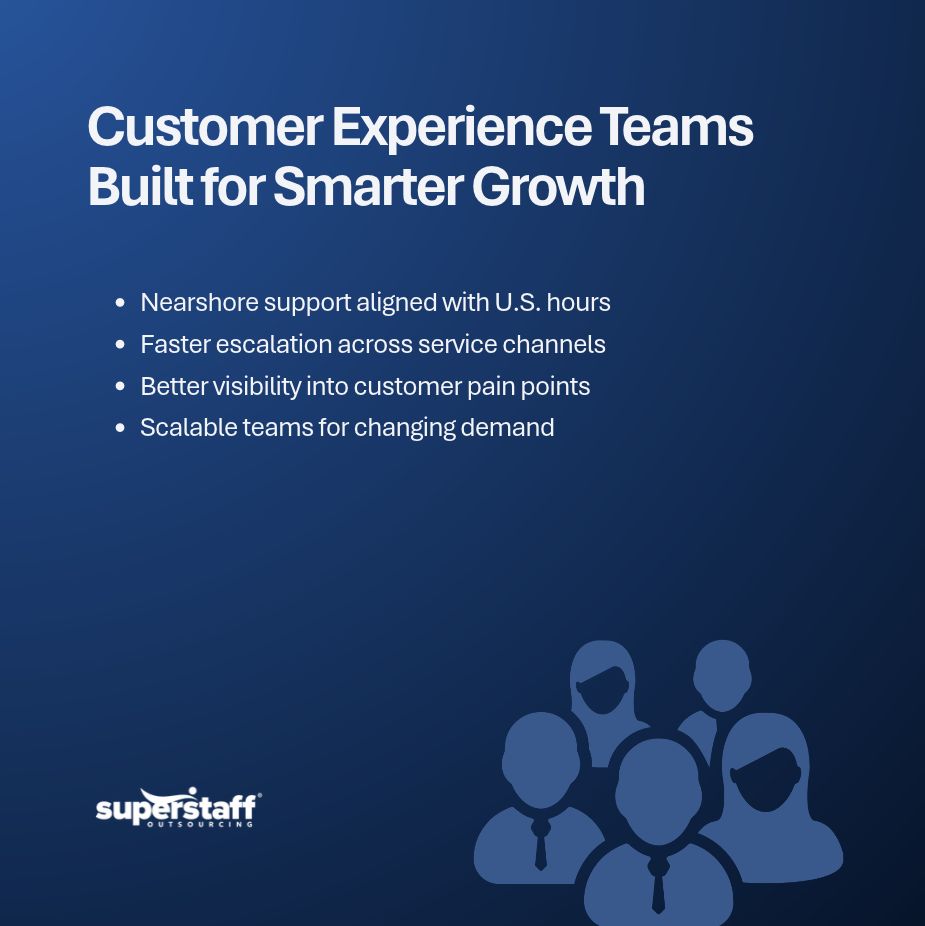
SuperStaff Colombia helps U.S. businesses build customer experience teams that align with North American time zones. This makes collaboration easier for managers, quality assurance leaders, sales teams, and operations heads.
Real-time alignment matters. When an issue needs escalation, a nearshore team can connect with U.S. stakeholders during the same business day. This reduces delays and helps customers receive faster answers.
Customer experience teams in Colombia can support:
- Voice and nonvoice customer support
- Order tracking and account management
- Appointment setting and scheduling
- Technical support coordination
- Customer retention outreach
- Help desk and ticket management
- Back-office support tied to customer inquiries
This structure helps companies build a more connected support model. Customers receive help faster, while internal teams focus on strategy, product improvement, and revenue-generating work.
The Strategic Role Of Customer Experience Teams
Many businesses still view customer support as a reactive function. A customer reaches out, an agent responds, and the case closes. That mindset limits the value of customer experience teams.
Modern support teams can help companies detect recurring issues, identify service gaps, and improve operational workflows. They hear customer concerns daily. They see where processes break down. They understand which policies confuse customers and which internal delays create frustration.
When managed correctly, customer experience teams become a source of business intelligence. They give leaders visibility into customer needs without relying only on surveys or delayed reports.
For example, if customers frequently ask about the same billing concern, that may signal a need to improve invoice clarity. If support agents receive repeated shipping inquiries, operations may need better tracking visibility. If customers struggle to complete forms or submit documents, the company may need stronger outsourced document management services to support the full customer journey.
Why Documentation Also Affects Customer Experience
Customer service depends on accurate information. Agents need updated records, organized files, clear account histories, and accessible documentation. Without these, even well-trained customer experience teams can struggle to resolve issues quickly.
This is why many companies pair customer support with business document processing outsourcing. When customer records, claims, forms, contracts, or account documents are handled efficiently, support teams can respond with confidence.
For industries such as health care, logistics, financial services, legal support, and e-commerce, documentation is part of the customer experience. A delayed file can delay a claim. A missing form can delay service. An incorrect record can lead to repeated follow-ups.
Companies exploring how to outsource document management for businesses should look at the customer impact, not just the administrative cost. Better document handling helps customer experience teams work faster and more accurately.
Building Teams With The Right Skills
Effective customer experience teams need more than communication skills. They need critical thinking, process discipline, product knowledge, and comfort with digital tools.
Many roles now blend customer support with technical workflows. Agents may need to navigate CRM platforms, ticketing systems, order management tools, health care portals, logistics dashboards, or basic troubleshooting guides. This creates more technical career options for professionals who want to grow beyond traditional support roles.
For employers, this also changes hiring strategy. Businesses need people who can learn systems quickly, follow compliance requirements, and communicate clearly with customers. They also need supervisors who can monitor quality, coach performance, and translate customer feedback into operational improvements.
SuperStaff Colombia helps companies build customer experience teams around these needs. The focus is not only on staffing seats. The focus is on creating a team structure that supports quality, speed, and accountability.
What U.S. Companies Should Look For In A CX Partner
Choosing an outsourcing partner requires more than comparing rates. Leaders should examine how the provider manages performance, training, escalation, and customer alignment.
A strong partner should understand the company’s brand voice, service standards, customer profiles, and operational risks. They should also know how to build customer experience teams that can adapt as demand changes.
Before outsourcing, businesses should assess:
- Which customer touchpoints need support
- What hours require coverage
- Which channels need staffing
- What systems the team must use
- Which tasks require escalation
- What quality standards must be tracked
- How internal and outsourced teams will communicate
These questions help define the right model. Some companies need dedicated agents for voice support. Others need blended support across chat, email, and back office. Some need customer-facing help combined with document processing, data entry, or administrative coordination.
The best structure depends on the business model and customer journey.
How SuperStaff Colombia Supports Growth
SuperStaff Colombia gives U.S. companies access to skilled nearshore professionals who can support customers with clarity, consistency, and care. The location allows closer time zone alignment, smoother coordination, and stronger operational visibility.
For SMEs and midmarket companies, this matters. Growth often brings higher ticket volumes, more complex customer concerns, and greater pressure on internal teams. Without additional support, service quality can decline just when customer expectations are rising.
Customer experience teams from SuperStaff Colombia can help businesses maintain service standards while scaling. They can support daily customer needs, manage routine interactions, and coordinate with internal teams when issues require deeper attention.
This gives leaders more control. Instead of rushing to hire internally or stretching existing staff, companies can build a flexible support model that grows with demand.
The Long-Term Value Of Better CX Operations
Customer experience teams influence how customers decide whether to stay, renew, reorder, or recommend a company. Every interaction can either strengthen trust or create friction.
A well-built outsourced team helps reduce that friction. Customers receive faster answers. Internal employees face fewer repetitive tasks. Managers gain more visibility into customer concerns. Operations become more organized.
This is the real value of nearshore outsourcing. It is not only about lowering labor costs. It is about building a support function that improves the customer journey while helping the business operate with more discipline.
For U.S. companies, SuperStaff Colombia offers a practical way to expand service capacity without losing control of quality. The right team can support customers, protect brand consistency, and help leaders respond faster to business needs.
Build Stronger Customer Experience Teams With SuperStaff
Customer experience teams play a direct role in retention, loyalty, and operational performance. When they are trained well and supported by the right systems, they help businesses serve customers with more consistency and confidence.
SuperStaff Colombia helps U.S. SMEs and midmarket companies build nearshore support teams designed around real business needs. From customer service and technical support coordination to back-office and document-related workflows, SuperStaff can help you create a support model that works.
Explore SuperStaff services today and see how a nearshore team in Colombia can help your business deliver better customer experiences at scale.