Compliance requirements keep getting more complex, but most growing companies do not have unlimited internal bandwidth to manage every audit trail, documentation request, customer verification step, and process update. For SMEs and midmarket companies, compliance support services can help protect operations, improve consistency, and free internal teams to focus on higher-value work.
The challenge is not always the lack of expertise. Many companies already have legal, finance, HR, quality, or operations leaders who understand the rules. The real issue is execution capacity.
Compliance depends on repetitive, detail-heavy work. Someone has to update records, review documents, track exceptions, escalate issues, organize files, support customer checks, and make sure every process follows the agreed standard.
When these tasks fall on already stretched teams, delays happen. Documentation gets scattered. Internal reviews take longer. Customer response times slow down.
That is where outsourcing becomes a practical business decision.
Why Compliance Work Needs More Operational Support
Compliance is often treated as a policy function, but it runs through daily operations. A process can look strong on paper and still fail if the team does not have enough people to execute it properly.
A healthcare company may need support with patient documentation, insurance verification, and HIPAA-aligned workflows. A fintech company may need customer verification support, transaction documentation, and structured escalation handling. An e-commerce business may need accurate refund records, vendor documentation, and customer communication logs.
These are not one-time tasks. They happen every day.
Compliance support services help companies manage these recurring responsibilities without overloading internal teams. Instead of asking managers, analysts, or customer-facing staff to handle everything, businesses can build a trained support layer that keeps processes moving.
This matters because compliance gaps rarely begin with one major failure. They often start with small delays, inconsistent documentation, unclear ownership, or manual work that nobody has time to complete.
The Hidden Cost of Handling Compliance Alone
Many growing companies try to manage compliance work internally for as long as possible. At first, this seems manageable. A team member updates the tracker. A manager reviews the files. A department head follows up on missing documents.
Then volume increases.
More customers come in. More transactions need review. More records need to be stored. More internal teams need documentation. More clients ask for proof of process control.
At that point, internal teams may still be capable, but they are no longer operating efficiently.
Compliance support services reduce that pressure by giving companies reliable execution support for recurring tasks. This allows leadership teams to protect internal capacity while keeping compliance-related work organized and timely.
The cost of doing everything in-house is not only payroll. It also includes slower turnaround times, distracted managers, missed follow-ups, employee burnout, and weaker process visibility.
For U.S. companies competing in demanding sectors, those delays can affect client trust.
What Compliance Support Can Include
The scope of support depends on the industry, risk level, and maturity of the business. However, many companies need help with the same operational foundations.
Compliance support services may include document review support, records management, customer verification assistance, data entry, case tracking, audit preparation support, process documentation, internal reporting, and escalation coordination.
A support team can also help maintain consistency across communication channels. For example, agents can follow approved scripts, document customer interactions, tag cases properly, and route sensitive matters to the right internal owner.
The goal is not to replace legal or compliance leaders. The goal is to give them the operational structure they need to enforce standards at scale.
This distinction matters. Strategic compliance decisions should stay with qualified internal stakeholders. Execution-heavy tasks can be supported by trained outsourced teams working under clear guidelines, quality checks, and supervision.
Why the Philippines Works for Compliance Support
The Philippines has long been a trusted outsourcing destination for customer service, back-office support, healthcare support, finance operations, and technical support. For compliance-related work, the country offers a strong fit because of its English proficiency, service orientation, process discipline, and experience supporting U.S. business operations.
Compliance support services based in the Philippines can help U.S. companies extend their operational capacity without building large internal teams from scratch. This is especially valuable for SMEs and midmarket companies that need reliable support but may not yet have the budget or volume to justify a full in-house department.
The right outsourcing partner can provide trained staff, structured onboarding, performance management, quality monitoring, and secure workflows. This gives businesses a more controlled way to scale support functions while keeping internal leadership focused on oversight and decision-making.
For companies with customer-facing compliance needs, the Philippines also offers a strong advantage in communication quality. Support teams can manage documentation requests, customer follow-ups, and verification workflows with professionalism and care.
Where Compliance Support Creates the Most Value
The biggest value often comes from consistency. Compliance work depends on doing the right steps every time, not only when the team has capacity.
Compliance support services can help businesses maintain that consistency across several areas.
Customer Onboarding Support
Teams can help collect required information, verify details against approved checklists, and flag incomplete records for review.
Documentation Management
Support staff can organize files, update records, track missing items, and prepare materials for internal audits or client requests.
Case Tracking and Escalation
Teams can monitor open items, follow up on pending actions, and route exceptions to the appropriate internal stakeholder.
Process Adherence Support
Agents can follow documented workflows, use approved templates, and maintain accurate logs for quality review.
Reporting Assistance
Support teams can compile operational data, prepare status updates, and help leaders see where bottlenecks are forming.
These functions may sound simple, but they are critical. When performed consistently, they help the business maintain control.
How Outsourcing Supports Risk Management
Outsourcing is often discussed through the lens of cost savings, but compliance-related support should be evaluated through a broader business lens. The real question is whether the company has the right operating model to manage recurring risk.
Compliance support services can improve risk management by creating clearer ownership for routine tasks. Instead of relying on busy internal employees to complete compliance-adjacent work between other responsibilities, companies can assign trained support staff to handle defined workflows.
This creates better accountability.
It also helps leaders separate strategic judgment from administrative execution. Internal experts can focus on policy, interpretation, approvals, and complex escalations. Outsourced teams can handle structured tasks that require accuracy, follow-through, and documentation discipline.
For many SMEs, this model is more sustainable than waiting until compliance work becomes unmanageable.
What to Look for in a Compliance Support Partner
Not every outsourcing provider is equipped to support compliance-driven work. Businesses should look beyond headcount and pricing.
The right partner should understand secure operations, quality assurance, documentation standards, and escalation protocols. They should be able to train agents on client-specific workflows and maintain performance visibility through clear reporting.
Compliance support services should also be built around confidentiality. Teams may handle sensitive customer, financial, healthcare, or operational information. That means secure systems, access controls, documented processes, and strong management oversight are essential.
A good provider will not overpromise. They will clarify what can be outsourced, what should remain internal, and how both teams will work together.
This is where SuperStaff brings value. As a Philippine-based BPO supporting U.S. businesses, SuperStaff helps companies build dedicated teams for customer experience, back-office operations, healthcare support, finance and accounting support, technical support, recruitment, and other operational functions that require structure and reliability.
When Compliance Becomes a Growth Issue
Compliance can quietly limit growth when support capacity does not keep up with business demand. New clients may require more documentation. More customers may create more verification work. Expanding into new markets may require stronger process control.
If internal teams cannot keep pace, growth becomes harder to manage.
Compliance support services help businesses prepare for that next stage. They give leaders more room to scale without sacrificing accuracy, customer experience, or operational discipline.
For example, a company preparing to expand its customer base may need more support for onboarding documentation and account updates. A healthcare provider may need help with scheduling, insurance coordination, and patient record support. A logistics company may need organized documentation across shipments, vendors, and client communications.
In each case, compliance-related work supports the customer experience. When it runs well, customers feel the difference.
Build a More Reliable Compliance Operating Model
Strong compliance depends on more than policies. It depends on people, processes, documentation, and follow-through. For growing companies, the question is not whether compliance work matters. The question is whether the current team has enough capacity to manage it well.
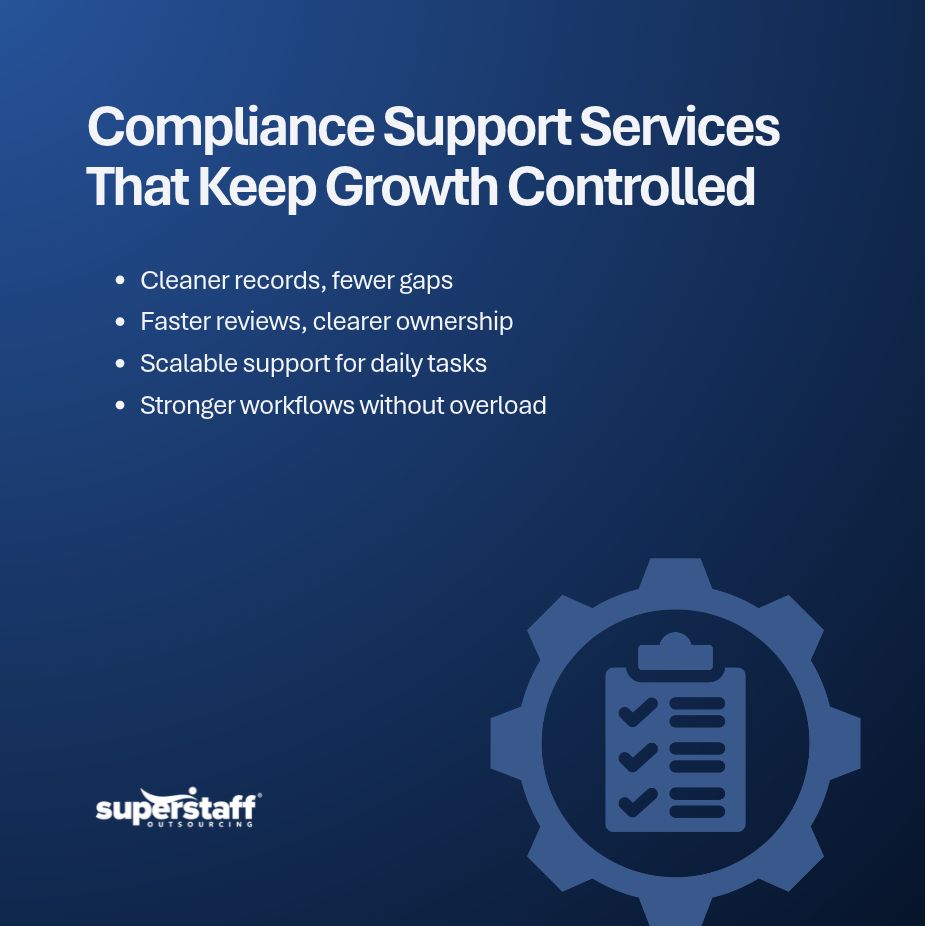
Compliance support services give SMEs and midmarket companies a practical way to strengthen operations without slowing growth. With the right outsourcing partner, businesses can improve consistency, reduce internal pressure, and build a more reliable support structure for daily compliance demands.
SuperStaff helps U.S. companies build dedicated outsourced teams in the Philippines that support accuracy, service quality, and operational control. Explore SuperStaff services today and see how the right offshore team can help your business manage compliance work with greater confidence.