For many U.S. companies, customer support costs are rising faster than customer expectations are settling. Leaders want faster response times, better coverage, stronger reporting, and consistent service quality. At the same time, they cannot afford to keep adding headcount every time volume increases. That is why reducing call center costs with automation has become a practical operating strategy, especially when paired with a skilled nearshore support team in Colombia.
Automation can lower repetitive workload. People still handle judgment, empathy, escalation, and relationship-building. The real opportunity is not to replace agents. It is to design a support model where technology handles routine tasks and trained professionals focus on conversations that need care.
Reducing Call Center Costs With Automation Starts With Better Workflow Design
Many companies start automation in the wrong place. They buy tools before they review how work actually moves through the call center. This creates fragmented systems, duplicated processes, and frustrated agents.
Reducing call center costs with automation should begin with a clear look at the customer journey. Which questions come up every day? Which tasks slow agents down? Which tickets require human judgment? Which steps create long handle times?
Once those patterns are clear, automation becomes more targeted. A chatbot can answer basic account questions. An IVR system can route callers to the right department. A CRM workflow can trigger follow-ups after a call. Quality tools can flag coaching opportunities.
This is where SuperStaff’s Colombia office can support U.S. companies strategically. Nearshore teams work in aligned time zones, which makes collaboration easier. When automation is built around real agent workflows, companies can reduce friction without weakening service quality.
Why Cost Reduction Requires More Than Fewer Agents
Some leaders see automation as a way to cut headcount. That thinking can create short-term savings but long-term service issues. Customers still need people when problems are sensitive, complex, or urgent.
Reducing call center costs with automation works best when companies use it to improve productivity. The goal is to help agents resolve more issues with less wasted effort. That means shorter queues, cleaner data, faster call routing, and fewer manual updates after every interaction.
For example, an agent should not spend several minutes searching for customer history while the caller waits. Automation can pull up account details, previous tickets, order information, and recommended next steps. The agent can then focus on solving the issue.
This model also helps supervisors. Instead of relying only on manual call reviews, they can use automation to spot trends across conversations. They can identify training gaps, recurring customer concerns, and process delays earlier.
Where Automation Delivers Practical Savings
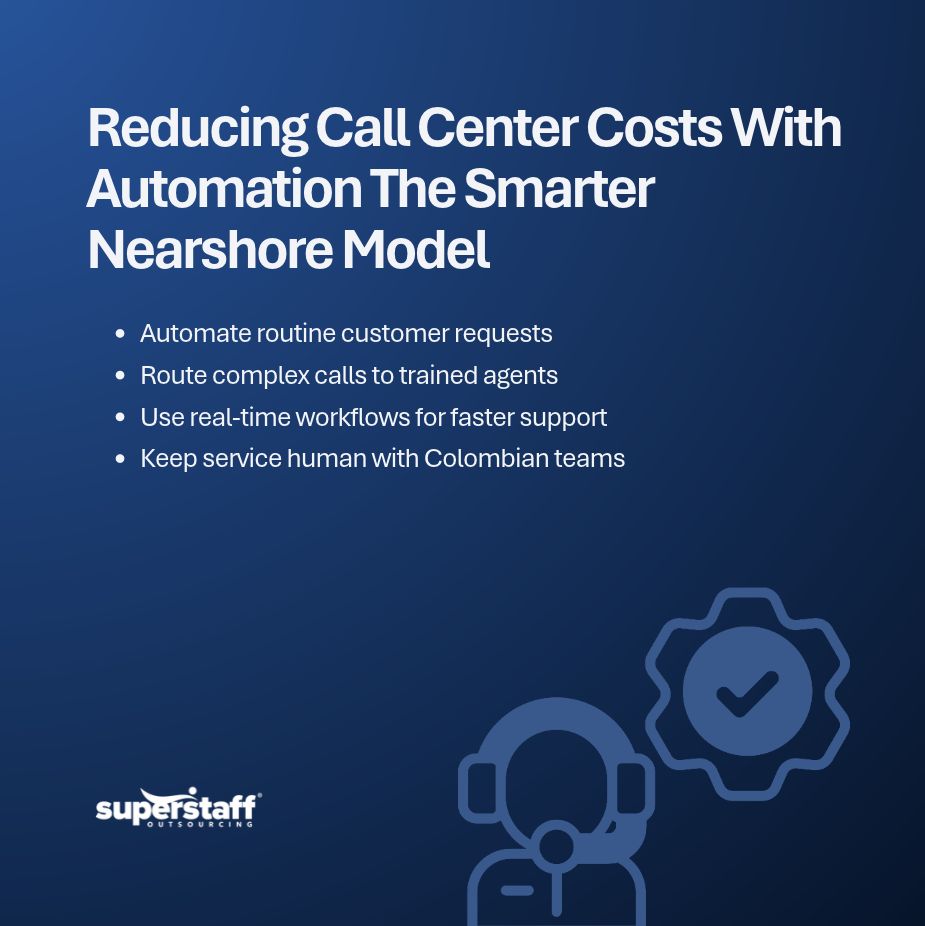
Reducing call center costs with automation becomes more valuable when businesses apply it to high-volume, repetitive areas first. These are usually the tasks that consume time but do not require advanced decision-making.
Common automation opportunities include:
- Call routing based on customer need
• Self-service answers for common questions
• Automated ticket creation and tagging
• CRM updates after customer interactions
• Follow-up reminders for unresolved cases
• Quality monitoring support
• Workforce scheduling inputs
• Reporting dashboards for managers
These functions do not remove the need for agents. They remove unnecessary steps around the agent’s work. That is a key difference.
A nearshore call center outsourcing model in Colombia adds another layer of value. U.S. companies can access bilingual support talent, aligned work hours, and operational flexibility. When automation handles repetitive work and nearshore agents manage customer conversations, the cost structure becomes more efficient without making the experience feel impersonal.
The Colombia Advantage For U.S. Customer Support Teams
Many U.S. companies want savings, but they also need responsiveness. Time zone alignment matters when managers need real-time communication, quick coaching, and same-day adjustments.
SuperStaff’s Colombia office gives businesses a nearshore option for customer support operations that require close collaboration. This is especially useful for companies that handle live calls, appointment scheduling, account support, technical assistance, billing questions, and bilingual customer service.
Reducing call center costs with automation is stronger when supported by teams that can work directly with U.S.-based managers during business hours. Issues can be reviewed faster. Training can happen in real time. Campaign changes can be implemented without waiting overnight.
This matters for SMEs and midmarket companies that cannot afford heavy layers of management. They need lean systems, responsive teams, and practical execution. Colombia offers that balance.
Automation Helps Agents Perform Better
Automation often gets discussed as a cost tool, but it is also an employee performance tool. Agents work better when they have the right information at the right time.
Reducing call center costs with automation can improve agent focus by removing repetitive administrative tasks. Instead of copying notes across systems, agents can use structured workflows. Instead of guessing the next step, they can follow guided prompts. Instead of escalating because information is missing, they can access customer records quickly.
This creates a better support environment. Agents can spend more energy listening, clarifying, and solving. Customers get more consistent answers. Supervisors gain better visibility into performance.
For growing companies, this is important. A poor support environment leads to inconsistency, burnout, and higher training demands. Automation can reduce that pressure when implemented with people in mind.
The Risk Of Automating Too Much
Automation should make support easier, not colder. Customers can tell when a company hides behind bots or makes it difficult to reach a person.
Reducing call center costs with automation should never mean forcing every customer into self-service. Some issues need a live agent from the start. Examples include billing disputes, healthcare-related concerns, account access problems, urgent delivery issues, technical failures, or emotionally sensitive situations.
A strong automation strategy sets clear boundaries. Simple requests can go through self-service. Complex concerns should move quickly to a trained agent. Escalations should be easy, not buried.
This is where SuperStaff’s human-led outsourcing model matters. Automation supports the process, but people still carry the customer relationship. That balance protects both cost efficiency and customer trust.
How Leaders Should Evaluate Automation Opportunities
Executives do not need to automate everything at once. A phased approach usually works better, especially for SMEs and midmarket companies.
Start with questions such as:
- Which tasks take the most agent time?
• Which call types repeat every day?
• Where do customers wait the longest?
• Which systems require duplicate data entry?
• Which reports take managers too long to prepare?
• Which issues are escalated because agents lack information?
These questions reveal where automation can create measurable operational improvement. They also help avoid unnecessary software spending.
Reducing call center costs with automation should be tied to business outcomes. Lower handle time, better routing, faster response, improved first-contact resolution, and stronger reporting are more useful goals than simply adding a new tool.
Why Outsourcing And Automation Work Better Together
Automation needs people to manage, refine, and act on it. Outsourcing provides the trained support structure to make that possible.
Reducing call center costs with automation becomes more effective when businesses pair the right technology with the right delivery model. SuperStaff can help companies build customer support teams that use automation without losing human service quality.
For U.S. companies, this combination is practical. A nearshore Colombia team can support live operations, manage customer conversations, follow documented workflows, and collaborate closely with internal stakeholders. Automation can improve speed and consistency, while agents handle the work that requires judgment.
This gives companies more than lower labor costs. It gives them a more flexible support model that can scale with demand.
Build A Smarter Cost Structure With SuperStaff
The future of customer support is not fully automated. It is better coordinated. Companies need systems that reduce repetitive work and people who can deliver reliable, thoughtful service.
Reducing call center costs with automation gives U.S. businesses a way to manage rising support demands without sacrificing customer experience. With SuperStaff’s Colombia office, companies can combine nearshore talent, time zone alignment, bilingual capability, and automation-ready workflows in one operating model.
If your team is ready to lower support costs while keeping service personal, explore SuperStaff’s call center and nearshore outsourcing solutions. Let us help you build a smarter customer support operation from Colombia.