U.S. companies are rethinking how they build teams. Full-time hiring still matters, but many leaders now need a blended workforce that combines in-house employees, nearshore talent, outsourced specialists, and flexible recruitment support to keep operations moving without adding unnecessary overhead.
For SMEs and midmarket companies, this shift is practical. Customer demand changes. Hiring timelines tighten. Internal teams get stretched. New roles appear before the business has the structure to recruit, onboard, and manage them effectively.
That is where Recruitment Process Outsourcing can create a stronger operating model. Through SuperStaff’s Colombia office, U.S. companies can access nearshore talent and RPO support designed to help them hire with more control, speed, and structure.
Why the blended workforce is gaining attention
A blended workforce gives companies more ways to fill important roles without relying on one hiring model for every business need.
Some roles should stay internal. Others can be supported by nearshore teams, outsourced recruiters, project-based specialists, or managed support staff. The goal is to match the work with the right employment structure.
This approach is especially useful for companies that face:
- Seasonal hiring needs
- Customer support spikes
- Back-office workload increases
- Hard-to-fill roles
- Expansion into new markets
- Limited internal recruiting capacity
- Pressure to reduce hiring delays
A blended workforce helps leaders avoid two common problems. The first is over-hiring during temporary demand. The second is under-hiring when teams need help immediately.
With the right RPO partner, companies can build a more flexible hiring system while keeping standards consistent across every role.
Colombia gives the blended workforce a nearshore advantage
Colombia is a strong fit for U.S. companies that want nearshore support without large time zone gaps. Teams can communicate during overlapping business hours, managers can stay more involved, and customers can receive faster support.
For customer service, sales support, back-office functions, and recruitment coordination, this makes a practical difference. Workflows move faster when teams are available at the same time.
A blended workforce based in Colombia can help U.S. companies extend capacity while staying connected to daily operations. This is valuable for companies that want international talent but do not want the disconnect that can come from far offshore locations.
SuperStaff’s Colombia office supports this strategy by helping clients identify where nearshore roles fit best. The focus is not only on hiring more people. The focus is on building the right team structure for the work.
How RPO supports a blended workforce model
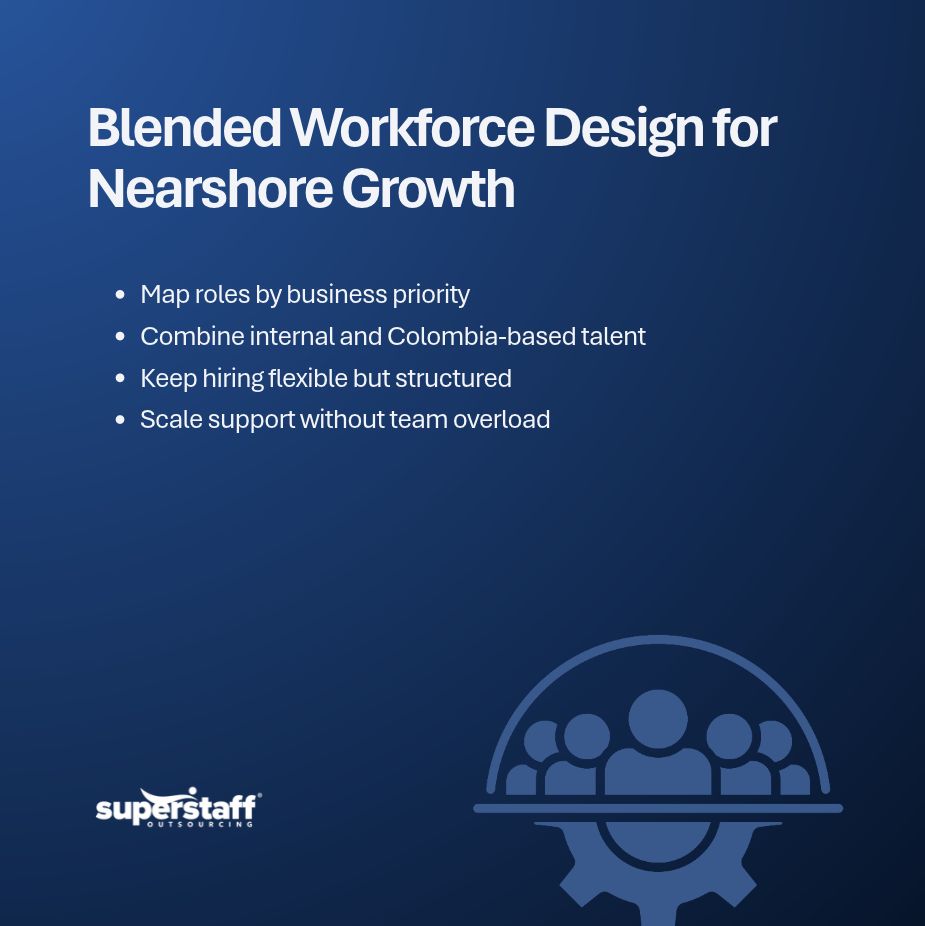
Recruitment Process Outsourcing helps companies design and execute hiring more efficiently. For a blended workforce, this matters because each role may require a different sourcing strategy, screening process, and onboarding path.
An RPO partner can help define:
- Which roles should be hired locally
- Which roles can be supported nearshore
- Which functions can be outsourced
- Which positions need full-time coverage
- Which roles need flexible or project-based support
- Which skills must stay close to the client’s core team
This creates a more intentional hiring model. Internal leaders still make the final decisions, but they gain a partner that can manage the recruiting process, candidate pipeline, and coordination needed to move faster.
For U.S. companies hiring in Colombia, blended workforce Recruitment Process Outsourcing in Colombia can reduce confusion between workforce planning and actual execution. The strategy becomes easier to act on because the recruiting engine is already aligned with the business need.
The risk of building teams without workforce design
Many companies grow teams one role at a time. This works in the early stages, but it can create problems as operations expand.
A manager may request another customer service representative. A finance leader may ask for back-office support. A sales leader may need appointment setters. HR may need recruiters to fill several urgent roles.
Each request makes sense on its own. The problem starts when there is no larger hiring structure behind those decisions.
Without a blended workforce plan, companies can end up with:
- Overlapping responsibilities
- Inconsistent hiring standards
- Slow candidate movement
- Unclear reporting lines
- Different onboarding experiences
- Higher administrative workload
- Limited visibility into workforce performance
A Recruitment Process Outsourcing partner helps bring order to this process. Instead of reacting to every role separately, companies can build a talent plan that supports growth across departments.
What U.S. decision-makers should evaluate first
A blended workforce works best when leaders understand which roles create the most value internally and which roles can be supported through nearshore or outsourced talent.
Before expanding a team, executives should ask:
- Which roles require direct internal control?
- Which tasks are repeatable and process-driven?
- Which functions need customer-facing communication skills?
- Which roles are slowing down current employees?
- Which teams need time zone alignment?
- Which hiring needs are urgent but not permanent?
- Which roles can be managed through defined KPIs?
These questions help companies avoid hiring based only on urgency. They also make the RPO process more effective because recruiters can search for talent based on actual business outcomes, not vague job descriptions.
For example, a growing company may not need to hire more internal recruiters immediately. It may need an RPO partner that can source and screen candidates while the internal HR team focuses on final interviews, culture fit, and workforce planning.
That is the practical value of a blended workforce.
Blended teams can improve customer support capacity
Customer support is one of the clearest use cases for this model. Many U.S. companies need more coverage, but they also need quality, training consistency, and strong communication.
A blended workforce can help companies support customers through a combination of internal leads, nearshore agents, outsourced specialists, and recruitment support.
The internal team can focus on quality standards, customer insights, escalation rules, and brand knowledge. The nearshore team can handle daily support volume, customer follow-ups, appointment coordination, email responses, chat support, or bilingual service needs.
This structure helps companies add capacity without overwhelming internal managers. It also keeps service delivery closer to U.S. business hours when Colombia-based teams are involved.
SuperStaff helps clients think through these details before recruiting begins. That includes role design, candidate requirements, training needs, reporting structure, and long-term scalability.
Why RPO should be part of the strategy early
RPO works best when it is involved before hiring becomes urgent. Once a company is already behind, recruitment becomes reactive. Timelines compress, screening quality can suffer, and managers may settle for available candidates instead of the right candidates.
Early RPO involvement helps companies build a stronger blended workforce because recruitment planning becomes part of business planning.
A good RPO partner can help identify role priorities, refine job requirements, manage pipelines, and keep hiring managers informed throughout the process. This gives companies more discipline without slowing them down.
For Colombia-based hiring, this is especially important. Local market understanding, candidate communication, and nearshore operations all affect hiring success. A partner with regional experience can help companies avoid common gaps between what the business wants and what the labor market can support.
What makes SuperStaff’s Colombia RPO model different
SuperStaff’s approach connects recruitment support with operational understanding. The goal is not to fill seats quickly and leave the client to figure out the rest.
For U.S. companies, SuperStaff can support a more practical path to nearshore hiring through:
- RPO support for targeted roles
- Colombia-based talent access
- Candidate screening and coordination
- Customer support and back-office hiring experience
- Workforce setup guidance
- Scalable team-building support
- Communication aligned with U.S. business expectations
This matters because a blended workforce needs structure. Companies need to know who they are hiring, why the role matters, how the work will be managed, and how the team can grow over time.
SuperStaff helps bring that clarity into the recruitment process.
Build the right team without adding complexity
A blended workforce gives U.S. companies more flexibility, but it still needs a strong hiring strategy behind it. Without the right partner, flexible hiring can become fragmented hiring.
SuperStaff helps SMEs and midmarket companies build nearshore teams through Colombia-based RPO support, practical workforce planning, and recruitment processes designed around real business needs.
If your company needs more capacity, better hiring structure, or a smarter way to scale customer support and operational roles, explore SuperStaff’s services today and see how our Colombia office can help you build a blended workforce that works.