Regulated industries operate under strict rules that affect every part of their operations. Companies must manage data carefully, maintain clear records, and ensure that every system follows legal standards. As businesses adopt cognitive AI solutions, they also introduce new layers of complexity that require close monitoring and control.
At the same time, customer expectations continue to rise. Companies now depend on cognitive AI solutions to support tasks such as data-driven decision-making in customer service and predictive customer support insights. These tools help improve speed and accuracy, but they also create risks if left unmanaged. Because of this, organizations are now turning to AI governance consulting to ensure proper oversight, reduce risk, and maintain compliance across all operations.
Growing Compliance Demands Across Industries
Regulations continue to expand across industries, which increases the need for structured governance. Companies must respond quickly to these changes while maintaining stability in their operations.
1. Stronger Data Protection Rules
Governments enforce strict data privacy laws to protect consumers. Therefore, companies using cognitive AI solutions must ensure that personal and sensitive data is handled with care and proper authorization.
2. Increased Audit Requirements
Regulators require clear documentation of system activities. As a result, businesses must track how cognitive AI solutions process data and support automated customer support systems.
3. Industry-Specific Guidelines
Different industries follow different compliance standards. For example, healthcare and finance require strict reporting and validation processes, so cognitive AI solutions must meet these expectations.
4. Cross-Border Regulations
Many organizations operate across multiple regions. However, each location has unique legal requirements, which makes governance more complex and harder to manage without expert support.
5. Penalties for Non-Compliance
Failure to meet regulatory standards can lead to fines and legal action. Therefore, companies invest in governance consulting to reduce risks and maintain operational stability.
Managing Risk in AI-Driven Operations
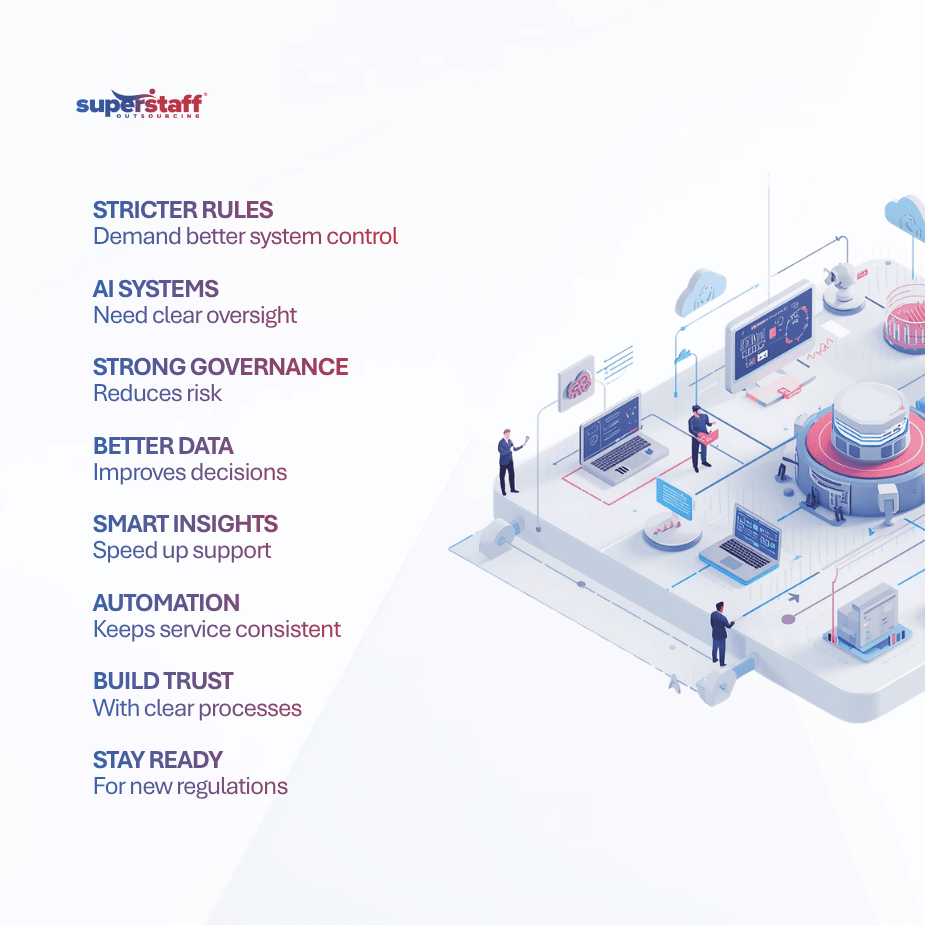
As organizations rely more on cognitive AI solutions, they must also address the risks that come with automation and data processing. Governance helps reduce these risks and ensures better control.
1. Limited Visibility into Systems
Some systems operate without clear transparency. Because of this, companies may struggle to explain how decisions are made by cognitive AI solutions.
2. Data Quality Issues
Poor data quality can affect system performance. As a result, predictive customer support insights may become unreliable without proper governance.
3. System Failures
Automated tools can fail unexpectedly. Therefore, businesses must monitor automated customer support systems to ensure consistent performance.
4. Security Risks
Cyber threats continue to evolve. At the same time, cognitive AI solutions must include strong security measures to protect sensitive information.
5. Operational Disruptions
Without proper oversight, system errors can interrupt services. Because of this, governance frameworks help maintain continuity and reduce downtime.
Supporting Better Business Decisions
Accurate data and reliable systems are essential for strong decision-making. Governance ensures that cognitive AI solutions provide trustworthy insights that support business goals.
1. Improved Data Accuracy
Clean and validated data improves outcomes. Therefore, governance strengthens data-driven decision-making in customer service by ensuring consistency and reliability.
2. Increased Confidence in Insights
Teams need to trust the results generated by systems. As a result, governance frameworks validate predictive customer support insights before teams act on them.
3. Alignment with Business Objectives
Systems must support company goals. Because of this, governance ensures that cognitive AI solutions remain aligned with operational priorities and customer needs.
4. Reduced Decision Errors
Unchecked systems can produce incorrect recommendations. However, governance processes help identify and correct these errors before they affect operations.
5. Better Customer Experience
Reliable systems improve service quality. Therefore, businesses can enhance customer interactions through well-managed automated customer support systems.
Strengthening Accountability and Control
Clear accountability helps organizations manage complex systems effectively. Governance consulting supports this by defining roles and improving oversight.
1. Clear Ownership of Systems
Every system requires responsible ownership. As a result, teams can manage cognitive AI solutions with greater accountability and efficiency.
2. Defined Policies and Procedures
Organizations need clear rules for system use. Therefore, governance frameworks establish consistent processes for handling data and operations.
3. Continuous Monitoring
Regular monitoring improves system visibility. Because of this, companies can detect issues early and take corrective action before problems grow.
4. Ethical Standards and Compliance
Businesses must follow ethical practices when using technology. At the same time, governance ensures that cognitive AI solutions operate within approved standards.
5. Ongoing Process Improvement
Governance evolves with the business. Therefore, organizations update their frameworks to keep pace with new challenges and regulatory changes.
Preparing for Future Regulations
Regulations will continue to change as technology advances. Companies must stay prepared to adapt quickly and maintain compliance.
1. Proactive Compliance Planning
Planning ahead reduces risk and uncertainty. Therefore, businesses use governance consulting to prepare for upcoming regulatory requirements.
2. Scalable Governance Frameworks
As companies grow, their systems become more complex. Because of this, governance models must scale alongside cognitive AI solutions.
3. Integration with Existing Operations
New regulations often affect current systems. As a result, governance ensures smooth integration without disrupting ongoing operations.
4. Workforce Training and Awareness
Employees must understand governance practices. Therefore, training helps teams manage automated customer support systems and other tools effectively.
5. Long-Term Risk Management
Sustainable strategies support long-term success. At the same time, governance helps organizations maintain compliance and reduce risk over time.
Build Trust Through Strong Governance
Organizations that invest in governance consulting build stronger and more reliable operations. As they continue to use cognitive AI solutions, they improve compliance, reduce risks, and support better decision-making across teams.
SuperStaff supports businesses with structured outsourcing solutions that help manage operations, improve control, and maintain compliance. Our team works closely with clients to ensure systems run smoothly and align with industry requirements.
Reach out to us today to learn how SuperStaff can help you manage cognitive AI solutions with confidence and build a strong governance strategy for your business.