U.S. companies expanding customer support across the Americas are rethinking how and where teams are built. Speed, language coverage, and operational alignment now matter as much as cost. Colombia has emerged as a practical choice for organizations that need bilingual capability without unnecessary complexity. The country’s BPO environment supports fast learning, cultural alignment, and reliable performance for customer-facing roles.
What differentiates Colombia is not a single operational advantage. It is the way education, workforce expectations, and nearshore delivery combine into a system that produces adaptable bilingual teams. For SMEs and midmarket companies, that system reduces risk while supporting growth.
Language capability as a baseline expectation
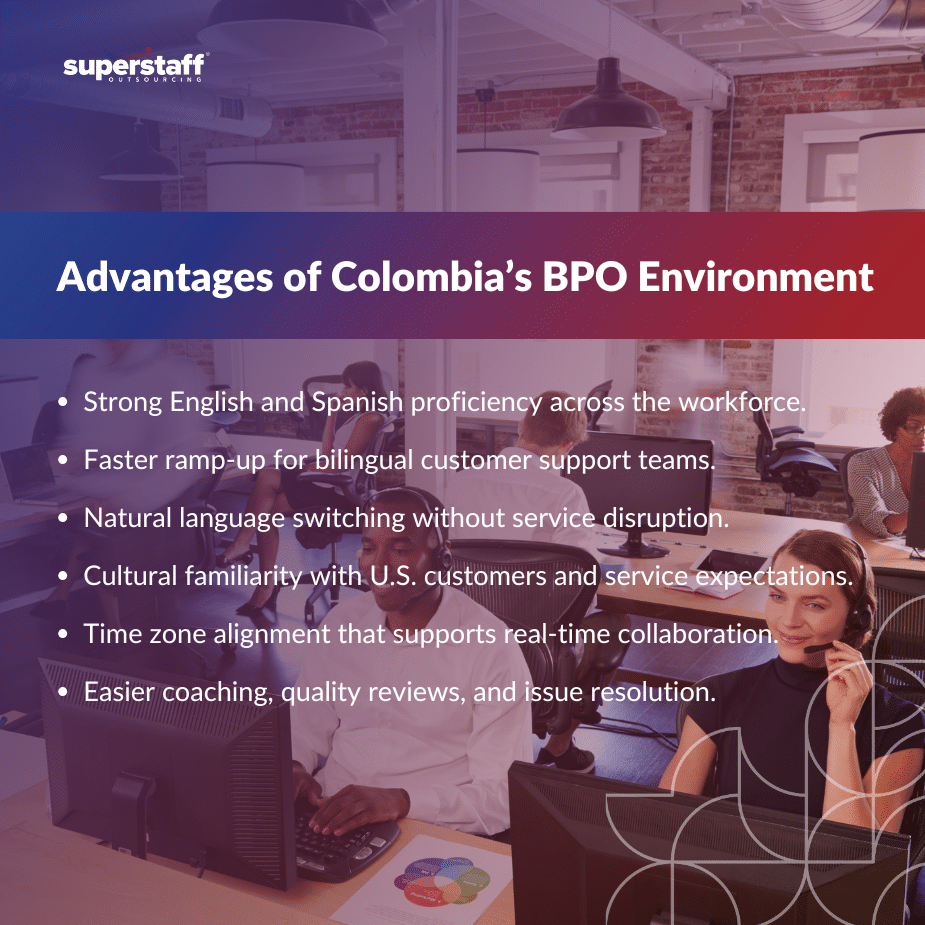
Colombia produces a steady pipeline of professionals trained in both English and Spanish. Language education is embedded early through formal schooling, private instruction, and professional development. English proficiency is tied to career mobility, especially in service-driven industries.
This foundation enables bilingual customer support that feels natural rather than forced. Agents are comfortable switching languages within the same shift or even the same conversation. That flexibility is essential for U.S. brands serving diverse customer segments.
Within the broader BPO environment, bilingual capability is treated as a core operational requirement. Teams are built with language coverage in mind from day one, rather than retrofitted after deployment.
Cultural familiarity that reduces service friction
Colombia’s alignment with U.S. business culture plays a critical role in service delivery. Agents are familiar with American conversational norms, customer expectations, and escalation etiquette. This familiarity shortens training cycles and reduces misunderstanding during live interactions.
Time zone proximity also supports this alignment. Managers can coach in real time. Quality assurance teams can provide same-day feedback. Clients remain closely connected to operations.
As a result, the BPO environment supports adaptability at the human level. Agents respond appropriately to tone changes, service urgency, and customer sentiment without rigid scripting.
Education systems that reinforce adaptability
Colombian universities and technical institutions emphasize communication, reasoning, and problem-solving. Many graduates enter the workforce with strong interpersonal skills that translate directly into customer support roles.
This educational emphasis matters in environments where customers expect resolution, not repetition. Agents are trained to interpret issues, apply policy correctly, and communicate outcomes clearly in two languages.
That mindset strengthens the BPO environment by producing teams capable of handling complex scenarios. When issues fall outside standard workflows, agents remain composed and solution-oriented.
Operational maturity in bilingual delivery
Bilingual operations require more than hiring multilingual agents. Scheduling, performance metrics, and quality monitoring must support both languages equally. Colombia’s BPO sector has matured to handle this complexity.
A well-run Colombia call center integrates language coverage into workforce planning. Leaders allocate staffing dynamically based on volume trends rather than fixed language assignments. This approach improves utilization without compromising service levels.
The BPO environment supports this maturity through experienced operations managers, standardized training frameworks, and proven escalation models.
Workforce stability and retention dynamics
Employee expectations in Colombia align well with long-term service roles. Career progression, skills development, and schedule stability matter to the workforce. This results in lower attrition compared to many high-turnover service markets.
Retention strengthens the BPO environment by preserving institutional knowledge. Agents develop deeper product familiarity and stronger customer handling skills over time. For U.S. companies, this translates into consistent service quality and fewer disruptions.
Stable teams also reduce onboarding costs and protect service continuity during peak periods.
Training models designed for speed and accuracy
Colombian BPO teams are accustomed to structured onboarding programs. Training focuses on product knowledge, compliance, and conversational accuracy in both languages. Role-playing and live-call shadowing are standard components.
Continuous coaching reinforces these foundations. Agents receive regular feedback tied to performance metrics rather than subjective assessments.
This approach enables the BPO environment to support rapid scaling. New hires reach productivity quickly while maintaining quality standards expected by U.S. brands.
Flexibility for growing and evolving businesses
SMEs and midmarket companies rarely grow in straight lines. Seasonal demand, market expansion, and product changes require flexible support models. Colombia’s nearshore structure supports incremental scaling without long-term commitment risk.
Teams can expand gradually or pivot between channels as demand shifts. Voice, chat, and email coverage can be adjusted without rebuilding the operation.
That flexibility defines the BPO environment decision-makers value. Leaders gain control over service capacity while maintaining bilingual readiness.
Process discipline and compliance awareness
Customer support increasingly intersects with data protection and regulated workflows. Colombian BPO operations are structured around documented processes and compliance training. Agents are taught to follow protocols while maintaining conversational flow.
This balance matters for industries such as healthcare, financial services, and logistics. Teams deliver bilingual customer support without introducing operational risk.
The BPO environment reinforces accountability through audits, reporting, and continuous improvement practices.
Real-world application for U.S. organizations
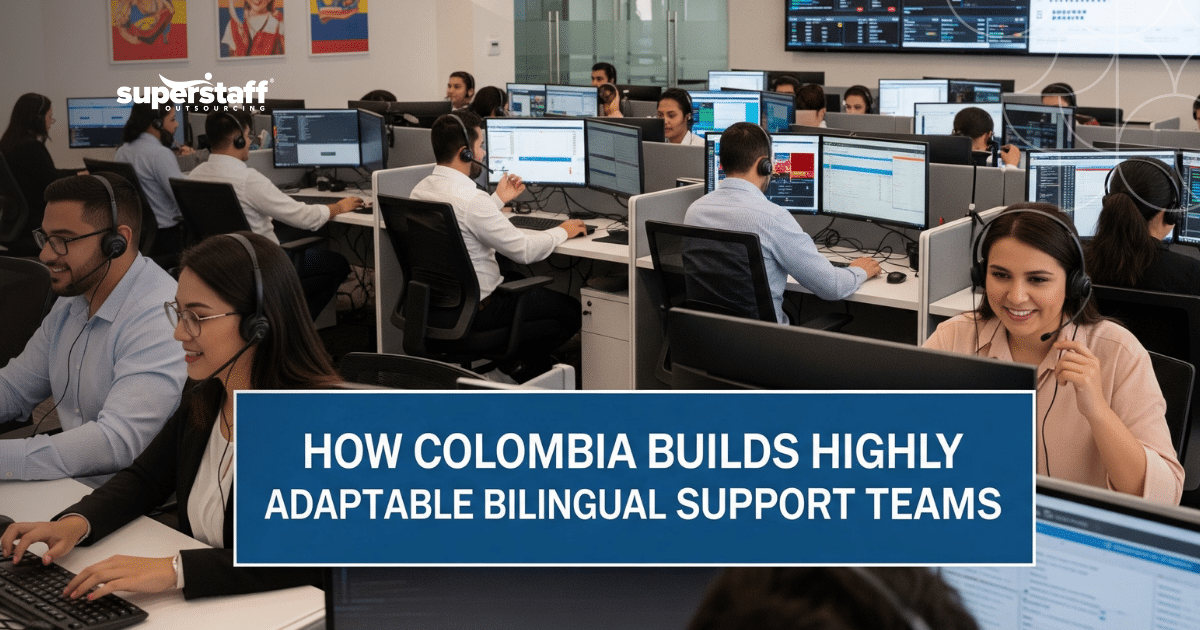
Consider a U.S.-based ecommerce company serving customers across North America. English and Spanish inquiries arrive through voice, chat, and email throughout the day. A Colombia call center provides bilingual coverage aligned with U.S. business hours.
Agents handle order tracking, returns, and payment concerns in both languages. Supervisors adjust staffing based on campaign activity and seasonal demand. Quality teams monitor interactions across channels without duplicating resources.
Within this BPO environment, operations remain streamlined while customer experience remains consistent. Growth is supported without operational strain.
Strategic advantages of nearshore positioning
Nearshore outsourcing to Colombia for bilingual support allows U.S. leaders to stay actively involved in service delivery. Travel times are reasonable. Communication remains synchronous. Oversight does not feel distant.
This proximity strengthens the BPO environment by keeping strategy and execution aligned. Adjustments to policy, branding, or service scope can be implemented quickly and accurately.
For decision-makers, this visibility reduces uncertainty and improves confidence in outsourced operations.
Reap the advantages of Colombia’s BPO environment with SuperStaff
Colombia’s ability to produce adaptable bilingual teams is the result of structural alignment, not coincidence. Education, cultural familiarity, operational maturity, and workforce stability work together to support a reliable BPO environment. For U.S. SMEs and midmarket companies, this environment enables bilingual customer support without unnecessary complexity.
SuperStaff helps organizations leverage this advantage through disciplined onboarding, performance management, and scalable service models. If you are exploring bilingual support strategies that balance control, quality, and flexibility, connect with SuperStaff to see how our nearshore solutions can support your growth.