Business needs change fast, and hiring models are evolving to match that pace. Many companies now prefer arrangements that give them control over daily work while removing the burden of HR management, payroll, and compliance. This is where employee leasing solutions come in.
Employee leasing gives businesses access to skilled workers without the full responsibility of being their direct employer. Through a leasing partner, companies can scale teams, manage compliance, and focus on growth. From small startups to global enterprises, organizations use employee leasing solutions to achieve flexibility and efficiency in their workforce strategy.
Understanding Employee Leasing Solutions
Employee leasing allows a company to “lease” staff from a third-party provider, who becomes the legal employer. The provider manages HR functions like payroll, taxes, and benefits, while the client directs the employee’s day-to-day work.
This setup helps businesses operate smoothly without being weighed down by administrative tasks. Below are the main elements that make employee leasing solutions work effectively.
1. Clear Division of Responsibilities
The leasing provider handles employment-related duties such as compliance and documentation. The client manages employee supervision and performance. This balance creates efficiency and clarity.
2. Simplified Payroll Management
Payroll processing and tax filing can take up significant time. Under employee leasing solutions, the provider handles these tasks, ensuring accuracy and on-time payment.
3. Compliance and Legal Assurance
Employment laws differ across countries and industries. A leasing partner stays updated on these regulations to help businesses avoid costly mistakes.
4. Access to Skilled Talent
Leasing providers maintain large talent pools covering different industries. Businesses can quickly fill roles with qualified professionals when needed.
5. Cost Efficiency
Leasing minimizes the overhead of full-time hiring. With predictable monthly costs, companies can budget better and scale operations when required.
Employee Leasing vs Other Hiring Models
Understanding how employee leasing compares to other models helps companies choose the right approach for their needs.
1. Employee Leasing vs Direct Hiring
With direct hiring, the company is responsible for all HR tasks and compliance. Leasing transfers those responsibilities to the provider while maintaining operational control. This approach saves time and resources.
2. Employee Leasing vs Outsourcing
When comparing employee leasing vs outsourcing, the difference lies in control and integration. In outsourcing, a third-party team handles a full function or project independently. In employee leasing, leased employees become part of the client’s internal team but remain legally employed by the provider.
3. Difference Between Employee Leasing and Outsourcing
The difference between employee leasing and outsourcing is mainly about management. Leasing focuses on staffing individuals for specific roles, while outsourcing transfers entire business processes to another company.
4. Better Flexibility
Employee leasing provides more control over how tasks are done compared to outsourcing. Businesses can manage work quality and integrate leased employees into their systems.
5. Stronger Employer Brand
Even though the provider handles HR functions, leased employees often work closely with the client’s teams. This helps maintain company culture and standards.
Key Benefits of Employee Leasing Solutions
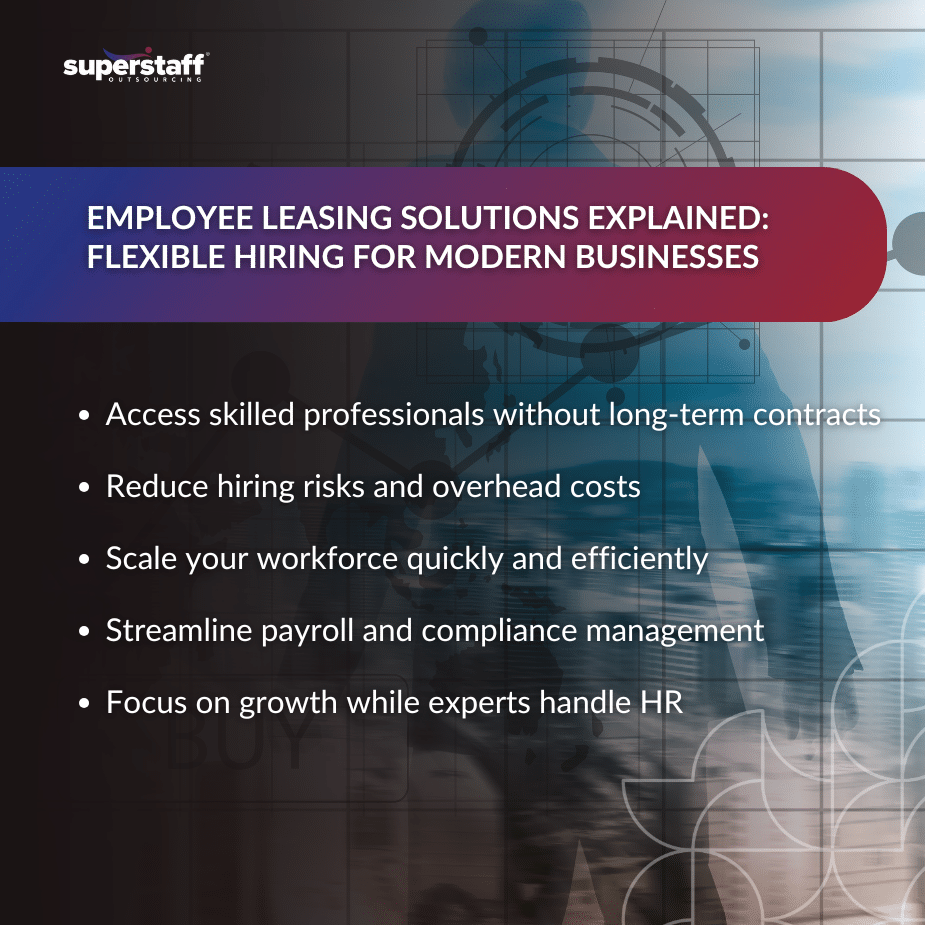
Companies of all sizes gain several advantages from using employee leasing solutions.
1. Faster Hiring Process
Recruiting and onboarding become quicker since leasing providers already have ready-to-hire candidates.
2. Reduced Administrative Burden
Businesses no longer need to handle HR paperwork, insurance, or payroll concerns.
3. Flexibility to Scale Teams
Companies can easily add or reduce staff based on project needs without the challenges of permanent hiring.
4. Access to Specialized Skills
Leasing providers connect businesses with experts in finance, IT, customer service, and healthcare.
5. Cost Savings
By avoiding recruitment fees, benefits administration, and long-term commitments, businesses save significantly on labor expenses.
Industries That Benefit From Employee Leasing
Employee leasing solutions can be customized for various industries and business needs.
1. Startups and Small Businesses
Startups often need fast access to skilled employees but have limited HR resources. Leasing gives them flexibility and support.
2. Healthcare
Hospitals and clinics use leasing to fill roles such as administrative staff or remote medical assistants efficiently.
3. Information Technology
IT firms lease developers, engineers, and support staff to meet short-term project demands.
4. Manufacturing
Manufacturers use leasing to handle seasonal production without long-term commitments.
5. Customer Support
Contact centers lease agents to maintain service levels during busy seasons.
Challenges and Considerations
Before using employee leasing solutions, businesses should evaluate possible challenges and plan accordingly.
1. Compliance in Multiple Regions
Different countries have unique labor laws. Companies must ensure the leasing partner follows all local regulations.
2. Communication and Integration
Clear communication between leased employees, the provider, and the client company helps maintain smooth operations.
3. Cultural Alignment
Leased employees should align with the company’s values and work environment for long-term success.
4. Provider Selection
Choosing a credible leasing company is essential for quality service and compliance assurance.
5. Data and Security Management
Businesses must ensure that sensitive employee information is managed securely by the provider.
Future of Employee Leasing Solutions
The demand for flexible workforce models continues to grow as businesses prioritize agility and cost control.
1. Global Expansion
Companies are now using employee leasing solutions across borders to support regional growth.
2. Focus on Compliance and Risk Management
More firms prefer leasing for its ability to handle complex compliance tasks efficiently.
3. Integration with Technology
Digital tools are making leasing arrangements smoother, improving coordination between clients and providers.
4. Increased Support for Remote Work
Leasing allows companies to manage remote teams legally and effectively across countries.
5. Strategic Workforce Planning
Leasing helps organizations plan staffing around demand cycles while keeping labor costs manageable.
Flexible Workforce Solutions for Smarter Growth
Employee leasing solutions give companies a simple way to grow, stay compliant, and manage costs without sacrificing quality. Whether expanding globally or adjusting to project-based needs, this model supports both short-term flexibility and long-term stability.
Businesses that partner with experienced providers gain the advantage of having a skilled workforce without the burden of full HR management.
SuperStaff helps organizations design workforce strategies using employee leasing solutions that fit their specific goals. From compliance to staffing support, SuperStaff ensures businesses have the right people at the right time to achieve sustainable growth.