
Organizations consistently attempt to improve employee experience through engagement programs, leadership development sessions, and flexible work arrangements. However, operational overload often remains unaddressed. Teams juggle reporting, documentation, coordination, compliance tracking, and transactional tasks in addition to core responsibilities.
This congestion reduces clarity and focus. Managers notice declining attention to strategic initiatives. Employees report time pressure, fragmented schedules, and limited autonomy. Companies that want to improve employee experience must examine workload design, not just morale initiatives. Structural pressure cannot be solved through surface level engagement programs.
Operational overload also creates decision bottlenecks. When managers are buried in administrative review cycles, approvals slow down. Delays affect customer satisfaction and internal momentum. Over time, frustration builds across teams. Leaders seeking to improve employee experience must remove recurring friction points that consume cognitive energy.
Why Leaders Must Improve Employee Experience Through Work Redesign
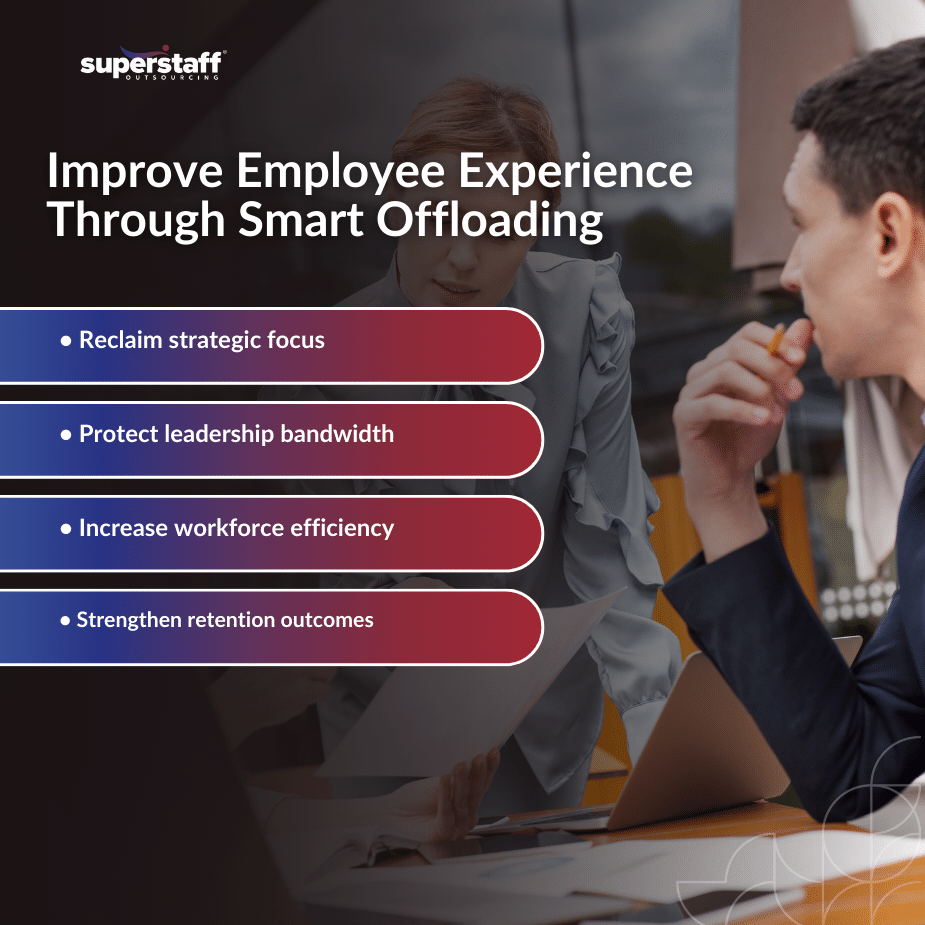
To improve employee experience in a sustainable way, leaders must rethink how work is distributed across departments. Employees deliver higher value when they concentrate on specialized tasks aligned with their expertise and career trajectory.
Operational overflow fragments schedules and shifts attention away from core objectives. Strategic thinking suffers. Structured offloading of administrative responsibilities helps reduce workload and restores focus. Organizations that align responsibilities with value creation strengthen workforce efficiency across departments.
Work redesign also clarifies accountability. When internal teams know which tasks remain in house and which are managed by nearshore partners, confusion decreases. Clear boundaries protect productivity. Companies that improve employee experience through deliberate task allocation often observe stronger ownership culture as well.
Why Colombia Has Become a Strategic Nearshore Destination
Colombia has emerged as a reliable nearshore location for U.S. companies seeking to improve employee experience without disrupting collaboration. Time zone alignment allows real time communication during standard business hours. English proficiency supports seamless interaction with U.S. teams and customers.
Cultural familiarity with North American business norms simplifies onboarding and performance alignment. Established BPO infrastructure provides operational stability across major cities. Companies seeking workforce efficiency find Colombia to be a practical and accessible solution for offloading operational burdens for better employee satisfaction.
Nearshore proximity also reduces escalation delays. Teams can resolve questions during the same workday rather than waiting overnight. Faster resolution cycles contribute directly to efforts to improve employee experience within internal departments.
Improving Workforce Efficiency by Separating Core and Support Functions
Leaders who improve employee experience focus on role clarity and operational discipline. Core teams must concentrate on strategic execution, innovation, and relationship management. Administrative and process driven responsibilities can be managed by specialized nearshore teams trained for consistency and accuracy.
Finance departments often spend excessive hours on reconciliations, invoice tracking, and data preparation. Offloading those functions enhances workforce efficiency and enables finance leaders to prioritize forecasting, scenario planning, and cost optimization.
Marketing teams also benefit from redistributing reporting and analytics preparation. When repetitive dashboard updates are reassigned, internal talent focuses on campaign strategy and customer insights. Companies that improve employee experience by redefining responsibilities create measurable gains in output quality.
How Offloading Operational Burdens Supports Employee Retention
Retention improves when employees feel productive and respected. Offloading operational burdens for better employee satisfaction creates measurable impact across performance reviews and engagement conversations. Reduced administrative clutter allows professionals to focus on high impact tasks aligned with career growth.
Employees regain control of schedules. Stress declines when reduced workload initiatives are implemented structurally rather than temporarily. Leaders who improve employee experience through workload balance strengthen long term loyalty and internal advocacy.
Retention also protects institutional knowledge. When burnout decreases, turnover slows. Fewer exits mean fewer disruptions. This continuity reinforces workforce efficiency and supports leadership stability.
Integrating Colombian Teams Without Disrupting Culture
Successful integration requires structured communication and governance. Clear KPIs and service expectations protect consistency. When nearshore teams operate within defined frameworks, internal employees experience less uncertainty about accountability.
Regular reporting, performance reviews, and alignment meetings ensure transparency. Organizations that improve employee experience understand that cultural alignment depends on clarity and operational visibility. Colombian teams become operational extensions rather than disconnected vendors.
Documented workflows and shared dashboards strengthen collaboration. Defined escalation paths eliminate ambiguity. These controls ensure that efforts to improve employee experience are reinforced rather than undermined by outsourcing transitions.
Use Cases Where Operational Offloading Delivers Immediate Impact
Certain functions consistently benefit from nearshore support. Customer service overflow management protects response times during demand spikes. HR teams offload onboarding documentation, payroll coordination, and compliance tracking. Finance departments transfer reporting preparation and data entry.
Operations teams can also delegate scheduling coordination and vendor communication tasks. These shifts reduce workload across internal teams and free managers to focus on strategic initiatives. Workforce efficiency improves as departments redirect attention to growth and customer relationships.
Companies that improve employee experience recognize the value of targeted operational reassignment instead of broad restructuring. Focused offloading generates quicker results and strengthens internal confidence.
Measuring Success Beyond Cost Savings
Cost reduction should not be the only performance metric. Leaders who aim to improve employee experience evaluate qualitative and operational indicators. Reduced overtime hours provide one clear signal of workload balance. Improved turnaround times indicate restored focus and accountability.
Manager feedback often reflects greater clarity and capacity. Employees report improved collaboration when task overload declines. Workforce efficiency strengthens when administrative pressure is redistributed.
Performance measurement should also include retention trends and engagement survey patterns. Organizations that improve employee experience through operational redesign often observe gradual yet sustainable cultural improvements.
Governance and Accountability in Nearshore Models
Structured oversight ensures quality control and alignment. Clear reporting dashboards create transparency across departments. Defined review cycles maintain service standards and prevent process drift.
Organizations that improve employee experience through outsourcing must maintain governance discipline from the beginning. Service level agreements, documentation protocols, and performance metrics protect internal trust.
Regular evaluation sessions allow leadership teams to refine scope and adjust capacity. This flexibility supports workforce efficiency and ensures that outsourcing decisions remain aligned with business strategy.
Long Term Strategic Value of Offloading Operational Work
Leadership bandwidth determines growth potential. When executives and managers spend time resolving administrative issues, innovation slows and strategic planning suffers. Offloading operational burdens to Colombia enables companies to improve employee experience while preserving decision making capacity.
Workforce efficiency expands as teams focus on differentiated value. Reduced workload creates resilience during demand fluctuations and seasonal variability. Organizations that redesign work structures strengthen competitive positioning without expanding headcount unnecessarily.
Long term value also appears in employer branding. Companies known for balanced workloads and thoughtful role design attract stronger talent. Leaders who consistently improve employee experience through disciplined operational strategy build organizations that scale with stability.
Aligning Employee Experience With Operational Strategy
Companies that improve employee experience through deliberate workload redesign strengthen engagement, retention, and productivity. Offloading operational burdens to Colombia enhances workforce efficiency and allows teams to focus on what matters most.
SuperStaff supports U.S. businesses by building structured nearshore and offshore teams that reduce workload and align with strategic priorities.
If your organization is ready to improve employee experience while driving operational clarity, explore how SuperStaff can help you design the right support model today.