
Customer service defines how people remember a business. Whether it is through a phone call, chat, or email, every interaction shapes brand perception. As companies expand, many face a choice: should they build an in-house team or work with outsourced customer support?
Both options have benefits. In-house teams provide direct control, while outsourcing offers flexibility and cost savings. Many businesses use outsourced customer support to provide faster response times and maintain service quality without large overhead costs. Understanding which model fits your organization helps you deliver consistent customer satisfaction while managing resources effectively.
Understanding Customer Service Models
Businesses can manage customer service internally or through external partners. Each method has unique features that affect cost, control, and efficiency.
1. In-House Customer Service
Companies hire and manage their own service staff. These teams operate under the company’s supervision, directly reflecting its culture and standards.
2. Outsourced Customer Support
Outsourced customer support means working with a third-party provider that manages customer interactions on behalf of a business. This setup allows companies to scale easily and focus on core functions while ensuring customer needs are met.
3. Hybrid Model
Some businesses combine both methods. Core operations remain in-house, while outsourced customer support handles overflow or after-hours inquiries.
4. Why the Choice Matters
The decision affects customer experience, costs, and growth capacity. Businesses that choose wisely can maintain high-quality service while managing resources efficiently.
5. What Drives the Comparison
Factors such as budget, service volume, and regional presence often determine whether outsourced customer support or an internal team is better suited for the company.
Advantages of In-House Customer Service
Maintaining an internal support team allows for direct supervision and stronger control over brand identity.
1. Direct Oversight and Training
Companies can train staff according to specific procedures and monitor performance closely. This ensures service consistency and compliance with internal policies.
2. Strong Brand Familiarity
In-house employees often have deeper product knowledge and stronger loyalty to the brand. This can result in more personalized customer interactions.
3. Better Collaboration Across Departments
Support teams can easily coordinate with sales, marketing, or technical departments to solve issues quickly.
4. Immediate Feedback and Response
Managers can address customer service problems as soon as they arise, improving response time and accountability.
5. Easier Integration with Company Systems
Internal teams often adapt faster to internal tools, reporting systems, and workflows.
Advantages of Outsourced Customer Support
Many organizations now rely on outsourced customer support to improve service reach, manage costs, and increase flexibility.
1. Cost Savings
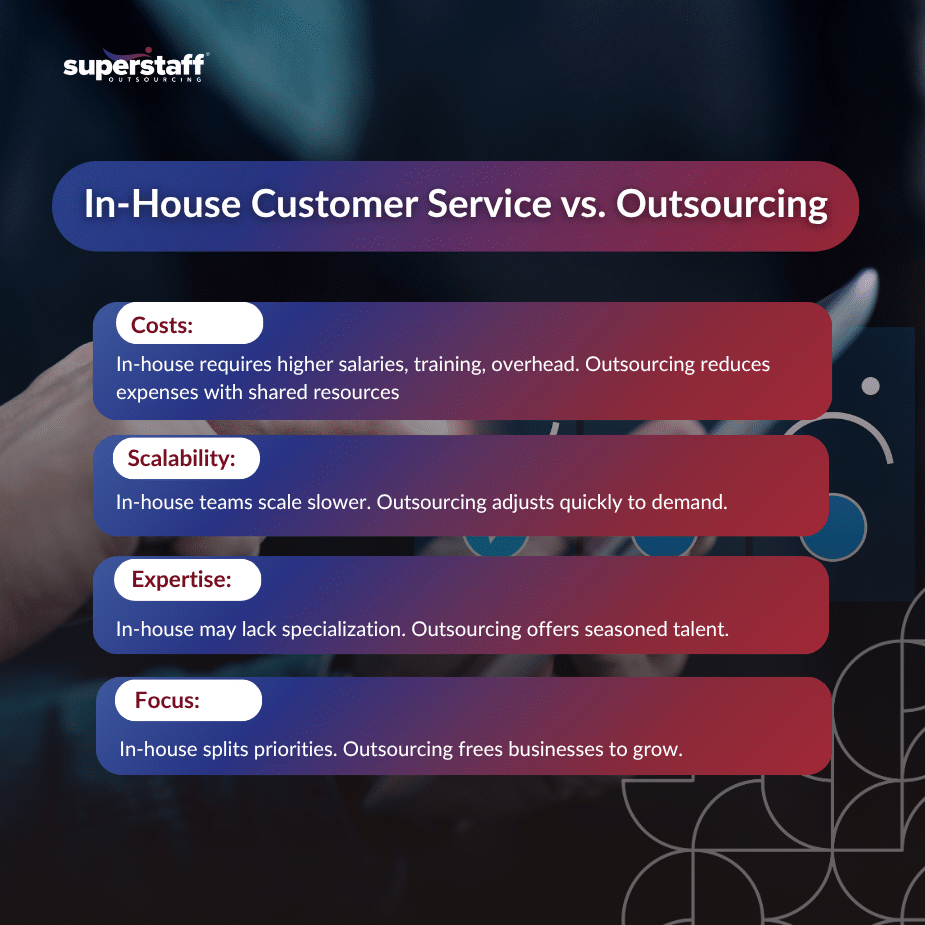
Outsourcing reduces expenses related to hiring, training, office space, and equipment. Businesses can redirect savings toward product improvement or marketing.
2. 24/7 Service Availability
Providers of outsourced customer support often operate across multiple time zones. This ensures round-the-clock customer service, which helps global businesses maintain satisfaction.
3. Scalability and Flexibility
Companies can easily increase or decrease support staff during busy or slow seasons without long-term commitments.
4. Access to Experienced Professionals
Many outsourcing partners specialize in customer service management solutions, employing trained agents familiar with various industries and platforms.
5. Focus on Core Operations
By outsourcing, management teams can focus on strategy, innovation, and business growth rather than day-to-day service issues.
In-House vs. Outsourced: Key Comparison Points
The debate over which is better: in-house or outsourced customer service depends on several key factors that affect business performance and long-term goals.
1. Cost and Resource Allocation
In-house operations require high fixed costs for salaries, facilities, and software. Outsourcing converts those costs into predictable monthly expenses.
2. Control and Oversight
While in-house teams allow tighter control, outsourced customer support providers use advanced reporting tools to ensure transparency and accountability.
3. Service Quality and Training
Both models can maintain high-quality service if proper training and performance metrics are applied consistently.
4. Customer Reach and Availability
Outsourcing provides multilingual support and extended hours, which benefit companies serving global customers.
5. Data Security and Compliance
Reliable outsourcing partners follow international standards for data protection to ensure client and customer information remains secure.
When to Choose Outsourced Customer Support
Outsourced customer support is not limited to large corporations. It benefits organizations of all sizes depending on their stage of growth and customer demand.
– Startups and Small Businesses
Outsourcing helps small teams manage service efficiently without heavy investment in staffing and equipment.
– Seasonal or Project-Based Businesses
Retail and travel industries often rely on outsourced customer support during peak seasons to handle increased inquiries.
– Expanding Companies
When entering new markets, outsourcing enables businesses to provide local language support without opening new offices.
– Enterprises with Large Call Volumes
High-volume industries like e-commerce or telecommunications benefit from the scalability that outsourcing provides.
– Businesses Seeking Cost Efficiency
Companies that prioritize cost control find outsourcing a practical solution that balances quality and affordability.
Challenges and Considerations
Choosing the right model involves understanding potential risks and how to manage them effectively.
1. Communication Gaps
Coordination between in-house and outsourced customer support teams requires clear communication to avoid confusion or delays.
2. Cultural Alignment
Outsourced teams must understand the client’s tone and customer expectations to maintain consistent service.
3. Data Management
Both models must ensure customer data is handled securely under compliance regulations.
4. Quality Monitoring
Regular performance reviews and feedback loops are necessary to maintain service excellence.
5. Vendor Selection
Selecting a reliable outsourcing partner with proven experience in outsourcing customer experience ensures better long-term outcomes.
The Future of Customer Service Models
The customer service industry continues to evolve with changing customer expectations and digital transformation.
1. Hybrid Approaches Gaining Popularity
Many companies combine in-house expertise with outsourced customer support for maximum flexibility and coverage.
2. Expanding Nearshore and Offshore Markets
Countries like the Philippines, Colombia, and Mexico are becoming key destinations for outsourcing due to their skilled workforce and affordability.
3. Growing Focus on Quality Metrics
Businesses increasingly track response times, customer satisfaction, and resolution rates to assess provider performance.
4. Investment in Training and Development
Outsourcing partners now invest heavily in training to align agents with client goals and customer expectations.
5. Enhanced Use of Technology
Automation, ticketing systems, and real-time dashboards make outsourced customer support more efficient and transparent for clients.
Reliable Support Solutions for Sustainable Growth
Choosing between in-house and outsourced customer support depends on your business goals, budget, and operational needs. Both models can succeed when managed strategically. For many growing companies, outsourcing offers an affordable and flexible way to improve service without sacrificing quality.
Partnering with a trusted provider like SuperStaff ensures access to professional agents, structured performance monitoring, and seamless coordination. SuperStaff helps businesses design customer service management solutions that support growth, efficiency, and global customer satisfaction.
Whether you’re deciding which is better: in-house or outsourced customer service, SuperStaff can guide you toward the approach that fits your strategy best.