
Missed appointments quietly drain healthcare organizations. They disrupt provider schedules, delay care, and reduce revenue without ever appearing as a line item. As patient volumes rise and staffing pressure continues, many healthcare leaders are rethinking how scheduling work gets done.
The patient scheduler remote model is emerging as a practical response. It allows healthcare providers to stabilize access, improve utilization, and maintain service levels without adding local headcount. More importantly, it aligns scheduling operations with the realities of modern healthcare delivery.
This shift is no longer experimental. It is becoming operationally necessary.
Appointment gaps are an operational problem, not a clinical one
Healthcare organizations often treat scheduling as an administrative task. In reality, it is a core operational function that affects every downstream outcome. When appointments go unfilled or are booked incorrectly, the impact spreads quickly.
Small inefficiencies compound over time.
- Providers lose productive hours
- Patients experience longer wait times
- Staff spend more time correcting errors
- Revenue cycles slow down
As volumes increase, in-house teams struggle to keep up. Phone queues lengthen. Follow-ups fall through. Rescheduling requests pile up. These challenges push organizations to reconsider how scheduling work and other patient access services are structured.
Why healthcare systems are moving scheduling offsite
Healthcare leaders are not outsourcing scheduling because it is easy work. They are doing it because consistency matters more than proximity. Scheduling requires focus, accuracy, and availability across time zones.
Remote scheduling models offer that stability.
A well-structured patient scheduler remote setup gives organizations access to trained schedulers who handle appointment workflows all day. This includes inbound calls, outbound reminders, insurance verification coordination, and rescheduling.
As a result, in-house teams can refocus on patient-facing care rather than administrative recovery.
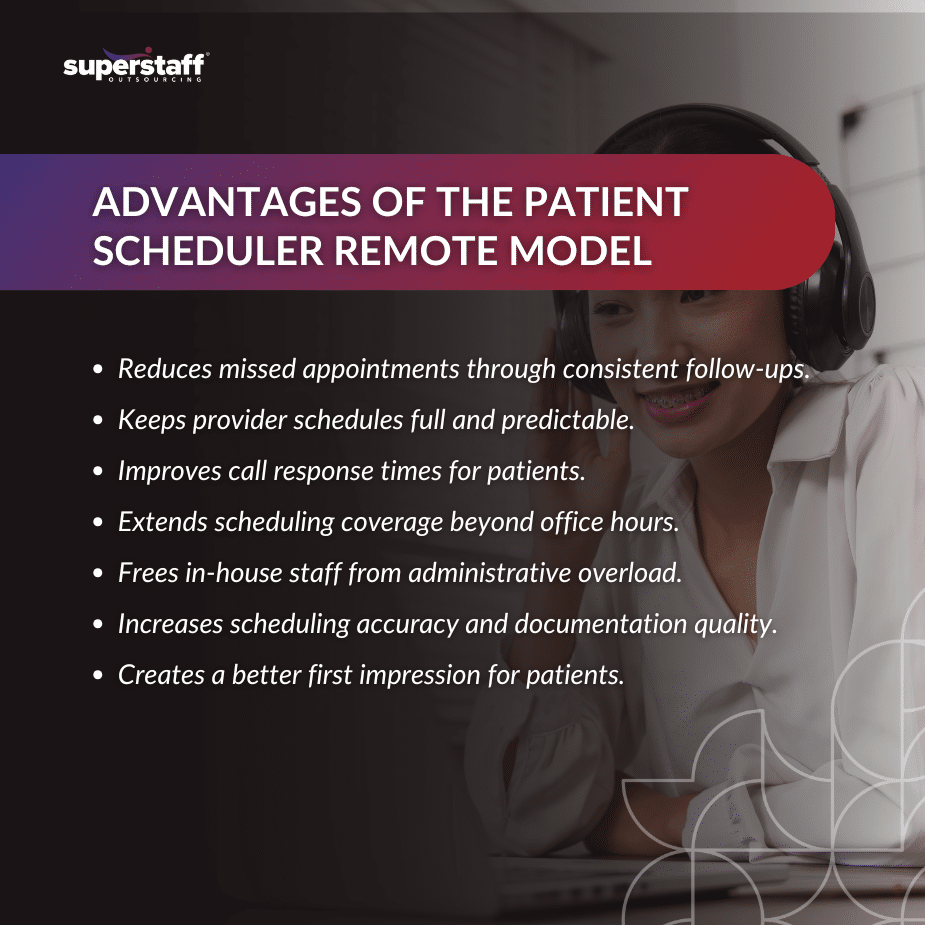
Remote schedulers reduce missed appointments through consistency
Missed appointments rarely happen by accident. They occur when reminders are late, instructions are unclear, or patients cannot easily confirm or change bookings. Remote schedulers address these gaps through disciplined execution.
They follow defined workflows every day.
- Confirming appointments within set time windows
- Proactively reaching out for reschedules
- Escalating issues before slots go unused
Because remote schedulers are not pulled into clinical interruptions, they maintain consistency. This reliability improves patient attendance without adding pressure to front-desk staff.
Over time, organizations using a patient scheduler remote approach see smoother schedules and fewer last-minute gaps.
Scheduling accuracy improves patient experience
Patients judge healthcare experiences on access as much as outcomes. A confusing scheduling process erodes trust quickly. Long hold times and repeated calls create frustration before care even begins.
Remote scheduling teams improve this first interaction.
They answer calls promptly, follow clear scripts, and document accurately in scheduling systems. Patients receive confirmations, reminders, and clear instructions without confusion.
When scheduling works well, patients feel supported. That perception carries into the rest of the care journey.
Extended coverage supports modern patient behavior
Patients no longer schedule appointments strictly during office hours. Many call during lunch breaks, evenings, or early mornings. Traditional staffing models struggle to cover these windows consistently.
Remote scheduling and other healthcare back-office support services solve this coverage gap.
By operating across time zones, healthcare organizations extend availability without overworking local teams. Calls are answered when patients are ready to engage, not when staff happen to be available.
A patient scheduler remote model allows scheduling operations to align with patient behavior rather than forcing patients to adapt.
Compliance and process control remain intact
Healthcare leaders often worry about compliance when considering remote models. Scheduling teams handle sensitive information, and errors carry risk. However, remote does not mean unmanaged.
Strong providers implement clear safeguards.
- HIPAA-aligned training protocols
- Role-based system access
- Documented call handling procedures
- Quality monitoring and audits
With proper oversight, remote schedulers operate within the same standards as in-house staff. In many cases, processes become more consistent because workflows are documented and enforced.
This structure makes the patient scheduler remote model both scalable and secure.
Scheduling becomes a measurable performance function
One overlooked benefit of remote scheduling is visibility. When scheduling is treated as a dedicated function, performance becomes easier to track and improve.
Healthcare organizations gain clearer insights.
- Call volumes and response times
- Appointment confirmation rates
- Reschedule turnaround times
- Utilization patterns by provider
These metrics support better decision-making. Leaders can adjust staffing, refine scripts, or optimize appointment templates based on real operational signals.
Remote scheduling transforms a reactive task into a managed function.
Cost control without service tradeoffs
Healthcare organizations face constant pressure to control costs without compromising access. Hiring locally for administrative roles is becoming more difficult and expensive, especially in tight labor markets.
Remote teams offer flexibility. They scale up during peak periods, stabilize operations during hiring gaps, and reduce overtime pressure on in-house staff.
A patient scheduler remote strategy allows organizations to protect service quality while managing cost exposure responsibly.
The Philippines has become a trusted scheduling hub
The Philippines has long supported healthcare operations for U.S. providers. Its talent pool offers strong English proficiency, service orientation, and familiarity with U.S. healthcare workflows.
Schedulers trained in the Philippines integrate smoothly into existing systems. They follow U.S. time zones, documentation standards, and patient communication expectations.
For many organizations, a patient scheduler remote team based in the Philippines delivers both reliability and cultural alignment.
Integration matters more than location
Remote scheduling succeeds when integration is intentional. Clear handoffs between schedulers, clinical staff, and billing teams prevent breakdowns.
Effective models prioritize alignment.
- Shared scheduling systems
- Defined escalation paths
- Regular performance reviews
- Ongoing training updates
When integration is strong, remote schedulers function as an extension of the care team rather than an external service.
This operational cohesion is what makes the patient scheduler remote model sustainable.
Leadership sees scheduling as infrastructure, not support
Forward-looking healthcare leaders no longer view scheduling as a back-office task. They see it as infrastructure that supports access, utilization, and patient satisfaction.
Remote scheduling fits this strategic mindset. It creates predictability, improves throughput, and supports growth without adding complexity. As healthcare delivery continues to evolve, scheduling models must evolve with it.
Adopt the Patient Scheduler Remote Model With a Reliable Healthcare BPO
Healthcare organizations cannot afford persistent appointment gaps. They strain resources and delay care. Addressing them requires operational clarity, not temporary fixes.
The patient scheduler remote model offers a structured path forward. It stabilizes scheduling, improves access, and supports both patients and providers.
SuperStaff helps healthcare organizations build and manage remote scheduling teams in the Philippines with discipline and care. Our approach focuses on integration, compliance, and performance from day one.
Are you hoping to enhance your remote healthcare operations for patient appointment management? If your organization is ready to close appointment gaps and strengthen access, explore how SuperStaff can support your scheduling operations with confidence and control.