Customers expect fast replies, accurate answers, and smooth support across every channel. Because of that, many companies now ask the same question: will AI replace customer service teams completely? Some business owners worry about job loss, while others see new ways to improve support operations. At the same time, outsourcing providers continue to adjust their services to match changing customer expectations.
The reality looks more balanced. While technology can handle repetitive tasks, customers still want human support for complex concerns. As a result, businesses are not removing outsourcing services entirely. Instead, they are changing how customer service teams work. Companies now combine digital tools with trained support staff to improve speed, quality, and customer satisfaction. Therefore, the discussion around will AI replace customer service is no longer about replacement alone. It is also about adaptation, efficiency, and long-term business growth.
Why Customer Service Outsourcing Still Matters
Many businesses continue to rely on outsourcing because customer support requires flexibility, skilled agents, and round-the-clock service. Although automation helps with simple requests, human support still plays a major role.
1. Customers Still Prefer Human Conversations
Many customers become frustrated when automated replies fail to solve their issues. Because of this, they often ask to speak with a real person after a few minutes. Human agents can understand emotions, explain solutions clearly, and calm upset customers.
In many cases, empathy matters just as much as speed. While digital systems answer basic questions quickly, they cannot fully replace human understanding. Therefore, businesses still invest in customer experience outsourcing to maintain personal support while increasing service capacity.
2. Complex Problems Need Human Judgment
Not every customer concern follows a simple process. Billing disputes, technical issues, and account concerns often require careful review. As a result, trained agents remain essential for handling sensitive situations.
Companies asking will AI replace customer service often realize that technology works best when paired with human decision-making. Support agents can review the full context of a situation and decide when an issue requires additional attention.
3. Outsourcing Helps Businesses Scale Faster
Customer demand changes throughout the year. During product launches, holiday seasons, or promotions, support tickets can increase quickly. Because of this, outsourcing providers help companies add customer service capacity without building large in-house teams.
Additionally, outsourcing companies may already have trained agents, management systems, and support infrastructure. Therefore, businesses can expand customer support while managing operational costs.
4. Global Support Requires Local Understanding
Many businesses serve customers from different countries and cultures. Outsourced teams can provide multilingual support and region-specific knowledge. This can improve communication across different customer markets.
AI translation and communication tools can assist agents, but context, tone, and cultural differences may still require human judgment. Therefore, businesses continue to rely on customer service professionals for interactions that require more careful communication.
5. Human Support Builds Brand Loyalty
Customer service affects how people view a brand. A helpful support experience can encourage customers to continue doing business with a company. On the other hand, poor service can lead to complaints and lost customers.
Because of this, businesses asking whether AI can replace customer service should also consider where human interaction provides the most value within the customer journey.
How Technology Is Changing Outsourcing Services
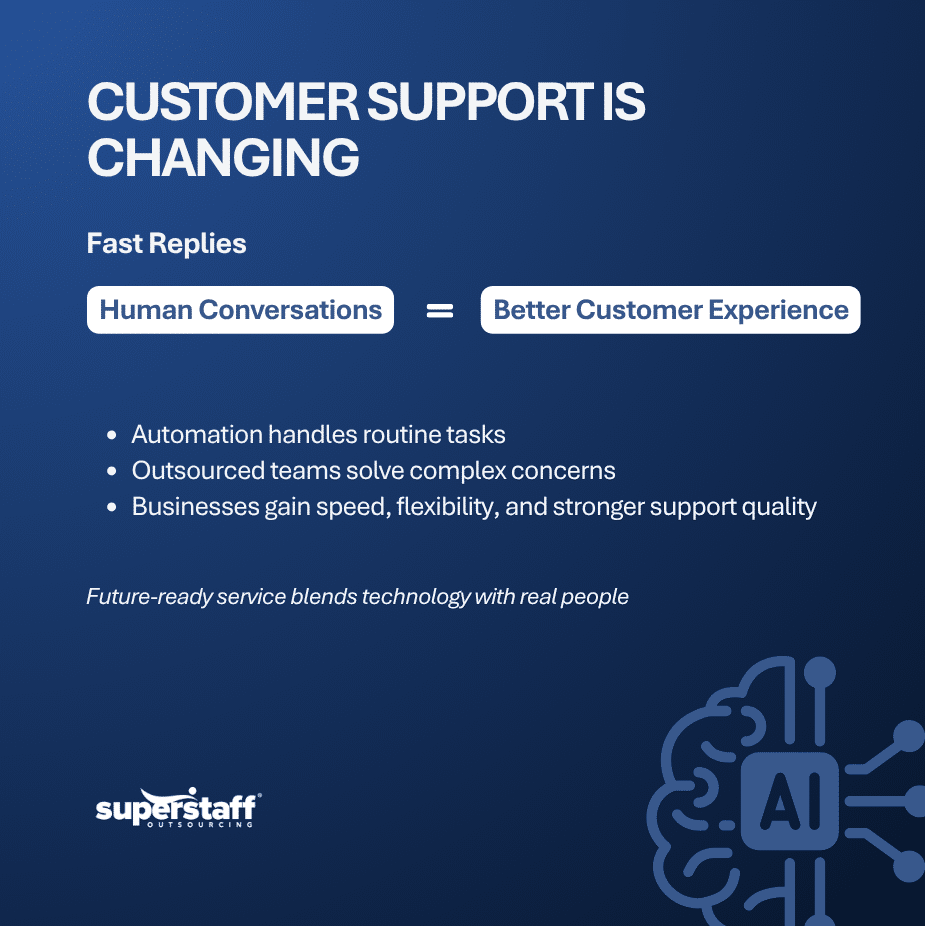
Technology continues to reshape customer support operations. However, many outsourcing companies use it alongside human agents rather than treating automation as a complete replacement. This hybrid approach to AI customer support allows routine tasks to be automated while agents focus on concerns that require judgment and direct communication.
1. Faster Responses for Simple Questions
Many support teams now use automated systems to answer common questions. These tools can assist customers with order status, password resets, account information, and frequently asked questions.
As a result, agents spend less time handling repetitive concerns. Instead, they can focus on more complicated customer issues that require personal attention.
2. Better Data for Customer Support Teams
Support platforms can collect customer history, previous interactions, and other relevant information. Agents can use this data to understand the customer’s situation before responding.
Companies discussing will AI replace customer service may find that these tools can also improve agent productivity. AI can assist with data retrieval, response suggestions, and other routine tasks while the agent remains responsible for the interaction.
Businesses exploring this approach can also review Zendesk’s AI customer service resources to see how AI tools are being used for customer support workflows.
3. Improved Workflow Management
Outsourcing providers use digital systems to organize support tickets and monitor customer interactions. These systems can route inquiries to the appropriate team based on the issue, channel, or other predefined rules.
Automated customer service tools can also reduce manual tasks such as ticket routing and data lookup, allowing agents to spend more time resolving customer concerns.
4. Support Teams Can Work Across Multiple Channels
Customers contact businesses through email, live chat, social media, phone calls, and other platforms. Because of this, outsourcing providers often use integrated systems to organize these conversations.
This setup allows agents to access relevant customer information and maintain more consistent communication across channels.
5. Training Processes Continue to Improve
Technology can also support agent training. Recorded calls, quality monitoring, performance data, and real-time guidance give managers more information about how agents handle customer interactions.
However, experienced trainers and managers remain important for developing communication, problem-solving, and customer handling skills.
What Businesses Should Expect Moving Forward
The future of outsourcing will likely involve stronger collaboration between technology and human support teams. Instead of treating AI and human agents as separate options, businesses can decide which tasks are better suited to each.
1. Hybrid Support Models Will Grow
Many companies already combine automated systems with live agents. Customers can handle simple requests through self-service tools and move to a human agent when the issue becomes more complex.
This approach can reduce repetitive work while keeping human support available when customers need it.
2. Customer Expectations Will Continue to Increase
Customers expect fast replies, accurate information, and convenient service across channels. Businesses must consider these expectations when deciding how much of their support process to automate.
Companies asking will AI replace customer service should focus on where technology improves the experience and where human involvement remains necessary.
3. Human Skills Will Become More Valuable
As automation handles more repetitive tasks, agents may spend more time on complex customer issues, conflict resolution, account concerns, and relationship management.
This means outsourcing providers may need to place greater focus on communication, problem-solving, technical knowledge, and other skills that support higher-value interactions.
4. Businesses Will Prioritize Cost and Quality Together
Companies want efficient operations, but they also need reliable customer experiences. Outsourcing providers that combine trained agents with appropriate technology can support both goals.
The question of whether AI will replace customer service may therefore become less about removing agents and more about determining how people and technology should divide the work.
5. Outsourcing Providers Will Continue Evolving
The outsourcing industry continues to adjust as customer expectations and technology change. Providers are adding automation, AI-supported workflows, analytics, and other tools to existing service models.
Businesses considering this type of support can explore SuperStaff to learn more about customer service and outsourcing solutions that combine people, processes, and technology.
Smarter Support Starts With the Right Team
The question will AI replace customer service does not have a simple yes or no answer. Technology will continue changing how support teams operate, but human agents remain important for complex concerns, sensitive interactions, and situations that require judgment.
Customer service outsourcing is also changing alongside these tools. Instead of relying only on manual processes, businesses can combine automation with trained support professionals to create a service model that matches their customer needs.
SuperStaff provides customer service outsourcing solutions that combine trained professionals with technology-supported processes. Businesses can build support teams around their channels, operating hours, and customer service requirements.
Want to discuss the right balance between technology and human support for your business? Contact SuperStaff to explore your customer service outsourcing options.