
Customer retention does not begin with scripts or technology. It begins with people. Companies that build an employee first culture create conditions where service quality becomes consistent, dependable, and trustworthy.
This connection between internal workforce care and external customer loyalty is not theoretical. It shows up in every interaction customers have with support teams.
Leaders often look at retention through the lens of marketing, pricing, or product experience. However, the way customers are treated during moments of need often determines whether they stay or leave.
Those moments are handled by people. That is why workforce conditions deserve attention in retention discussions.
Customer retention starts with workforce stability
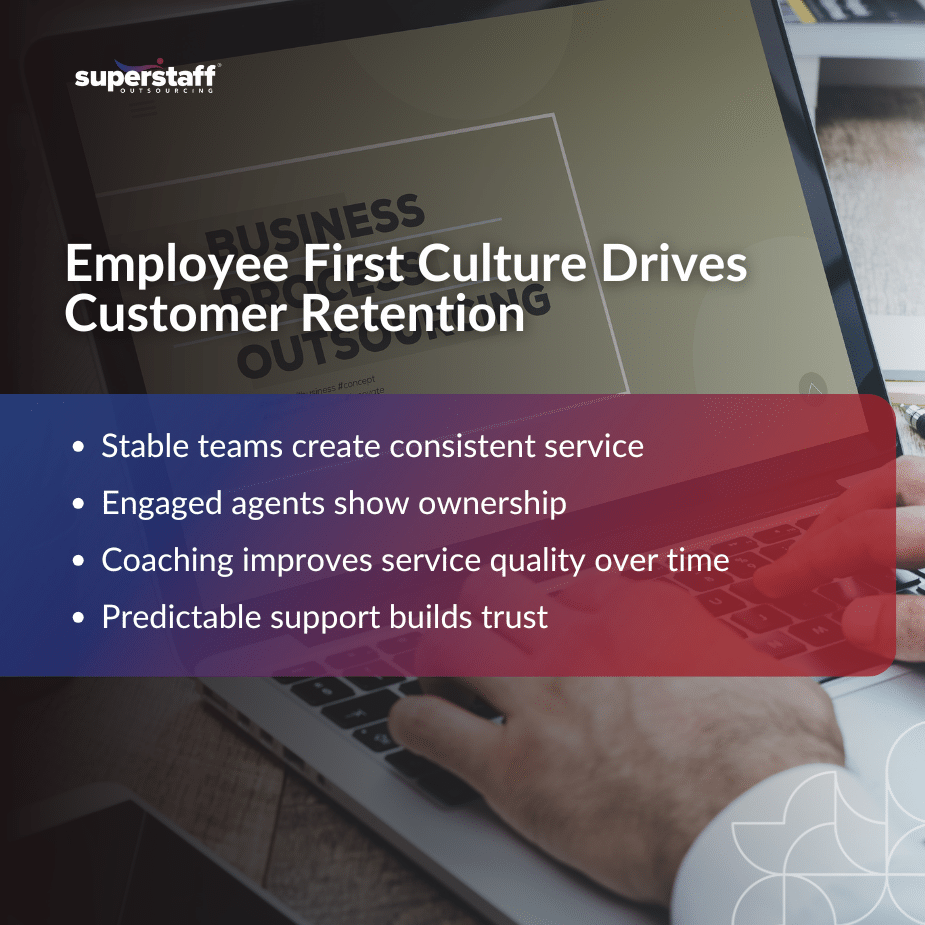
An employee first culture reduces turnover. Teams stay longer. Knowledge compounds over time.
Customers speak to agents who understand their history, preferences, and recurring concerns. Familiarity shortens conversations and improves outcomes. Stability allows service quality to improve naturally without constant retraining cycles.
Long-tenured teams also build internal coordination. They know who to approach for escalations and how to resolve issues faster. This internal fluency creates smoother customer experiences.
Supported employees perform with higher attention to detail
Work conditions shape how carefully tasks are performed. Teams that feel supported take fewer shortcuts. They follow procedures because they have the capacity to do so.
This relationship between employee experience and customer experience becomes visible in accurate documentation, clear communication, and correct resolutions. Customers notice reliability even when they cannot see the process behind it.
Attention to detail reduces repeat contacts. Fewer mistakes mean fewer callbacks, which directly affects how customers evaluate service quality.
Process familiarity reduces customer friction
Agents who stay longer master internal systems. They navigate tools faster. They know where errors typically happen.
An employee first culture allows teams to gain operational confidence. Customers benefit from quicker answers and fewer transfers. Reduced friction makes support interactions feel effortless.
Process mastery also allows agents to explain solutions clearly. Customers appreciate clarity because it saves them time and frustration.
Emotional tone reflects internal culture
Customers can sense the difference between rushed service and composed service. Emotional tone travels through voice and chat.
Teams working in an employee first culture show patience and professionalism. They listen fully before responding. This emotional quality influences how customers feel about the brand long after the interaction ends.
Positive emotional experiences often matter as much as the resolution itself. Customers remember how they were treated.
Tenure strengthens brand consistency
Long-term employees understand how a brand should sound. They learn when to be formal and when to be conversational.
An employee first culture creates tenure that aligns agents with brand expectations. Customers receive consistent communication across channels and over time. Consistency strengthens brand recognition and trust.
Agents begin to internalize brand guidelines. They apply judgment naturally without needing constant reminders.
Engagement drives discretionary effort
Engaged employees do more than follow scripts. They look for ways to solve problems completely.
This link between employee engagement and customer retention becomes visible when agents take ownership of issues. Customers remember when someone makes an extra effort to help them. These small moments build long-term loyalty.
Discretionary effort shows when agents follow up, double-check solutions, and ensure customers leave the interaction satisfied.
Stable teams improve operational efficiency
Learning curves flatten when teams stay intact. Agents answer faster and with greater accuracy.
An employee first culture leads to efficient handling times without sacrificing quality. Customers appreciate quick, correct resolutions. Efficiency reduces customer effort, which is a key factor in retention.
Operational efficiency also reduces queue times, which improves the overall perception of responsiveness.
Coaching improves when teams stay longer
Supervisors can invest in meaningful coaching when employees remain in their roles. Skill development becomes cumulative rather than repetitive.
An employee first culture allows coaching to focus on refinement instead of constant onboarding. Skilled agents handle complex concerns with confidence. Customers receive better solutions for challenging issues.
Coaching also builds confidence in agents, which translates into calmer and clearer conversations with customers.
Predictable service builds customer trust
Customers value predictability. They want to know what kind of service they will receive each time they reach out.
Teams shaped by an employee first culture deliver consistent interactions. Reliability builds confidence. Confidence turns into trust, and trust drives retention.
Predictability reduces customer anxiety when they need support. They know what to expect.
Outsourcing partners influence customer outcomes
The connection between workforce treatment and service quality is critical when selecting a BPO partner. Outsourcing does not remove this relationship. It amplifies it.
Understanding how employee first culture improves customer retention helps leaders evaluate providers beyond cost and capacity. Providers that invest in their people create better experiences for customers. SuperStaff builds its operations around this principle.
Workforce programs, leadership visibility, training investments, and retention practices all contribute to the customer experience delivered by outsourced teams.
Why Workforce Care Is a Retention Strategy
An employee first culture is not an internal initiative. It is a customer retention strategy. Workforce stability, engagement, coaching, and operational mastery all shape how customers experience a brand.
Companies that recognize this connection make better outsourcing decisions. SuperStaff’s approach centers on building teams that stay, grow, and perform with consistency.
Explore how SuperStaff can support your customer operations with teams designed to strengthen long-term customer loyalty.