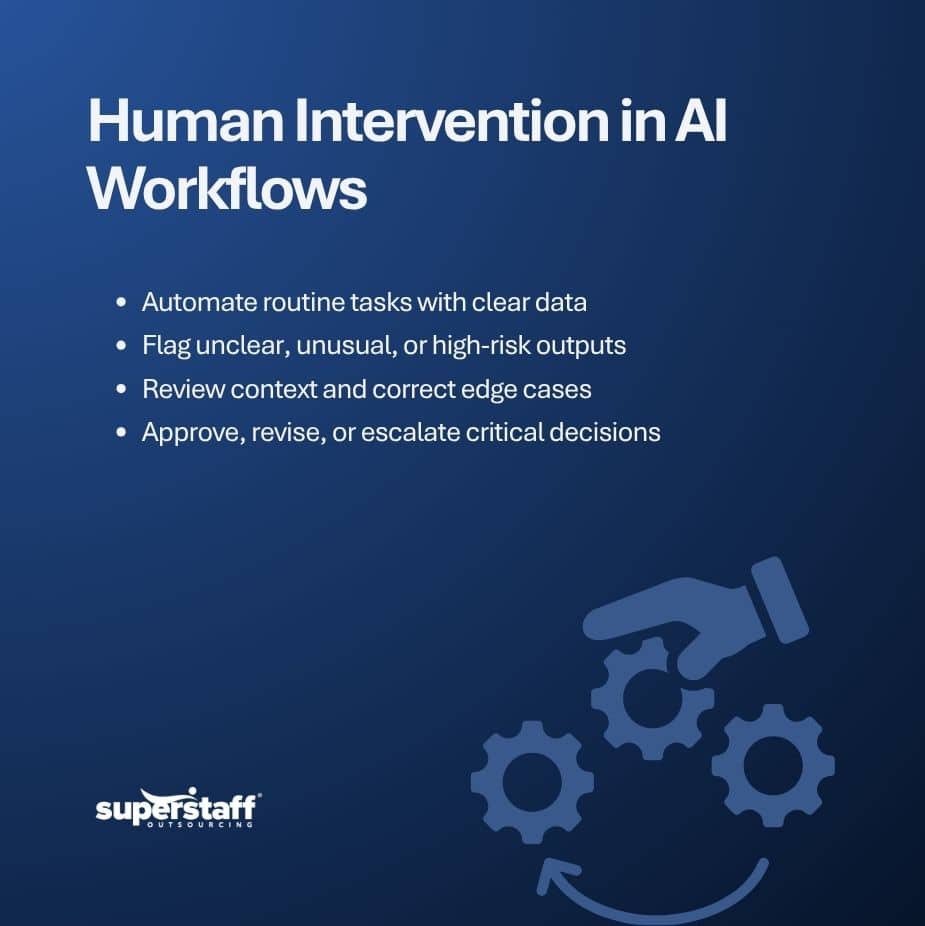
AI can answer a question in seconds, sort thousands of records, and flag unusual activity without stopping. But what happens when an answer does not look right? What if a situation needs context that the system cannot understand?
That is where human-in-the-loop processes help. Instead of asking people to review every AI output, organizations can define clear points where AI human intervention should begin. The goal is not to remove AI from the process. Instead, businesses can use people where their judgment, experience, and accountability matter.
A well-designed human-in-the-loop process gives employees a clear role. AI handles tasks it can manage, while people step in when an output needs review, correction, or a final decision.
Where AI Human Intervention Should Begin
AI does not need a person to check every simple task. However, certain situations require human attention. Companies can identify these situations by looking at risk, complexity, and the possible impact of an incorrect result. The NIST AI Risk Management Framework offers guidance on identifying and managing risks associated with AI systems.
1. When AI Shows Uncertainty
AI systems can produce an answer even when the available information does not support a confident conclusion. Therefore, businesses should create rules that flag uncertain outputs for human review.
For example, an AI system may classify a customer request but show low confidence between two categories. A human reviewer can check the request, select the correct category, and prevent an incorrect action.
2. When the Output Breaks a Rule
Business processes often follow specific policies. AI may process information correctly but still produce an answer that conflicts with company rules.
For instance, an automated system may recommend approving a transaction that exceeds an internal limit. In that case, AI should flag the result instead of completing the action. A person can then review the recommendation against the policy.
3. When a Customer Could Be Affected
Customer-facing decisions require extra attention. A wrong answer can create frustration, cause financial problems, or damage trust.
As a result, businesses can set human review points for complaints, refunds, sensitive requests, account changes, or unusual customer situations. AI can handle routine cases while employees review cases that require more care.
4. When the Situation Falls Outside the Data
AI works from patterns and information available to it. However, unusual cases may not match those patterns.
For example, an AI support tool may understand common billing questions but struggle with a rare account issue. Instead of forcing the system to make a decision, the process can send the case to a trained employee.
5. When the Decision Carries High Risk
Some decisions have greater consequences than others. Therefore, businesses should consider human review when an AI output could affect money, compliance, employment, security, or customer access.
AI can still support these processes by gathering information, identifying patterns, or preparing recommendations. However, a qualified person should review the relevant details before the business takes action.
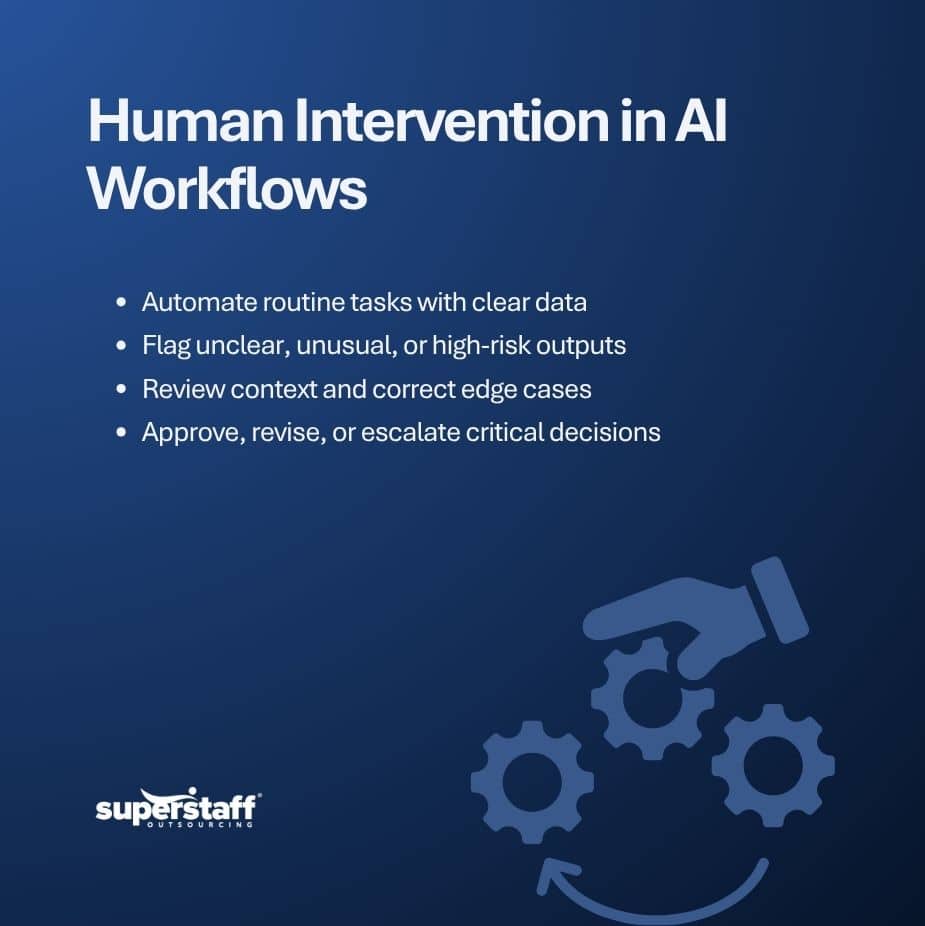
How Human-in-the-Loop Sets Review Points
Once a company identifies when people need to step in, it can build those points into the workflow. The process should tell employees what to review, when to intervene, and what action they can take. These responsibilities are also important in human-in-the-loop outsourcing, where employees support AI-enabled tasks and review outputs that need human attention.
1. Set Clear Escalation Rules
Employees should not have to guess when they need to review an AI output. Instead, companies can create simple rules based on confidence levels, exceptions, policy violations, or specific types of requests.
These rules also make the process easier to manage. When everyone follows the same criteria, teams can respond more consistently.
2. Give Reviewers Enough Context
A human reviewer cannot make a good decision from an AI result alone. They need access to the information behind the recommendation and the business rules that apply to the situation.
Therefore, a useful workflow should show relevant records, customer details, previous actions, and the reason for escalation. This allows the reviewer to make a decision without repeating the entire process.
3. Let People Correct the Output
Human review should involve more than simply accepting or rejecting an AI result. Reviewers should have a clear way to correct errors.
For example, a worker may change an incorrect classification, update a recommendation, or provide the correct response. These corrections can also help the organization identify recurring problems in the AI workflow.
4. Separate Review From Final Approval
Some processes need two levels of control. One person may review the AI output, while another employee approves an action with greater business impact.
This approach adds another checkpoint without requiring people to manually handle every task. As a result, businesses can maintain control while still allowing AI to complete routine work.
5. Track Why People Step In
Companies should record the reasons behind human intervention. Over time, this information can show which tasks AI handles well and which areas create frequent problems.
For example, repeated escalations may indicate unclear business rules, incomplete data, or a process that needs improvement. Managers can use these findings to adjust the workflow.
What Effective Human Oversight Looks Like
Human-in-the-loop works best when employees know exactly what they are responsible for. Meanwhile, AI should handle the parts of the process that match its capabilities. A clear division of work also supports the human-in-the-loop AI outsourcing model, in which people remain involved in tasks that require review and judgment.
1. AI Handles Routine Work
AI can sort information, summarize records, detect patterns, generate drafts, and complete other repeatable tasks. This reduces the amount of manual work employees need to perform. Businesses that need additional support for customer interactions can also explore SuperStaff’s customer service outsourcing services.
However, automation should stop when the process reaches a defined review point. That gives people the opportunity to check the result before the business moves forward.
2. People Apply Business Context
AI may recognize patterns, but employees understand the specific circumstances behind a case. They can consider customer history, company policies, exceptions, and information that may not appear in the original data.
Therefore, human oversight adds context that automated systems may miss. This makes the process more practical for real business situations.
3. People Take Responsibility for Decisions
A business needs clear accountability when an AI-supported decision affects customers, employees, or operations. Human reviewers can provide that accountability by approving, changing, or rejecting the AI recommendation.
AI can support the decision, but the responsible employee should understand what they are approving. This keeps decision-making aligned with company policies.
4. Teams Review Patterns, Not Just Errors
Human oversight should not focus only on individual mistakes. Teams should also examine patterns across many reviewed cases.
For example, if employees frequently correct the same type of AI output, the organization should investigate the cause. It may need better data, clearer instructions, stronger quality checks, or a different workflow.
5. Businesses Adjust the Process Over Time
Human-in-the-loop systems should change as the business learns. Some tasks may eventually require less review, while new risks may create additional review points.
Regular reviews help companies maintain the balance between automation and human oversight. In turn, businesses can use AI where it provides value without removing people from decisions that need human judgment.
Better AI Decisions Start With Human Oversight
AI does not need to replace every human decision. Instead, businesses can decide where automation makes sense and where people should take control. Clear escalation rules, defined responsibilities, and regular reviews make that process easier to manage.
For businesses building AI-supported workflows, AI human intervention can provide an important layer of control. It helps teams identify exceptions, review uncertain outputs, and make decisions that require context.
SuperStaff can help businesses build teams that support AI-enabled operations, from quality review and customer support to back-office processes and specialized services. Contact SuperStaff to discuss how human oversight can fit into your AI-supported workflow.