An AI system can produce hundreds of results before a person notices that something went wrong. A wrong category, incomplete answer, or missed detail may look like a small error at first. However, one mistake can affect a customer, delay an operation, or lead a team to make the wrong decision.
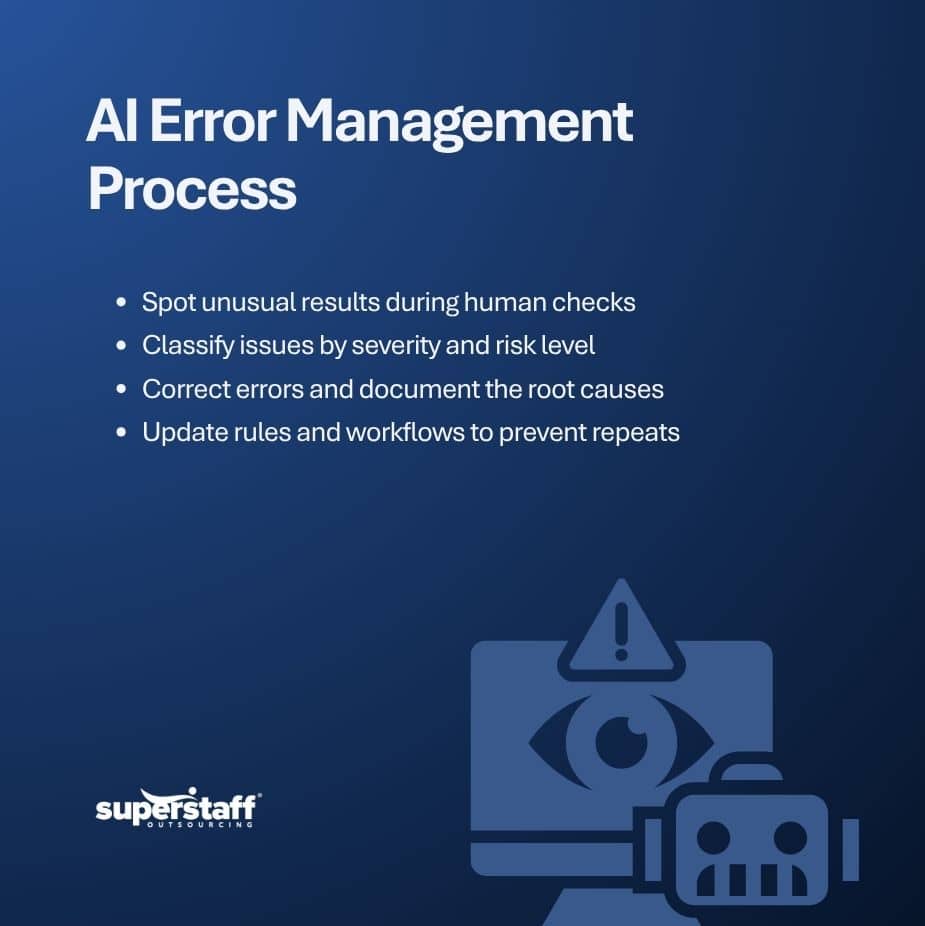
That is why AI error management should involve more than correcting bad outputs after they happen. Human-in-the-loop gives employees a role in finding errors, understanding why they happen, and improving the process that caused them. Instead of treating every mistake as an isolated problem, businesses can use human review to identify patterns and prevent similar issues.
The result is a process where people do not simply fix AI mistakes. They help the organization learn from them.
AI Error Management Starts With Human Review
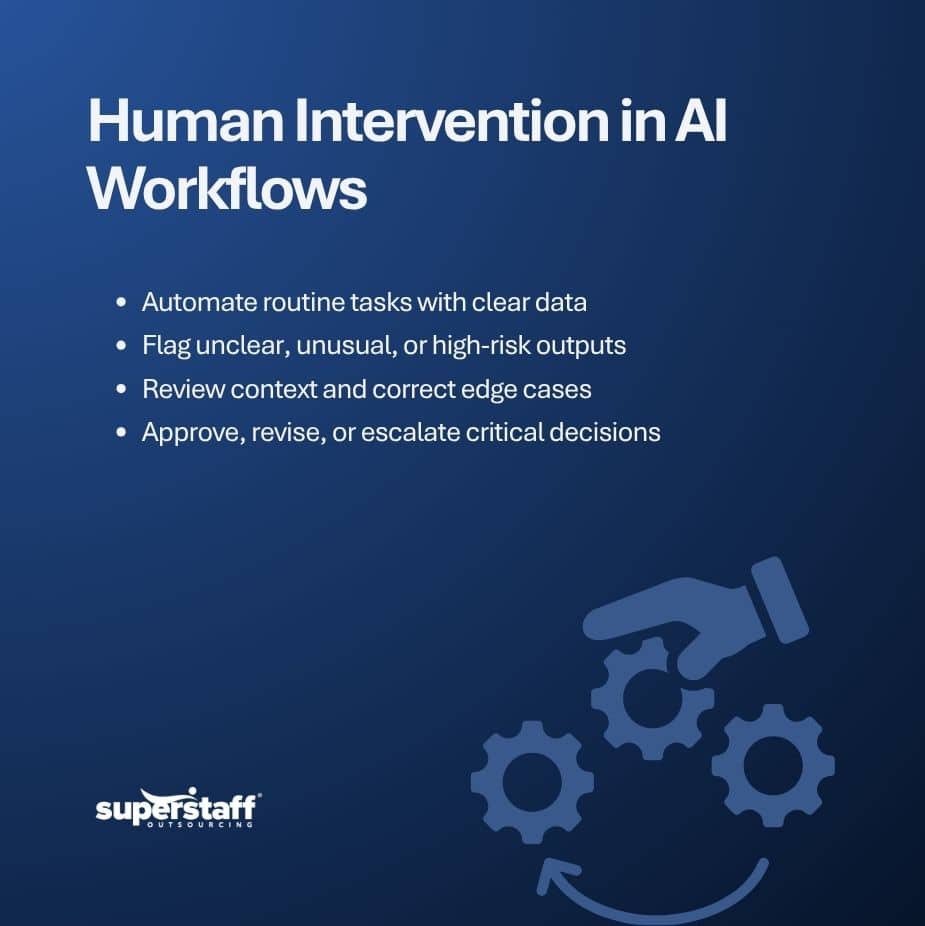
AI can handle repetitive work quickly. However, people still need to review certain outputs, especially when the result affects customers, money, compliance, or business decisions. The NIST AI Risk Management Framework provides guidance on identifying and managing risks associated with AI systems.
Human-in-the-loop creates clear points where employees can check AI work and decide what should happen next.
1. Identify Errors Before They Spread
A small AI error can affect several steps if the workflow continues without review. For example, an incorrect customer classification can lead to the wrong response, incorrect routing, or a delayed resolution.
Therefore, businesses should place review points where an error could create a larger problem. Early checks give employees a chance to correct the output before it reaches the next stage.
2. Separate Simple Errors From Serious Ones
Not every AI mistake needs the same response. A spelling issue may need a quick correction, while an incorrect financial recommendation may require a detailed review.
Businesses can create different levels of human intervention based on the type and possible impact of an error.
For example:
- Low-risk errors can go through a quick review.
- Repeated errors can trigger a process check.
- High-risk errors can require approval from a qualified employee.
- Serious issues can move to a specialized team.
3. Find Out Why the Error Happened
Correcting an output solves one problem. Understanding the reason behind the error can help solve several future problems.
A reviewer can ask whether the AI received incomplete data, misunderstood an instruction, used the wrong rule, or encountered a situation outside its normal range. As a result, teams gain information they can use to improve the workflow.
4. Give Employees Clear Review Rules
Human reviewers need to know what they should look for. Without clear rules, one employee may approve an output while another employee flags the same result.
Companies can define review criteria based on accuracy, policy, confidence, customer impact, and other business requirements. Consequently, human review becomes more consistent.
5. Record the Decisions People Make
A useful review process should capture what employees changed and why. This information can help managers understand where AI performs well and where it continues to create problems.
Over time, these records can reveal repeated errors that deserve attention. Teams can then focus improvement efforts on the areas that create the most work.
Human Oversight Turns Errors Into Data
An error does not have to end with a correction. With the right process, every reviewed case can provide information about the AI system, the workflow, and the people using it. This approach aligns with human-in-the-loop outsourcing, where employees review outputs, handle exceptions, and provide human judgment when automated processes need support.
This makes AI error management a continuous process rather than a one-time response.
1. Track Common Error Types
Teams can group errors into categories such as incorrect information, missing information, wrong classification, poor recommendations, or policy conflicts.
This makes patterns easier to identify. For instance, if employees repeatedly correct the same type of output, the organization can investigate that specific task instead of reviewing the entire system.
2. Review Repeated Corrections
A correction that happens once may not require a major change. However, repeated corrections can indicate a larger issue.
Therefore, managers should look for tasks that consistently require human intervention. The problem may come from the data, instructions, process design, or the AI system itself.
3. Use Human Feedback to Improve Workflows
Employees who review AI outputs often see problems that automated reports do not show. They can explain why a result does not make sense and what information the system missed.
Companies can use this feedback to update instructions, improve data quality, change approval steps, or redesign parts of the workflow.
4. Measure Error Trends Over Time
Businesses should not only count how many errors occur. They should also examine whether the number, type, and impact of errors change over time.
Useful measures can include:
- Error frequency
- Correction rate
- Repeat error rate
- Human review volume
- Escalation rate
- Time needed to resolve an error
These measurements help teams determine whether process changes actually improve results.
5. Know When More Review Is Needed
Some workflows may require additional human oversight when error rates increase. Others may need less review when the system consistently performs well.
As a result, companies can adjust review levels based on actual performance rather than applying the same level of human involvement to every task.
Build a Process That Learns From Errors
Human-in-the-loop works best when businesses connect review, correction, and improvement. The goal should not simply be to catch mistakes. Teams should also use what they learn to make future results more reliable. A structured human-in-the-loop AI outsourcing model can help define how employees review AI outputs and support ongoing process improvements.
1. Create an Escalation Process
Employees should know where to send an issue when they cannot resolve it themselves. A clear escalation process prevents unusual or serious errors from getting lost in routine work.
For example, a reviewer may send a compliance concern to a specialist while routing a simple classification issue back to the operations team.
2. Define Who Owns the Decision
AI can provide a recommendation, but businesses still need people who own the final decision. Clear ownership prevents confusion when an AI-supported process produces an incorrect result.
Each workflow should identify who can approve, reject, correct, or escalate an output. This also makes accountability easier to track.
3. Review the Process, Not Just the AI
Sometimes the AI output is not the only problem. A poorly designed workflow can also cause errors by giving the system incomplete information or asking employees to act without enough context.
Therefore, teams should examine the full process whenever they find repeated issues. They should check the data, instructions, approval steps, employee actions, and final outcome.
4. Protect Human Review From Becoming a Bottleneck
Adding people to every step can slow down operations. Instead, companies should reserve human review for tasks that actually need human judgment.
For routine cases, AI can continue handling the work. Meanwhile, employees can focus on exceptions, unusual cases, and decisions with greater consequences. Businesses that need additional support for customer interactions can explore SuperStaff’s customer service outsourcing services.
5. Improve the System Based on Real Cases
Real-world examples provide useful information about how an AI workflow performs. Teams can review corrected cases and identify changes that could reduce similar errors.
This creates a practical improvement cycle:
- AI completes a task.
- A person reviews selected outputs.
- The team identifies errors and patterns.
- The business adjusts the workflow.
- Teams monitor the results.
- The process improves based on actual cases.
Better Error Handling Starts With People
AI will not produce perfect results every time. However, businesses can control how they respond when errors occur. Human-in-the-loop gives employees a defined role in reviewing outputs, correcting problems, identifying patterns, and improving processes.
That makes AI error management more than a way to repair mistakes. It becomes a method for improving how AI-supported work operates across the business.
SuperStaff can help businesses build teams that support AI-enabled processes through quality checks, customer support, back-office operations, and other specialized services. Contact SuperStaff to discuss how human oversight can strengthen your AI-supported operations.