Hiring has become harder to predict. One quarter, a company may need twenty customer service agents, healthcare support specialists, or back-office staff. The next quarter, hiring slows because budgets shift, demand changes, or leadership wants to reassess priorities. For many SMEs and midmarket companies in the United States, this creates a serious talent planning challenge. A fractional workforce gives businesses a more flexible way to recruit, scale, and support teams without locking themselves into a full in-house recruiting structure they may not always need.
For companies managing call center growth, this is where recruitment process outsourcing, or RPO, becomes especially valuable.
RPO allows businesses to bring in experienced recruitment support when hiring demand increases. Instead of building a large internal talent acquisition team from scratch, companies can work with a specialized partner that already knows how to source, screen, assess, and prepare candidates for customer-facing and support roles.
Why the fractional workforce model fits modern hiring
The traditional hiring model assumes demand will stay steady. That is rarely how growth works.
A business may win a new client, expand service hours, launch a new support channel, or prepare for seasonal volume. Suddenly, the internal HR team must fill multiple roles fast while still handling onboarding, employee relations, compliance, payroll coordination, and daily people operations.
A fractional workforce helps solve that pressure point. It gives companies access to recruiting capacity without requiring them to hire full-time recruiters before they are ready.
This model works well for organizations that need:
- Temporary recruiting support during hiring spikes
• Faster candidate sourcing for high-volume roles
• Help building candidate pipelines before expansion
• Specialized recruitment for customer service or support functions
• A practical alternative to overloading internal HR teams
For U.S. companies exploring offshore call center operations, a fractional workforce can also reduce the risk of entering a new labor market alone.
The RPO advantage for call center hiring
Call center recruitment is different from general hiring. It requires speed, consistency, communication skills assessment, schedule alignment, and role fit.
A candidate may look qualified on paper but may not be ready for live customer conversations, complex support workflows, or shifting coverage needs. This is why RPO matters.
An RPO partner can support the full hiring process, including job calibration, sourcing, screening, interview coordination, skills assessment, offer support, and onboarding preparation. For companies building teams in the Philippines, this structure helps create a smoother path from hiring plan to operational readiness.
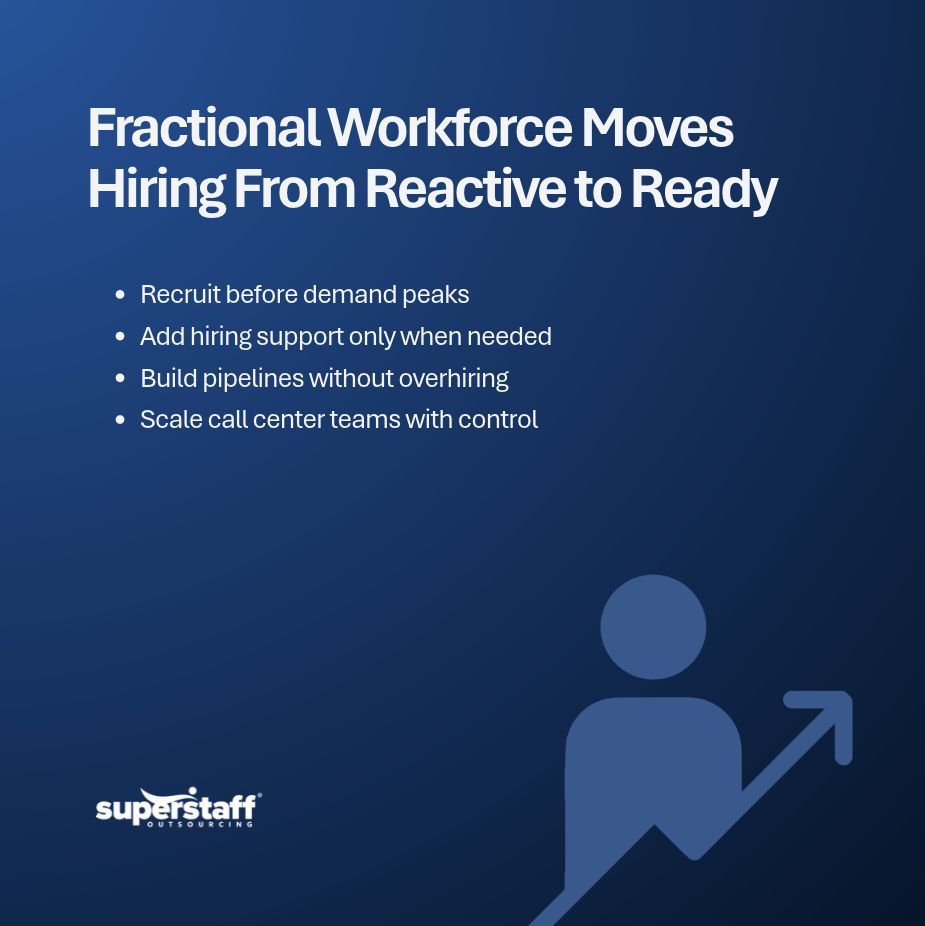
A fractional workforce model strengthens this even further because it lets companies scale recruiting support based on actual demand. If hiring volume increases, recruitment resources can expand. If hiring slows, the support can be adjusted.
That flexibility matters when leaders want growth without unnecessary fixed costs.
When in-house recruiting starts to feel stretched
Many SMEs and midmarket companies start with a lean HR team. That team may do excellent work, but there is a limit to how much one internal group can handle.
Hiring for call center operations adds extra layers. Recruiters must understand shift schedules, English communication requirements, service expectations, client-specific needs, and cultural fit. They also need to move quickly because strong candidates do not stay available for long.
A fractional workforce helps prevent internal teams from becoming reactive.
Instead of waiting until hiring becomes urgent, companies can use RPO to build a steady recruitment engine. This allows internal leaders to focus on strategy, workforce planning, and employee experience while the RPO partner handles the heavy lift of candidate generation and screening.
This approach is especially useful for companies asking whether they should hire recruiters internally or outsource part of the process.
The answer does not always have to be one or the other. A blended model can give companies the best of both.
How fractional workforce planning reduces hiring risk
Hiring mistakes are expensive. Delayed hiring can be just as costly.
When a business cannot fill support roles on time, customer experience may suffer. Internal employees may absorb extra workload. Managers may rush decisions. Service quality may become inconsistent.
A fractional workforce gives companies more control over timing and capacity. It allows leaders to respond to hiring demand without committing to permanent recruitment headcount too early.
This is particularly important when companies are testing offshore support for the first time.
For example, a U.S. company may want to start with a small team of customer service agents in the Philippines before expanding into technical support or back-office operations. With RPO support, the company can recruit for the first wave, evaluate performance, then scale based on business results.
That is a more disciplined way to grow.
Why the Philippines strengthens the RPO value proposition
The Philippines remains one of the most established destinations for outsourced customer support. Its workforce is known for strong English communication, service orientation, and experience supporting U.S. customers.
For companies exploring call center outsourcing, this creates a strong talent base. However, access to talent is only part of the equation. Businesses still need the right recruitment process to identify people who match the role, schedule, client expectations, and company culture.
A fractional workforce model supported by an RPO partner can help U.S. companies recruit more effectively in the Philippine market.
Instead of managing unfamiliar sourcing channels, interview flows, and local hiring expectations alone, companies can rely on a partner with existing recruitment experience. This can make the hiring process faster, more organized, and easier to manage from a U.S. headquarters.
What a strong RPO partner should provide
Not all recruitment support is equal. A strong RPO partner should operate like an extension of the business, not just a resume provider.
Companies should look for a partner that can bring structure, communication, and accountability into the hiring process.
The right RPO partner should help with:
- Clear role intake and hiring requirements
• Candidate sourcing aligned with business needs
• Screening for communication skills and work readiness
• Interview coordination and recruiter feedback
• Market insight on candidate availability
• Hiring process visibility for decision-makers
• Smooth handoff to operations and onboarding teams
A fractional workforce approach only works when the recruitment partner understands both speed and quality. Filling seats quickly matters, but filling them with the right people matters more.
Fractional workforce for recruitment process outsourcing
For many companies, the most practical solution is not a fully internal team or a fully outsourced model. It is a flexible recruitment structure that changes with hiring demand.
This is the value of fractional workforce for recruitment process outsourcing. It gives businesses access to recruitment expertise when they need it, while keeping the structure lean and adaptable.
A growing company may use RPO to support one department at first, such as customer service. Later, the same model can support back-office roles, healthcare support, logistics coordination, or technical support.
This creates continuity. The recruitment partner learns the company’s standards, preferred candidate profiles, communication style, and operational needs over time.
As a result, hiring becomes more consistent and less dependent on last-minute urgency.
How this supports better outsourcing decisions
Many U.S. companies hesitate to outsource because they worry about control. They want flexibility, but they also want visibility.
A fractional workforce model answers that concern because it does not require companies to give up strategic control. Instead, it gives them execution support.
The business still defines the role, approves candidates, sets service expectations, and makes final hiring decisions. The RPO partner supports the process by finding, screening, and preparing qualified candidates.
This structure is especially helpful for executives who want to test outsourcing before expanding. They can start with a smaller support team, measure outcomes, and scale when the model proves itself.
That is a smarter path than overbuilding internally or rushing into a large offshore commitment without a recruitment plan.
Why SuperStaff is built for flexible recruitment growth
SuperStaff helps SMEs and midmarket companies build high-performing support teams in the Philippines. Our experience in customer experience, back-office support, healthcare support, logistics, technical support, and recruitment services allows us to understand what growing companies need from both people and process.
Through RPO support, SuperStaff can help companies source and prepare talent for outsourced roles while keeping hiring aligned with business goals.
We understand that growth does not always happen in a straight line. Some companies need urgent hiring support. Others need a steady candidate pipeline. Some want to test offshore support before committing to a larger team.
A fractional workforce gives them room to move strategically.
Build the right team before demand outpaces capacity
Hiring should help a company grow, not slow it down. When internal teams become overloaded, recruiting can become reactive. When hiring is rushed, quality can suffer. When companies wait too long to build capacity, customer experience may feel the impact.
A fractional workforce gives businesses a practical way to strengthen recruitment without overextending their internal structure.
For U.S. SMEs and midmarket companies exploring call center outsourcing, SuperStaff offers recruitment support, operational experience, and Philippine talent market knowledge to help build teams with more confidence.
Explore SuperStaff’s RPO and outsourcing services to see how we can help you recruit, scale, and support your next customer service team.