Finding the right employees can shape the future of a business. A strong workforce supports growth, improves productivity, and helps companies stay competitive. However, hiring qualified candidates takes time, resources, and expertise. As hiring needs grow, many companies start comparing RPO vs in-house recruitment to determine which approach fits their workforce plans.
Both recruitment process outsourcing (RPO) and internal hiring teams offer advantages. While some businesses prefer complete control over recruitment, others choose external specialists to improve hiring capacity and efficiency. The right choice depends on company goals, budget, internal resources, and hiring demands.
Understanding the Differences Between Recruitment Models
Before deciding which strategy works best, it helps to understand how each model operates and what it offers.
1. What Is In-House Recruitment?
In-house recruitment relies on an internal HR or talent acquisition team to manage hiring activities. These teams handle job postings, candidate sourcing, interviews, hiring coordination, and onboarding.
Because recruiters work directly within the company, they often have close knowledge of the organization’s culture, values, processes, and long-term goals. As a result, they can align recruitment activities closely with internal workforce plans.
2. What Is Recruitment Process Outsourcing?
Recruitment process outsourcing involves partnering with a specialized provider that manages part or all of the hiring process. Depending on the arrangement, the provider may handle sourcing, screening, interview coordination, and onboarding.
Businesses can use recruitment process outsourcing when they need additional hiring capacity without expanding their permanent internal recruitment team.
3. How Hiring Responsibilities Differ
An internal recruitment team manages hiring using company resources, systems, and employees. Meanwhile, an RPO provider can bring dedicated recruiters, established hiring processes, sourcing capabilities, and recruitment technology.
The exact division of responsibilities depends on the RPO arrangement. Some businesses outsource the complete recruitment process, while others use outside recruiters for specific stages or hiring projects.
4. When Companies Choose In-House Recruitment
Many organizations choose in-house recruitment when hiring volumes remain relatively stable throughout the year. Internal teams may also work well for businesses that need close collaboration between hiring managers and recruiters.
Furthermore, companies with established recruitment departments may already have the people, technology, and candidate pipelines needed to manage regular hiring activities.
5. When Companies Choose RPO
Businesses often turn to RPO during periods of rapid growth, expansion, high-volume recruitment, or hard-to-fill hiring.
For example, end-to-end RPO can support several stages of recruitment, from initial sourcing through onboarding. This gives companies another option when their internal teams do not have enough capacity to manage increased hiring demand.
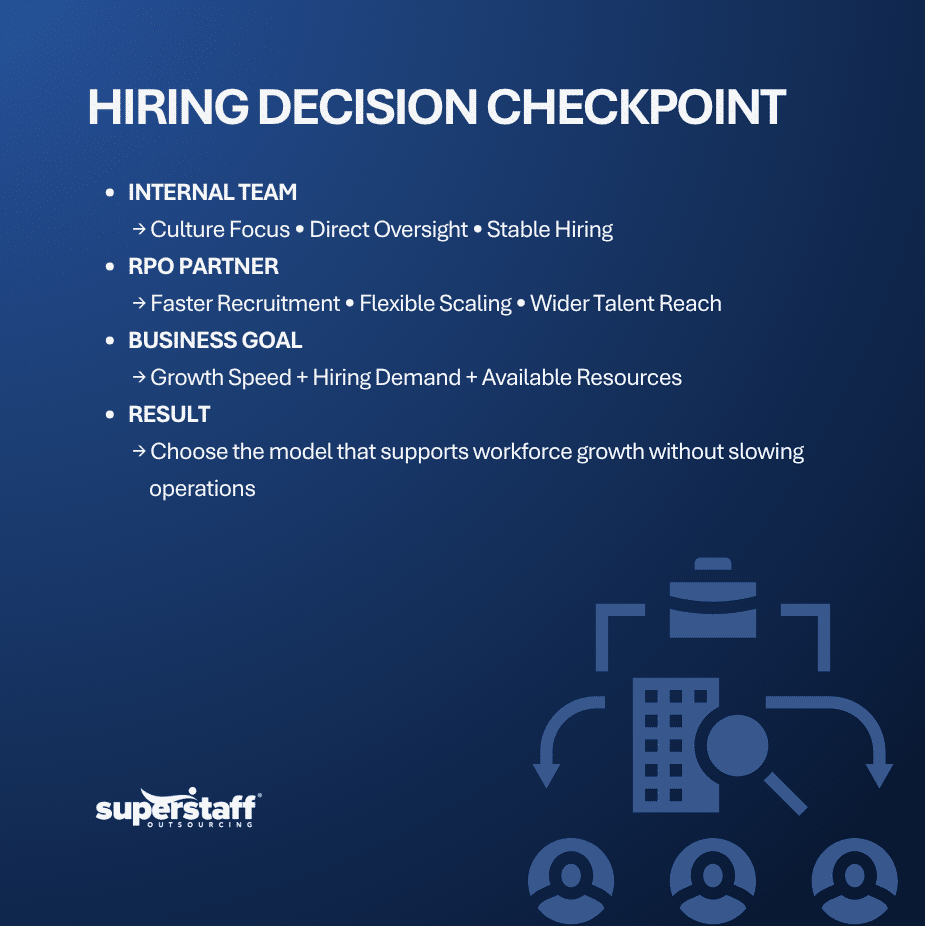
Comparing Performance Across Key Hiring Areas
The discussion around RPO vs in-house recruitment often centers on performance. However, results depend on the provider, internal recruitment capabilities, job market, roles being filled, and hiring volume.
1. Speed of Hiring
Hiring delays can affect productivity and workforce planning. Internal teams may face capacity problems when many positions open at the same time.
RPO providers can add recruitment resources without requiring the company to hire more permanent recruiters. This additional capacity may shorten hiring cycles when internal workload is the main cause of delays.
Recruitment speed remains an important issue across the labor market. According to SHRM recruiting benchmarking, the median time to fill a nonexecutive position was 39 calendar days in its 2026 data. The research also found that more than two-thirds of organizations reported difficulty recruiting for open positions.
2. Access to Talent
Finding qualified candidates remains one of the main challenges in recruitment. Internal recruiters may use company databases, job boards, employee referrals, social networks, and direct sourcing.
RPO providers can add their own sourcing channels and talent networks to this process. Companies hiring for difficult positions may also use RPO for hard-to-hire roles to expand sourcing beyond their existing recruitment channels.
3. Recruitment Technology
Modern hiring often relies on applicant tracking systems, candidate management platforms, sourcing tools, and recruitment analytics.
Large companies may already have these systems internally. Smaller organizations may have fewer tools available or may not want to invest in additional recruitment technology.
An RPO provider may supply technology as part of its service. Businesses should still check how those systems integrate with their existing HR platforms and how candidate data will be managed.
4. Scalability
Hiring needs rarely remain constant. Some organizations experience seasonal spikes, while others suddenly need more employees after expansion, a new contract, or a product launch.
Internal teams have a fixed amount of recruitment capacity unless the business hires more recruiters. RPO can provide additional recruitment resources when demand increases and reduce that support when hiring slows.
This flexibility can be useful for companies with changing or unpredictable hiring volumes.
5. Cost Management
Cost remains an important factor in the RPO vs in-house recruitment discussion. Internal recruitment can involve recruiter salaries, benefits, job advertising, software subscriptions, training, and other operational expenses.
RPO involves provider fees, which vary according to the scope and structure of the service. Therefore, businesses should compare total recruitment costs rather than assuming one model will always cost less.
Metrics such as cost per hire, time to fill, quality of hire, and employee retention can provide a clearer picture of recruitment performance.
Factors That Influence Recruitment Success
The right recruitment model depends on several business-specific considerations.
1. Company Growth Plans
Organizations planning rapid expansion may need recruitment capacity that can increase quickly. RPO can provide additional recruiters and sourcing support without requiring the company to permanently expand its HR department.
However, businesses with predictable hiring patterns may already have enough internal capacity.
2. Industry Competition
Highly competitive industries often require businesses to search actively for specialized talent. Posting vacancies and waiting for applications may not provide enough qualified candidates.
In these cases, businesses may need recruiters with experience in direct sourcing, specialized talent pools, referrals, and professional networks.
3. Internal Resources
Recruitment success depends heavily on available resources. Companies with experienced HR departments may already have effective sourcing, interviewing, and onboarding processes.
Organizations with limited recruitment staff may need outside support for specific tasks. A dedicated recruiter can work as an extension of an internal HR team while providing additional sourcing and screening capacity.
4. Hiring Volume
The number of positions a company needs to fill can significantly affect recruitment strategy.
A company hiring only a few employees each year may be able to manage recruitment internally. Organizations recruiting dozens or hundreds of workers within short periods may need additional resources to maintain consistent screening, communication, and interview coordination.
5. Long-Term Workforce Strategy
Businesses should also consider future workforce goals. Some organizations need continuous recruitment support, while others only experience temporary hiring surges.
Companies should determine whether they need a permanent internal capability, flexible external capacity, or a combination of both.
Choosing the Right Recruitment Strategy
There is no single answer when comparing RPO vs in-house recruitment. The better fit depends on business priorities, workforce demands, internal capabilities, and hiring volume.
Some companies maintain an internal recruitment team because they want direct control and already have enough resources. Others use RPO when they need additional sourcing expertise, technology, or recruitment capacity. A hybrid approach can also work, with internal recruiters managing certain positions while an RPO provider handles high-volume, specialized, or project-based hiring.
Key questions to consider include:
- How quickly do hiring needs change?
- Which recruitment metrics need improvement?
- Does the company regularly recruit specialized talent?
- Does the internal team have enough recruitment capacity?
- What is the total cost of the current hiring process?
- Can current recruitment systems support future growth?
- Which parts of recruitment should remain internal?
Answering these questions can make it easier to select a model based on actual hiring needs rather than choosing RPO or in-house recruitment by default.
Build Stronger Teams With Smarter Hiring Solutions
Choosing between RPO vs in-house recruitment requires careful evaluation of your hiring goals, budget, workforce plans, and existing recruitment resources. Internal teams can provide direct control and close company knowledge, while RPO can add flexible capacity, specialized sourcing expertise, and recruitment support when hiring demands increase.
SuperStaff provides recruitment process outsourcing solutions for companies that need support with sourcing, screening, onboarding, and large-scale recruitment projects. Businesses can choose the level of recruitment support that matches their current hiring requirements and growth plans.
Want to discuss your recruitment needs? Send SuperStaff a message and explore a recruitment solution built around your workforce goals.