Hiring in the U.S. has become more expensive, slower, and harder to predict. For many SMEs and midmarket companies, internal recruiters are stretched, talent pools are limited, and open roles stay vacant longer than expected. This is where talent arbitrage becomes a serious business advantage, especially when paired with recruitment process outsourcing built for speed, quality, and long-term workforce control.
For years, companies viewed outsourcing mostly through a cost lens. That view is too narrow now. The stronger opportunity is using global talent access to improve hiring outcomes without adding unnecessary fixed costs.
SuperStaff helps companies use RPO not as a temporary hiring shortcut, but as a more flexible way to build teams, support growth, and compete for talent across markets.
Why Talent Arbitrage Matters in Recruitment Today
Talent arbitrage is the practice of accessing skilled professionals in markets where quality talent is available at a more efficient cost structure. In recruitment, this does not mean choosing the cheapest labor. It means finding the right capability in the right location with the right operating model.
For U.S. companies, this matters because hiring pressure is no longer limited to one department. Customer support, healthcare support, logistics, finance, back-office, and technical roles all require people who can perform well and ramp quickly.
An RPO partner gives businesses a wider talent reach. Instead of depending only on local applicants, companies can build a recruitment engine that sources, screens, and supports qualified candidates across broader markets.
That is the practical value of talent arbitrage. It helps leaders protect service quality while making hiring more sustainable.
The RPO Advantage Behind Talent Arbitrage
Traditional recruitment often reacts to vacancies. A role opens, the team posts the job, reviews applicants, schedules interviews, and hopes the right candidate appears. This model works when hiring demand is low and talent is easy to find.
Many growing companies no longer operate in that environment.
RPO creates a more structured hiring system. It gives companies access to recruitment specialists, sourcing support, candidate screening, interview coordination, and hiring workflows without building a large internal talent acquisition team.
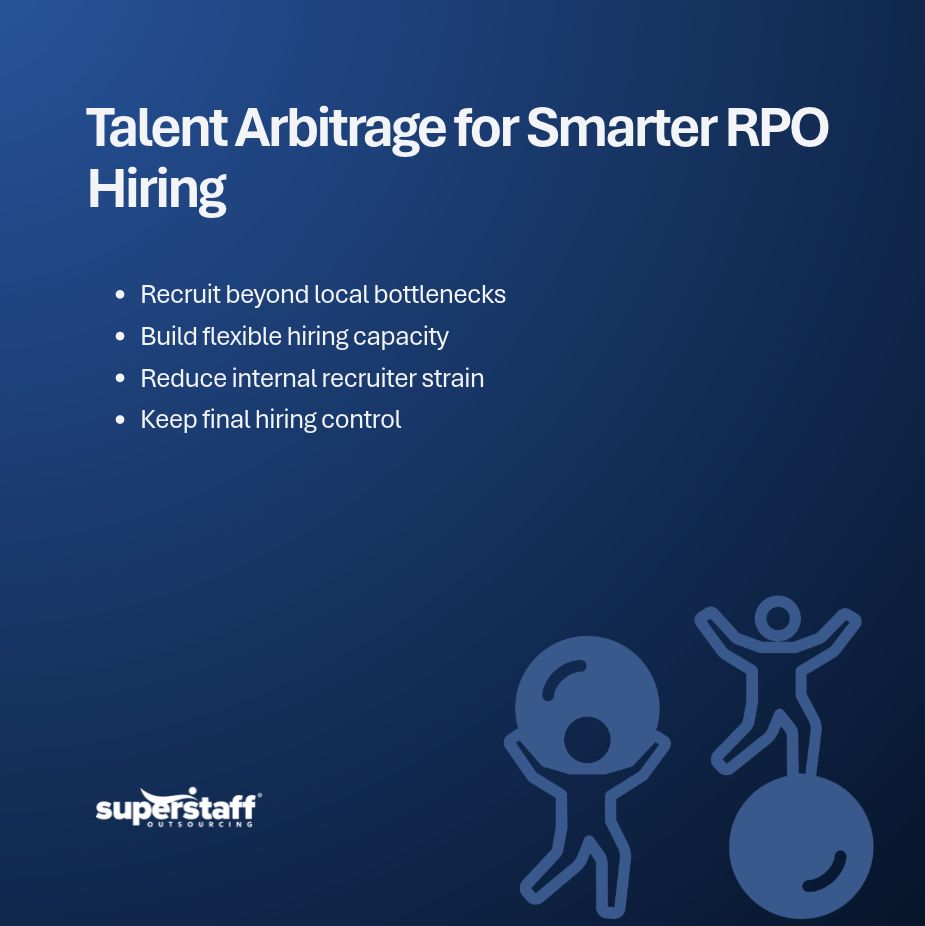
When paired with talent arbitrage, RPO becomes more strategic because it supports three business needs at once.
- Faster access to qualified candidates
• Lower recruitment overhead
• More flexible hiring capacity
This is especially useful for SMEs and midmarket companies that need to grow but cannot afford a slow or unpredictable hiring cycle.
Why U.S. Companies Are Rethinking Local-Only Hiring
Local hiring still matters. Some roles need domestic market knowledge, physical presence, or direct client access. The problem is relying only on local hiring for every role, even when the work can be performed remotely or supported from a proven offshore location.
Many U.S. companies face the same operational pattern. Their internal teams spend too much time filling recurring support roles. Managers lose productivity because they are heavily involved in screening. Candidates drop off before final interviews. Hiring timelines stretch, and existing employees absorb the workload.
Talent arbitrage helps solve this by opening access to skilled professionals in regions like the Philippines, where outsourcing, customer support, healthcare administration, finance support, and back-office work have strong talent foundations.
RPO makes that access easier to manage. The company still controls hiring decisions, standards, and business priorities. The RPO partner provides the process, sourcing capability, and operational support.
What Talent Arbitrage Looks Like in an RPO Model
A practical RPO setup starts with role clarity. The business defines what it needs, including required skills, schedule coverage, compliance needs, communication standards, and performance expectations.
From there, the RPO partner builds a recruitment workflow around the role.
This may include candidate sourcing, initial screening, skills assessment, interview scheduling, documentation, onboarding coordination, and reporting. The company can stay involved in final interviews and final selection while reducing the administrative burden on internal teams.
Talent arbitrage becomes valuable because the company is no longer locked into one labor market. It can compare talent availability, salary expectations, hiring timelines, and operational fit across locations.
For example, a healthcare company may need patient support representatives who can handle appointment scheduling and insurance-related inquiries. A logistics company may need coordinators who can support shipment tracking and customer updates. A technology company may need support agents who can manage tickets and escalate issues properly.
In each case, an RPO partner can help identify where qualified talent is available and how to hire efficiently.
Cost Savings Without Lowering the Bar
Cost efficiency is part of the conversation, but it should never be the whole story. Poor hiring decisions create hidden costs through rework, low productivity, missed service levels, and turnover.
The right talent arbitrage strategy protects quality first. It looks at the full hiring equation, not only the salary difference.
That means asking better questions.
Can the candidate communicate well with U.S. customers? Can they follow industry workflows? Can they work the required schedule? Can they be trained quickly? Can the role be supported securely and consistently?
This is where RPO adds discipline. A strong RPO partner filters candidates against business needs before they reach hiring managers. That saves time and protects decision quality.
For companies under pressure to scale support operations, talent arbitrage provides room to grow without lowering hiring standards.
Why the Philippines Fits RPO Talent Strategies
The Philippines remains one of the most trusted outsourcing destinations for U.S. companies because of its English-speaking workforce, customer service experience, cultural familiarity with Western markets, and deep BPO talent base.
For RPO, this creates a strong advantage. Companies can access candidates who are already familiar with call center operations, customer communication, process-driven work, and performance-based environments.
Talent arbitrage also works well in the Philippines because businesses can build teams for voice support, back-office support, recruitment support, healthcare administration, finance operations, and technical support.
This gives U.S. SMEs and midmarket companies more hiring options. They can fill critical roles faster while keeping internal teams focused on strategy, customer experience, and revenue growth.
SuperStaff brings additional value because it understands both sides of the equation. It works with U.S. companies that need dependable support and Filipino professionals who are trained to deliver consistent service.
RPO Helps Companies Stay Flexible
Hiring needs rarely stay flat. A company may need five support agents this quarter, then 20 more after a new client launch. Another business may need recruiters during a seasonal hiring push but not enough to justify a full-time internal recruitment expansion.
RPO gives companies flexibility without forcing permanent overhead.
Talent arbitrage strengthens that flexibility because the hiring pool is broader. Companies can adjust recruitment activity based on demand, market conditions, and operational priorities.
This matters for companies that are growing but still protecting cash flow. It also matters for leaders who want to avoid overhiring during uncertain periods.
With the right RPO structure, companies can scale recruitment support up or down while keeping the hiring process consistent.
Common Mistakes Companies Should Avoid
A weak global hiring strategy can create problems. The issue is usually not outsourcing itself. The issue is poor planning.
Companies often run into trouble when they treat talent arbitrage as a quick cost-cutting move instead of a structured workforce strategy.
Common mistakes include hiring without clear role definitions, skipping skills validation, failing to align schedules, underestimating onboarding needs, and choosing providers that do not understand the company’s industry.
RPO reduces these risks when the partner brings a clear recruitment process and strong communication standards.
The best results happen when the company and RPO provider align on role expectations, hiring timelines, candidate quality, reporting, and performance feedback from the start.
A Smarter Way to Build Support Teams
For many U.S. businesses, the real question is no longer whether they should outsource recruitment support. The better question is how they can build a hiring model that is faster, more flexible, and more cost-efficient without losing control.
Talent arbitrage gives leaders more room to make better workforce decisions. RPO gives them the structure to execute those decisions well.
Together, they create a hiring model that supports growth while reducing internal strain.
This approach is especially valuable for companies that need customer support teams, healthcare support staff, logistics coordinators, back-office specialists, finance support, or technical support roles. These functions are essential, but they do not always require local hiring.
With the right partner, businesses can access strong talent, improve hiring speed, and keep their teams focused on higher-value work.
Build Your RPO Strategy With SuperStaff
Talent arbitrage is not about cutting corners. It is about using global workforce access intelligently so your business can hire better, scale faster, and operate with more control.
SuperStaff helps SMEs and midmarket companies build recruitment solutions that fit real business needs. Whether you need support hiring call center agents, back-office professionals, healthcare support teams, or other operational roles, our RPO services can help you create a more reliable hiring engine.
Explore SuperStaff’s recruitment process outsourcing services and see how a smarter hiring model can help your business grow with confidence.