For U.S. companies, call center automation solutions are becoming a serious operating priority. Leaders want faster response times, cleaner workflows, better reporting, and lower support costs. At the same time, they do not want to lose the human judgment that keeps customers loyal. This is where talent arbitrage becomes a strategic advantage, especially when paired with an Employer of Record model in Colombia.
Automation can improve how a contact center runs, but it does not replace the need for skilled people. Customers still need agents who can listen, solve problems, explain next steps, and protect the relationship. The companies that get the most value are not the ones that automate everything. They are the ones that use automation to remove friction while building the right team around it.
For many U.S. businesses, Colombia offers a practical path forward. It provides access to nearshore talent, strong English and Spanish support capabilities, time zone alignment, and a growing workforce familiar with customer service, back-office support, technical support, and sales assistance. Through SuperStaff’s EOR staffing model, companies can hire and manage Colombian support talent without setting up a local entity.
Why Automation Alone Is Not Enough
Many companies invest in customer service platforms, chatbots, ticketing systems, CRM tools, workforce management software, and AI-assisted quality monitoring. These tools can reduce repetitive work and help teams respond faster. But tools do not run themselves.
A chatbot may answer simple questions, but an agent still handles exceptions. A CRM may organize customer history, but a trained support specialist still needs to interpret the issue. An AI tool may summarize a call, but a team lead still needs to review performance, coach agents, and improve the process.
This is where talent arbitrage becomes more than a cost strategy. It allows U.S. companies to build capable support teams in markets like Colombia while keeping labor spend under control. Instead of choosing between automation and people, companies can combine both.
The result is a leaner, more responsive operating model. Automation handles routine tasks. Agents handle judgment-based interactions. Managers use data to improve the customer journey.
What Talent Arbitrage Means for Call Center Automation
Talent arbitrage is often misunderstood as hiring lower-cost labor in another country. That view is too narrow. For growing companies, the real value is access to qualified talent that can perform critical work at a more sustainable cost structure.
In a contact center environment, talent arbitrage can support automation in several ways. Companies can hire agents who are comfortable using modern support platforms. They can build teams that understand CRM workflows, ticket routing, escalation procedures, and omnichannel communication. They can also create a stronger operating model without carrying the cost and complexity of a fully in-house U.S. support department.
For example, a U.S. healthcare company may use automation to route patient inquiries, organize appointment requests, and flag urgent cases. But it still needs trained support staff to confirm details, follow procedures, and communicate clearly with patients.
A logistics company may automate shipment updates and ticket categorization. But it still needs agents who can coordinate with customers, vendors, and internal teams when delays happen.
An e-commerce company may use AI to suggest responses. But it still needs support representatives who can manage refunds, returns, product questions, and customer concerns with care.
In each case, talent arbitrage helps the business stretch its support capacity without lowering service standards.
Why Colombia Fits the EOR Model
Colombia is an attractive nearshore destination for U.S. companies because it offers practical operational advantages. Time zone alignment makes real-time collaboration easier. Cultural familiarity helps with customer communication. Bilingual capabilities support both English-speaking and Spanish-speaking customers.
For companies expanding into customer support, technical support, sales support, or back-office operations, Colombia can provide a strong foundation. But hiring directly in another country requires local compliance, employment contracts, payroll administration, benefits management, and labor law knowledge.
That is where an Employer of Record becomes useful.
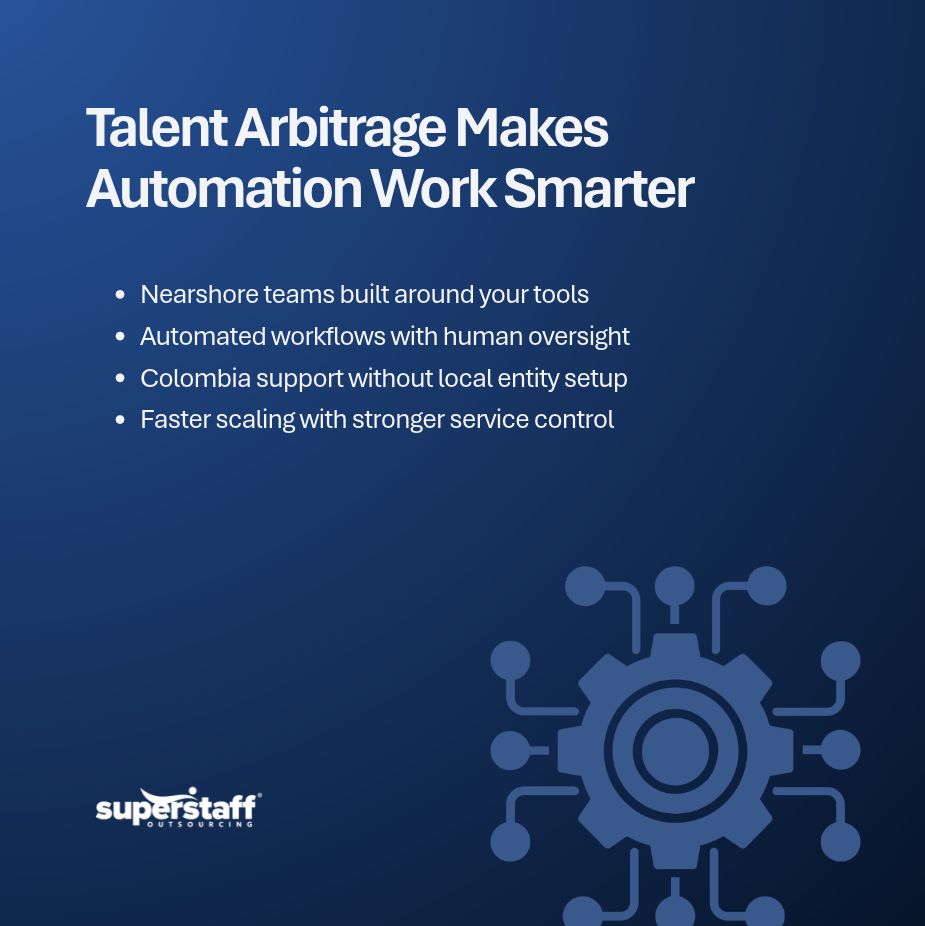
SuperStaff’s EOR model allows companies to hire Colombian talent without creating a local legal entity. SuperStaff handles employment administration, compliance support, payroll coordination, and workforce setup while the client guides the role, performance expectations, and daily priorities.
This gives U.S. companies a faster and more controlled way to enter the Colombian talent market.
How EOR Staffing Supports Call Center Automation Solutions
Call center automation solutions work best when the workforce is structured correctly. A company may have strong technology, but if agents do not know how to use it well, the customer experience still suffers.
An EOR staffing model helps companies build the people layer behind automation. It supports hiring for roles such as:
- Customer service representatives
• Bilingual support agents
• Technical support specialists
• Appointment setters
• Sales development representatives
• Back-office support staff
• Quality analysts
• Team leads and supervisors
These roles can support automated workflows across voice, chat, email, SMS, CRM systems, and ticketing platforms.
Talent arbitrage also gives companies room to build more complete teams. Instead of hiring only a small number of U.S.-based agents, a company can create a blended support structure with nearshore talent in Colombia. This can help extend coverage, improve queue management, and reduce pressure on internal teams.
The goal is not to replace the internal team. The goal is to give them stronger support.
The Strategic Difference Between Outsourcing and EOR
Traditional outsourcing often means handing over a full process to a third-party provider. That can work well for companies that want a fully managed service. But some businesses want more control over the people, workflows, tools, and customer experience.
EOR staffing gives them that control.
With SuperStaff’s EOR solution in Colombia, companies can build dedicated teams that operate as an extension of their business. They can train agents on their brand, tools, scripts, escalation rules, and service standards. They can also align team performance with internal KPIs.
This is especially useful for companies implementing call center automation solutions. Automation requires clear process ownership. The client may want to control the CRM, call flows, chatbot escalation rules, reporting dashboards, and quality standards. EOR staffing makes that possible while reducing the administrative burden of international hiring.
Talent arbitrage becomes more powerful when control and flexibility are preserved.
Where Automation Creates the Most Value
Automation should not be used simply because it is available. It should solve a specific business problem. For contact centers, the best use cases often include tasks that are repetitive, measurable, and easy to standardize.
Common areas include:
- Ticket routing and prioritization
• Call transcription and summaries
• Customer history retrieval
• Quality assurance prompts
• Appointment reminders
• Follow-up emails
• Knowledge base suggestions
• Reporting and performance dashboards
• Workforce scheduling support
These tools help agents work faster and more accurately. They also help managers identify patterns, coach teams, and improve service delivery.
Talent arbitrage supports this model by giving companies access to trained agents who can operate inside automated systems while still handling sensitive or complex interactions. The technology improves speed. The people protect quality.
Why Human Support Still Drives Customer Trust
Customers often accept automation when it gives them faster answers. They become frustrated when automation blocks them from getting help. That distinction matters.
A customer who needs a simple order update may appreciate a self-service tool. A customer dealing with a billing issue, delayed shipment, denied claim, or technical problem may need a trained agent who can take ownership.
This is why companies should avoid viewing automation as a replacement strategy. A better approach is to use automation as a support system for agents.
Talent arbitrage allows businesses to keep human support accessible without carrying unsustainable labor costs. This matters for U.S. SMEs and midmarket firms that need professional service quality but cannot always compete with enterprise hiring budgets.
With the right EOR partner, companies can build support teams in Colombia that are trained, compliant, and aligned with customer experience goals.
What U.S. Leaders Should Consider Before Expanding
Before adopting call center automation solutions and building a nearshore team, leaders should answer a few practical questions.
What parts of the customer journey are slowing down support?
Which tasks are repetitive enough to automate?
Which interactions still require human judgment?
What tools will agents need to use daily?
What language capabilities are required?
What level of client control is needed?
What compliance requirements affect the role?
These questions help companies avoid poor implementation. Automation should improve the workflow, not add another layer of confusion. EOR staffing should support business goals, not simply reduce payroll costs.
A strong partner can help companies define the right roles, structure the team, and match talent to the operating model.
Why SuperStaff’s Colombia Office Matters
SuperStaff’s Colombia office gives U.S. businesses a nearshore option for building customer-facing and back-office teams. It is especially relevant for companies that want time zone alignment, bilingual support, and a more flexible hiring model.
Through EOR staffing, SuperStaff helps companies access Colombian talent while reducing the complexity of local employment. This allows leaders to focus on team performance, customer outcomes, and process improvement.
Talent arbitrage works best when it is supported by strong recruitment, compliance guidance, onboarding, workforce management, and service alignment. SuperStaff brings these pieces together so companies can scale with more confidence and less operational friction.
For businesses adopting automation, this matters. The technology may improve speed, but the staffing model determines whether the operation can sustain quality.
Build a Smarter Support Model With SuperStaff
The next phase of customer support will not be defined by automation alone. It will be shaped by companies that know how to combine technology, skilled talent, and practical operating models. For U.S. companies looking at Colombia, talent arbitrage offers a smarter way to build support capacity while keeping control of the customer experience.
SuperStaff helps SMEs and midmarket companies create dedicated teams through its Colombia EOR services. Whether you need bilingual agents, customer service representatives, technical support specialists, or back-office staff, our team can help you build the right workforce around your automation strategy.
Explore SuperStaff’s EOR solutions in Colombia and discover how the right people can make your call center automation solutions work better for your business.