By Matt Narciso, Managing Director of SuperStaff and CEO of Agentic Trainers
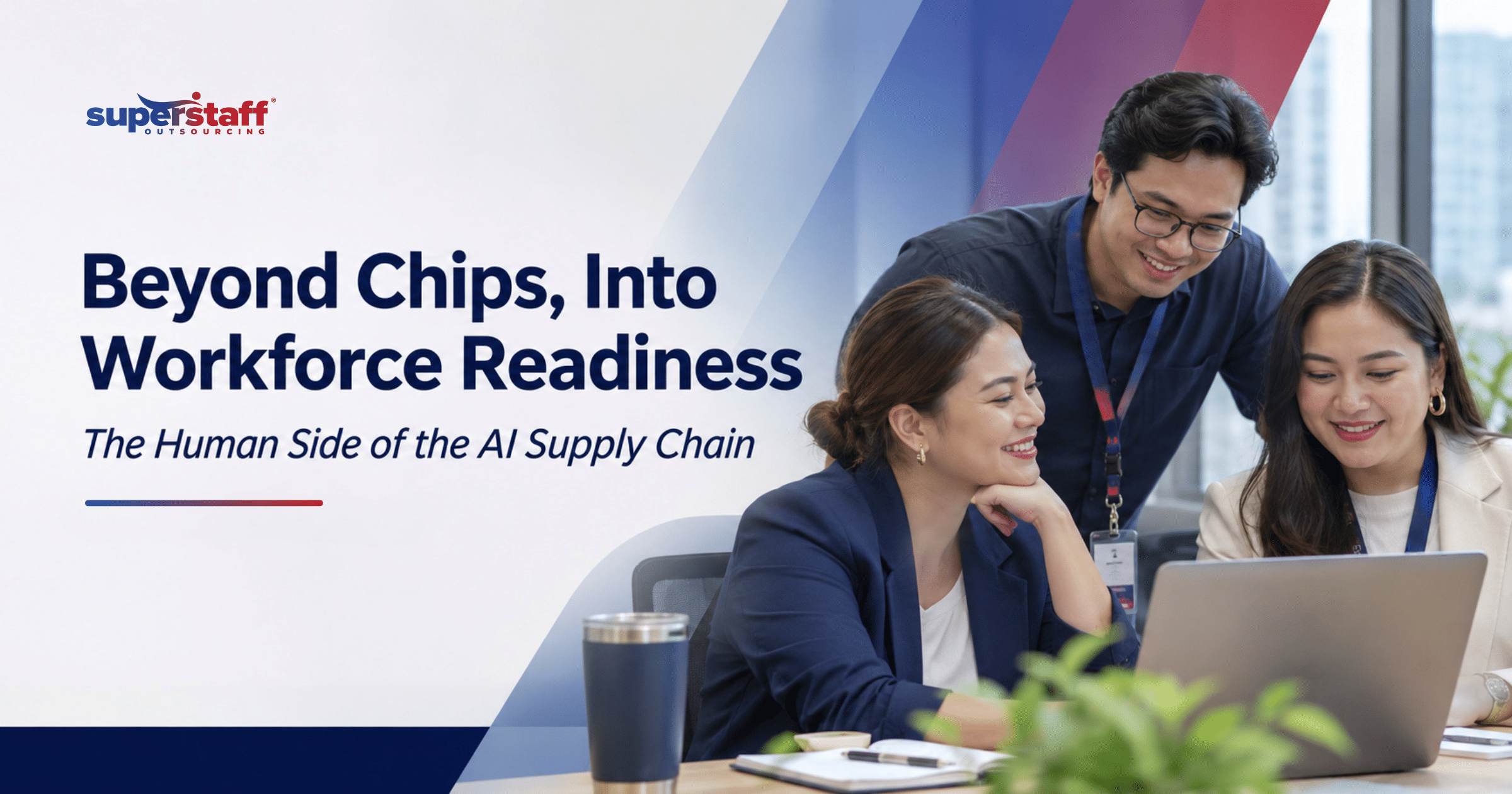
Every few years a headline arrives that makes outsourcing executives sit up a little straighter. This year it is Pax Silica, and the coverage reads like it was written by people who dream in nanometers: wafers, minerals, gigawatts, hectares. All important. But after a long career in Philippine operations, I have learned that every grand industrial plan eventually lands on a desk where somebody has to hire forty people, register a data processor and explain to a CFO why the pilot needs supervisors.
That desk is where SuperStaff lives. So here is the view from it: what Pax Silica actually is today, why it is really an AI workforce story, and what companies that already run (or plan to run) teams in the Philippines should do about it. Spoiler: mostly homework, and the good news is that homework pays off whether or not a ribbon gets cut on schedule.
What Pax Silica Is, in Plain English
Pax Silica is an initiative, led by the United States, that brings partner governments together around the technology supply chain. The U.S. Department of State describes its scope as covering, among other layers, “compute and semiconductors, advanced manufacturing, transportation logistics, minerals refining and processing, and energy” (U.S. Department of State). In other words, it treats AI as a supply chain that starts in the ground and ends in a data pipeline.
It launched in December 2025 with seven countries (Inquirer). When Paraguay signed on October 23, 2026, it became the 26th signatory (U.S. Department of State). The declaration itself is non-binding, and Trade Undersecretary Ceferino Rodolfo has said participating countries can end their commitments if they choose (Inquirer).
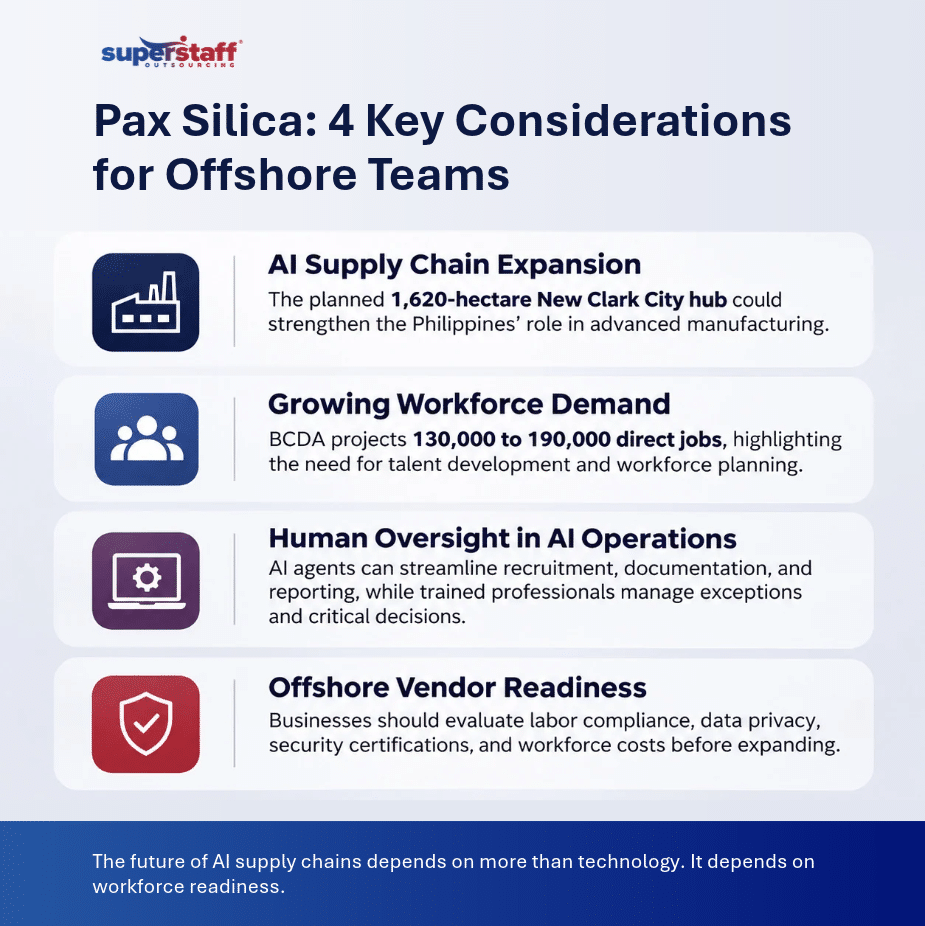
The Philippine piece is concrete in a way most declarations are not. In April 2026, the two governments announced plans for an industrial hub in the Luzon Economic Corridor, which the State Department called “the first of its kind” and framed as the first “AI-Native Industrial Acceleration Hub” under the initiative (U.S. Department of State). The Bases Conversion and Development Authority (BCDA) has designated 1,620 hectares of New Clark City in Tarlac for it (The Philippine Star).
Where It Actually Stands (As of November 9, 2026)
Here is the part the hype cycle tends to skip. The framework agreement is not signed. Asked about a signing this month, BCDA President and CEO Joshua Bingcang answered: “Nothing concrete, nothing is finalized” (GMA News). U.S. Ambassador Lee Lipton, in a statement dated November 7, said, “No such announcement on the Pax Silica Economic Security Zone was ever planned,” in reference to the upcoming ASEAN Summit in Manila (The Philippine Star; The Manila Times).
The construction timeline is measured in years. Bingcang has said the first phase covers roughly 500 hectares, adding, “We see that in three to five years” (Inquirer). BCDA has also pointed to the first quarter of 2028 for initial site development (The Philippine Star).
So if anyone tells you to relocate your back office to Tarlac by the end of the quarter, please send them a calendar.
Why This Is an AI Workforce Story, Not Just a Chip Story
Officials have been clear that the site is not meant to be a farm of hyperscale servers. According to GMA News, the Department of Trade and Industry has said the aim is to add value to Philippine critical minerals and turn out advanced components used in AI, not to build AI data centers (GMA News).
Components for AI still need humans, and lots of them. BCDA estimates the project could create 130,000 to 190,000 direct jobs (The Philippine Star). Treat that as an agency projection, not a promise. Meanwhile the existing industry is already short of people: SEIPI, the semiconductor and electronics industry association, estimates the sector needs 56,605 trained workers in 2026, of which 44,247 are operators, with 6,483 technicians and 5,875 engineers making up the rest (Gulf News, citing SEIPI).
That is not a small foundation to build on. The Philippines already accounts for roughly 10 percent of global semiconductor assembly, test and packaging output (ASEAN Business Advisory Council, citing OECD). Finance Secretary Frederick Go summed up the pitch this way: “I think why they want to locate in the Philippines is always because of our workforce” (BusinessWorld).
Not everyone is cheering without conditions, and that is healthy. As reported by Rappler, World Bank lead economist Gonzalo Varela tied the project’s payoff to more competitive energy, transport and logistics, plus stronger investment in Filipino skills (Rappler). Businessman Manny Pangilinan called the idea “great” while asking whether enough talent, capital and infrastructure exist to pull it off (CMFR). Notice the common thread. Talent shows up on every list.
The Language Advantage Has Fine Print
Here is a detail I love because it is so unglamorous. The Philippines placed 28th out of 123 countries and regions on EF’s 2025 English Proficiency Index (BusinessWorld). EF’s country fact sheet scores Central Luzon at 571 and Angeles at 600. It also scores the “Technicians & Maintenance” job function at 508, well below “Operations” at 610 (EF Education First).
Translation for operators: the people who will run equipment and the people who will document, escalate and report on that equipment may need different training plans. That is exactly the gap a structured support layer fills.
Where AI Agents Fit: Small Teams, Supervised Well
Most companies evaluating a new site do not need a 300-seat center on day one. They need a small, senior team that can coordinate recruiting, track permits, process documents, chase suppliers and produce reports that a board will actually read. In our experience, this is where AI agents earn their keep, provided a trained person reviews the output, handles the exceptions and owns any decision with legal or safety consequences. That is human-in-the-loop operations, and it is how SuperStaff and our agentic AI division, Agentic Trainers, approach AI work. (We wrote more about why that human layer matters in human-in-the-loop customer support.)
You do not have to take my word for the oversight principle. The NIST AI Risk Management Framework, released January 26, 2023, is intended for voluntary use to help organizations build trustworthiness into how they design, develop, use and evaluate AI systems (NIST). It is a sensible yardstick for any vendor that claims to run AI responsibly on your behalf.
The Offshore Vendor Readiness Checklist
If you already outsource to the Philippines, or plan to, here are the questions I would ask any partner, including us, before the Pax Silica hiring wave makes everyone busier.
- Is the arrangement legitimate contracting? DOLE Department Order No. 174 prohibits labor-only contracting and requires contractors to show substantial capital, which Triple i Consulting summarizes as at least PHP 5,000,000 of paid-up capital when the contractor is a corporation (Triple i Consulting). Ask how your provider meets that standard.
- Do your AI workflows trigger privacy registration? According to Emerhub’s guide to the Data Privacy Act rules, registration with the National Privacy Commission is required for systems involving automated decision-making or profiling “in all instances, whatever your headcount or data volume” (Emerhub). If agents are scoring, ranking or screening people, that matters.
- Who reviews the AI, and how is that documented? Ask for the escalation path, the review sample rate and the audit trail. If the answer amounts to “trust the model,” keep asking.
- What certifications back the security claims? SuperStaff lists ISO/IEC 27001:2022 certification and National Privacy Commission DPO registration (Agentic Trainers Security), and Agentic Trainers is independently audited for HIPAA compliance. Whoever you choose, ask for the evidence, not the badge.
- Is the pay plan built on today’s floor? Central Luzon’s non-agriculture daily minimum rose to PHP 600 on April 16, 2026 in every province except Aurora (NWPC). A large new employer in the corridor will compete for the same people, so budget for retention, not just recruiting.
- Do you need an entity yet? For a small pre-launch team, an Employer of Record can bridge the gap while you decide. We compare the options in EOR vs. establishing a local entity.
What to Do While the Ink Is Still Wet
My advice is boring on purpose. Treat Pax Silica as a scenario, not a certainty. Build relationships, compliance and AI oversight that are worth having either way. Benchmark talent in Central Luzon now, while you can still do it calmly. And when someone shows you a projection, ask for the date it was made and who made it.
SuperStaff is in its 18th year of business, and in my experience the companies that do best are the ones that prepare for growth before the headline, not after it.
Get the Full Pax Silica Readiness Brief
We put the detail into a free planning reference: the Pax Silica Readiness Brief, published by SuperStaff and its agentic AI division, Agentic Trainers. It covers project status, Central Luzon labor supply, wage benchmarks, Employer-of-Record mechanics, immigration pathways and the permitting stack, with every figure dated and sourced.
Download the Pax Silica Readiness Brief on AgenticTrainers.com
For background on the project itself, read the Pax Silica explainer on AgenticTrainers.com. To talk about a team in Central Luzon, contact SuperStaff.
This article is general information, not legal, tax or investment advice. SuperStaff and Agentic Trainers are not affiliated with either government or with BCDA, and could gain commercially if the project moves ahead.
Written by Matt Narciso with AI-assisted research and drafting. Every fact and source was reviewed by a human editor.