For many U.S. companies, IT support has become harder to scale than expected. Internal teams are managing help desk tickets, security alerts, onboarding requests, software access, and infrastructure concerns all at once. As the business grows, these demands often increase faster than headcount. This is where shared IT managed services can give SMEs and midmarket companies a more flexible, cost-conscious way to strengthen support without building a large in-house IT department.
Why shared IT managed services matter now
Technology now touches every part of the customer and employee experience. A delayed password reset can slow down a sales team. A system issue can affect customer response times. A missed security update can create operational risk.
For SMEs, the challenge is not whether IT matters. The challenge is how to deliver reliable IT support while keeping labor costs, coverage needs, and service quality under control.
Shared IT managed services help companies access experienced IT support through a structured delivery model. Instead of hiring every role internally, businesses can work with a managed services partner that supports multiple IT functions through trained professionals, clear processes, and defined service levels.
This model is especially useful for companies that need consistency but may not need a full-time specialist for every IT function.
The business case for a shared IT support model
Many growing companies reach a point where one or two internal IT employees can no longer keep up with demand. Tickets pile up. Response times become inconsistent. Strategic IT work gets pushed aside because urgent support issues keep taking priority.
Shared IT managed services address this pressure by giving businesses access to a broader support team without requiring a full internal buildout.
This setup can support:
- End-user help desk requests
• Device and account onboarding
• Software access management
• Basic troubleshooting
• Escalation support
• Remote infrastructure monitoring
• Documentation and reporting
• Coordination with internal IT leaders
The value is not only labor savings. The bigger value comes from structure. A shared model helps standardize how IT issues are logged, prioritized, resolved, and measured.
For U.S. business leaders, that consistency matters. It creates visibility. It also gives internal teams more room to focus on system improvements, vendor decisions, compliance needs, and technology planning.
Why Colombia is a strong delivery location
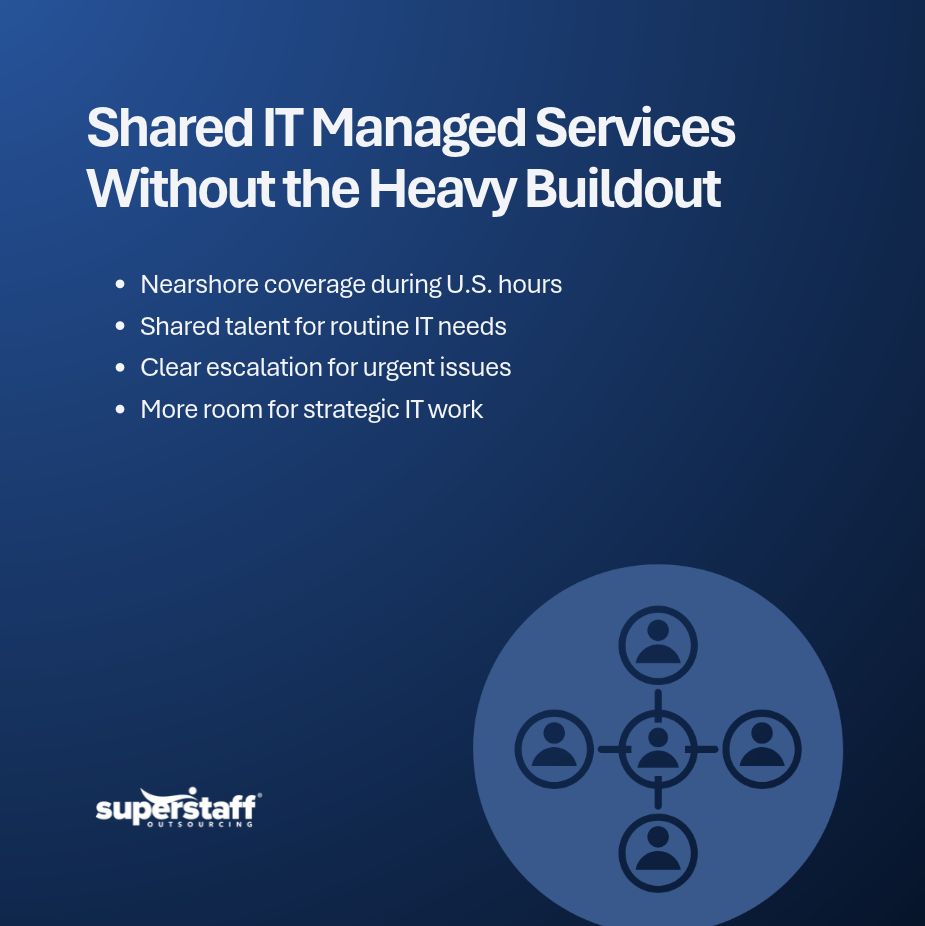
For U.S. companies evaluating shared IT managed services, Colombia offers a practical nearshore advantage. Its time zone alignment makes real-time collaboration easier for U.S. teams. That matters for IT support because many issues require quick coordination during business hours.
Colombia also gives companies access to bilingual talent, strong service culture, and professionals who can support both technical and customer-facing interactions. For IT support, this combination matters. Users want clear explanations, not overly technical responses that create more confusion.
A Colombia-based team can help U.S. companies extend their IT support coverage while keeping communication smooth. This is especially useful for companies that operate across multiple states, have distributed employees, or support hybrid work arrangements.
Shared IT managed services delivered from Colombia can also complement existing U.S. IT teams. The goal is not to replace strategic leadership. The goal is to support repetitive, time-sensitive, and process-driven work so internal teams can focus on higher-value priorities.
When companies should consider this model
A shared model is often the right fit when IT demand is growing but does not yet justify a large dedicated team. It can also work well for companies that want to improve support coverage before making long-term hiring decisions.
Shared IT managed services may be a strong fit if your company is dealing with frequent user support requests, delayed ticket resolution, limited after-hours coverage, or inconsistent documentation.
It can also help when your internal IT leaders spend too much time on routine support instead of security planning, system upgrades, automation, or vendor management.
For example, a fast-growing healthcare services company may need support with account access, device setup, and user troubleshooting across several locations. A legal services firm may need responsive technical assistance for remote staff who rely on secure document systems and communication tools. An e-commerce company may need IT support that keeps internal teams productive during peak order periods.
These scenarios do not always require a large permanent IT department. They require reliable execution, clear escalation paths, and support teams that understand business impact.
What makes shared IT support effective
The success of shared IT managed services depends on more than staffing. It requires strong process design. Companies should look for a partner that can define responsibilities clearly, document workflows, and align support delivery with business priorities.
A strong shared IT model should include:
- Clear ticket intake and routing
• Defined response expectations
• Escalation rules for urgent issues
• Documentation for repeat problems
• Regular performance reporting
• Coordination with internal stakeholders
These basics may sound simple, but they often determine whether outsourced IT support becomes helpful or frustrating.
The best models also separate routine support from strategic decision-making. Your internal leaders should still control systems, policies, risk decisions, and vendor direction. The outsourced team should help execute the operational work that keeps users supported day to day.
Shared IT managed services work best when the provider acts as an extension of your team, not as a disconnected vendor. Communication cadence, reporting discipline, and user experience all matter.
The connection between IT support and customer experience
Many executives think of IT as an internal function. That view is too narrow. When employees cannot access systems, customers feel the delay. When support teams deal with recurring technical issues, service quality suffers. When onboarding is slow, new hires take longer to become productive.
Shared IT managed services can help protect the customer experience by keeping employees equipped and supported. This is especially important for companies that run customer service, sales, billing, logistics, or technical support operations.
A stronger IT support layer can reduce avoidable downtime, improve employee productivity, and help teams respond faster to customer needs. It also gives managers better insight into recurring issues that may point to training gaps, system limitations, or process weaknesses.
For SMEs and midmarket companies, this level of visibility can be valuable. It helps leaders move from reactive troubleshooting to more informed operational planning.
Why shared does not mean lower quality
Some companies worry that a shared model means less attention. That concern is fair, especially if they have experienced poorly managed outsourcing before. The difference comes down to structure, governance, and fit.
Shared IT managed services should not feel generic. A good partner takes time to understand your systems, ticket types, user groups, escalation needs, and internal decision-making process.
The shared part refers to delivery efficiency. It does not mean vague ownership or inconsistent service. With the right setup, companies can receive dependable IT support while still controlling the rules, priorities, and standards that matter to their business.
This is where the right outsourcing partner becomes important. The provider should bring operational discipline, trained support professionals, and a service model that can adjust as demand changes.
How SuperStaff supports U.S. companies from Colombia
SuperStaff helps U.S. SMEs and midmarket companies build reliable outsourced support teams across key business functions. For companies exploring nearshore delivery, our Colombia office offers a strong option for real-time collaboration, bilingual service, and scalable support operations.
Our approach to shared IT managed services focuses on practical business needs. We help companies strengthen daily support capacity, improve service consistency, and free internal teams from repetitive tasks that slow strategic work.
Because SuperStaff operates as a global BPO provider with delivery capabilities in the Philippines, Colombia, and the United States, we understand that outsourcing is not a one-size-fits-all decision. Some companies need offshore scale. Others need nearshore alignment. Many need a blended model that balances cost, coverage, and collaboration.
For IT support, that flexibility matters. Your team may need Colombia-based coverage for U.S. business hours, offshore support for extended operations, or a carefully structured team that grows as demand increases.
Build a support model that can grow with you
IT support should not become a bottleneck every time your company adds employees, locations, systems, or customers. It should help the business move faster with less friction.
Shared IT managed services give U.S. companies a practical way to improve support capacity without overextending internal teams or committing too early to a large department buildout.
With SuperStaff, you can explore a smarter nearshore support model through our Colombia office, backed by the operational experience of a global outsourcing partner. Connect with SuperStaff today to learn how our services can help your business strengthen IT support, improve coverage, and scale with more control.