Outsourcing can help U.S. companies improve capacity, reduce local hiring pressure, and extend customer support coverage. But when teams operate outside the United States, leaders need more than talent and cost savings. They need offshore compliance built into hiring, operations, data handling, employee management, and daily service delivery.
For SMEs and midmarket businesses, this is where nearshore support in Colombia becomes a strategic option. Companies can access skilled talent closer to U.S. business hours while working with a partner that understands workforce structure, local employment requirements, and operational accountability.
SuperStaff Colombia helps businesses build support teams with the right mix of responsiveness, bilingual capability, and management discipline. The goal is simple. Help companies scale without creating avoidable compliance gaps.
Offshore Compliance Starts With the Right Employment Structure
Offshore compliance begins with how the team is hired. A company cannot treat international staffing like a simple contractor arrangement if the work requires full-time schedules, direct supervision, internal tools, and ongoing operational responsibilities.
That is why many U.S. companies look for an outsourcing partner with proper local employment support. The right partner helps manage payroll, HR administration, employee documentation, workplace policies, and local labor expectations.
For Colombia-based teams, this structure matters. It helps companies avoid confusion around worker classification, benefits, attendance, schedules, and employment obligations.
A nearshore support model should give U.S. leaders confidence that employees are managed through a compliant local framework. It also gives team members a clearer, more stable work environment.
Offshore compliance is not only about avoiding problems. It also helps create a stronger foundation for performance.
Why Colombia Makes Compliance More Manageable
Colombia gives U.S. companies a nearshore advantage because teams can work closer to U.S. time zones. This supports faster communication, easier coaching, and more practical oversight.
Offshore compliance becomes easier to maintain when managers can communicate with teams during the same business day. Leaders can review performance, clarify procedures, address concerns, and resolve issues without waiting across long time gaps.
This matters for customer service, sales support, technical support, account coordination, and bilingual support roles. These teams often need real-time guidance, especially when they handle customer concerns or process-sensitive information.
Nearshore alignment does not remove compliance responsibility. It makes daily management more visible and easier to reinforce.
SuperStaff Colombia supports U.S. companies that want operational control without building a local entity or managing every employment requirement alone.
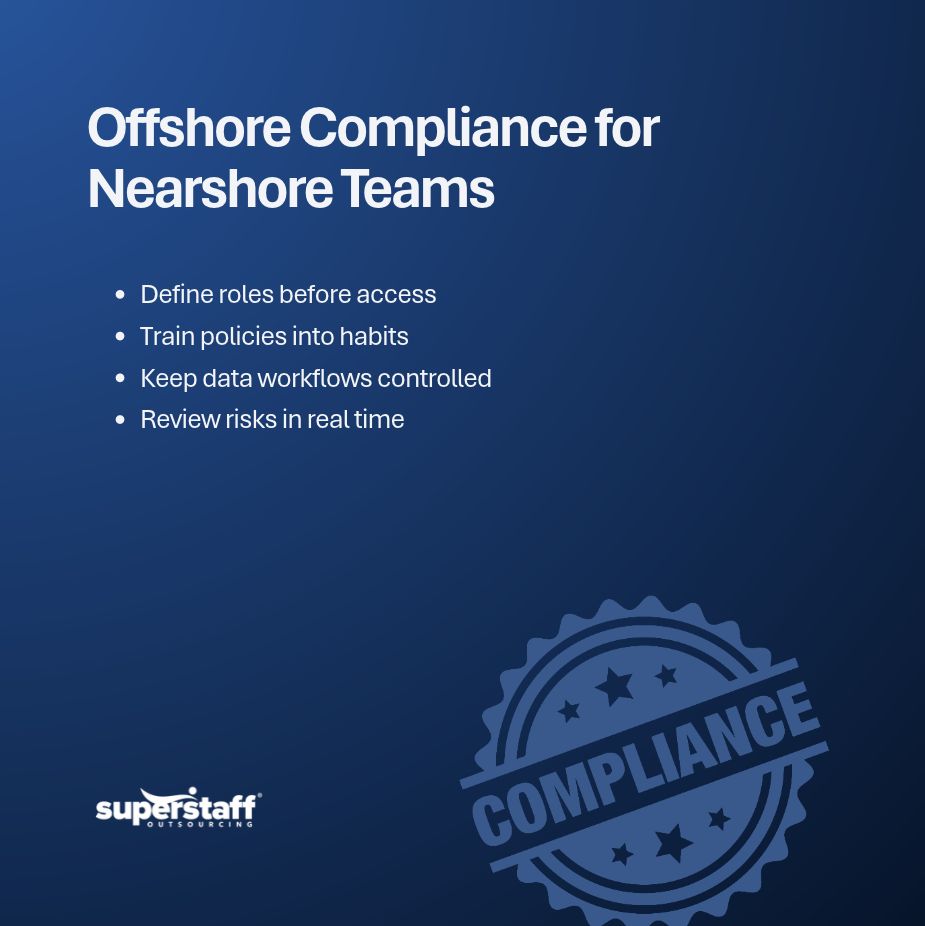
offshore compliance
Data Handling Must Be Designed Into the Workflow
Offshore compliance also depends on how customer and business data moves through the outsourced team. Every company should understand what information agents can access, where it is stored, how it is shared, and who approves exceptions.
For customer support teams, data may include contact details, order histories, account notes, appointment records, billing information, or service tickets. For financial services, healthcare support, logistics, or e-commerce, data handling becomes even more sensitive.
A compliant workflow should define:
- Approved tools and platforms
- Access levels by role
- Password and authentication rules
- Data sharing restrictions
- Escalation procedures
- Documentation standards
- Quality monitoring guidelines
- Incident reporting steps
These details protect both the company and the customer.
Offshore compliance works best when employees are trained on what to do and what not to do before they begin handling live work. Clear boundaries prevent confusion and reduce unnecessary risk.
Compliance Should Support the Customer Experience
Many leaders think of offshore compliance as a legal or administrative requirement. It is also a customer experience issue.
Customers expect accurate answers, secure handling of information, and consistent processes. If support teams do not follow approved procedures, trust can weaken quickly.
For example, a bilingual customer service representative may need to confirm identity before discussing account details. A technical support agent may need to document troubleshooting steps before escalating. A sales support specialist may need to use approved language when sending follow-up materials.
These are compliance habits, but they also shape the customer’s perception of the brand.
Offshore compliance helps make service more predictable. It gives employees a clear process and gives customers a more reliable experience.
For U.S. companies using Colombia-based teams, this is especially valuable when support happens during active customer hours. Real-time service must still follow disciplined standards.
Training Turns Policies Into Daily Behavior
A policy document alone does not create offshore compliance. Employees need training, reminders, coaching, and quality checks that connect policies to daily tasks.
Nearshore teams should understand the client’s service standards, data handling rules, communication guidelines, and escalation paths. They should also know when a question needs supervisor review.
This matters because many compliance problems start with uncertainty. An employee may want to help a customer quickly but may not know whether a certain action is allowed. Strong training gives them the confidence to respond correctly.
Effective compliance training may include:
- Account-specific rules
- Role-based scenarios
- Approved scripts and templates
- System access protocols
- Customer verification steps
- Escalation examples
- Documentation requirements
- Refresher coaching
Offshore compliance becomes part of the operating rhythm when training is practical and role-specific.
Management Visibility Reduces Risk
Nearshore outsourcing should make the work easier to manage, not harder to monitor. Offshore compliance depends on visibility into performance, attendance, quality, access, and customer interactions.
Managers need to know whether the team follows the right processes. They also need a way to identify risks before they become larger issues.
For U.S. companies, Colombia’s closer workday alignment can help. Supervisors and client stakeholders can review updates, join coaching sessions, discuss concerns, and clarify expectations during shared working hours.
This visibility supports faster correction. If a process is unclear, leaders can address it quickly. If a tool access issue appears, it can be escalated sooner. If a customer communication pattern needs adjustment, coaching can happen without long delays.
Offshore compliance improves when accountability is consistent and timely.
Role Design Prevents Compliance Confusion
Some compliance risks happen because roles are too broad. Employees receive responsibilities without clear limits. They may handle customer questions, update records, send messages, and coordinate approvals without knowing where their authority begins and ends.
Strong role design helps prevent this.
For Colombia-based support teams, each role should define what the employee can do independently, what requires approval, and what must be escalated. This is especially important for industries that involve sensitive information, regulated workflows, or customer-facing decisions.
A customer service agent may be allowed to update contact information but not adjust billing terms. A sales support specialist may schedule consultations but not provide financial guidance. A healthcare support representative may confirm appointment details but not discuss clinical advice.
Offshore compliance depends on these boundaries. Clear scope protects the business and helps employees perform with confidence.
Offshore Compliance Works Best With the Right Partner
U.S. companies should not have to figure out every nearshore employment and operational detail alone. The right outsourcing partner can help translate business needs into staffing plans, workflows, training structures, and management systems.
SuperStaff Colombia helps clients build nearshore teams for customer support, bilingual service, sales support, technical support, and back-office operations. The focus is on creating teams that are not only skilled but also properly supported.
This includes recruitment, onboarding, HR support, workforce management, and operational oversight. These functions help companies maintain consistency as the team grows.
Offshore compliance becomes easier when the partner understands both local workforce realities and U.S. client expectations.
For SMEs and midmarket businesses, that combination can reduce the burden on internal leaders while giving them more confidence in the outsourced team.
A Blended Model Can Strengthen Compliance and Capacity
Some companies need both offshore and nearshore support. The Philippines may be ideal for scalable customer service, back-office processing, healthcare administration, finance support, or other process-driven work. Colombia may be the better fit for bilingual support, real-time escalation, U.S. business-hour coverage, and customer-facing coordination.
A blended model allows companies to place work where it performs best.
Offshore compliance should guide that decision. Leaders should consider data sensitivity, customer interaction level, supervision needs, schedule alignment, and escalation requirements before assigning roles to a location.
SuperStaff can help clients design teams across the Philippines and Colombia based on function, coverage needs, cost goals, and operational risk.
This approach gives companies more control. It also helps prevent one-size-fits-all outsourcing decisions that may create friction later.
Build Nearshore Teams With Compliance From Day One
Offshore compliance should never be added after the team is already running. It should shape hiring, onboarding, data access, training, management, and reporting from the start.
For U.S. companies exploring Colombia, this is a chance to build nearshore support with stronger visibility and closer collaboration. The right structure helps teams serve customers faster while following clear standards.
SuperStaff Colombia helps SMEs and midmarket businesses build nearshore teams that support growth, customer experience, and operational discipline. If your company is ready to expand support without creating unnecessary risk, explore SuperStaff services today and see how a well-managed nearshore team can help you scale with more confidence.