U.S. organizations serving diverse communities need support teams that understand people, context, and communication. Multicultural social work practice gives leaders a useful framework for building service models that respect cultural differences while keeping care coordination, intake, outreach, and case support consistent.
For healthcare providers, community organizations, social service agencies, legal support teams, and public-facing programs, the work is becoming more complex. Clients may speak different languages. Families may have different expectations around care. Documentation needs to stay accurate. Follow-ups need to happen on time.
This is where nearshore outsourcing can help. Through SuperStaff’s Colombia office, U.S. companies can build support teams that combine bilingual communication, process discipline, and cultural awareness. The goal is simple. Help internal professionals focus on high-value work while trained support teams manage the operational load behind service delivery.
Why multicultural social work practice matters in service operations
Multicultural social work practice is often discussed in clinical, community, and human services settings. But the principles behind it also matter in daily operations.
Every intake call, appointment reminder, eligibility follow-up, referral update, and document request can affect a person’s experience with an organization. When support teams communicate clearly and respectfully, clients are more likely to understand the next step.
For U.S. organizations, this is especially important when serving multilingual or multicultural communities. A process may be technically correct but still feel confusing to the person receiving support.
Operational teams must know how to listen, clarify, and escalate concerns appropriately. They also need structure so sensitive situations are handled with care and consistency.
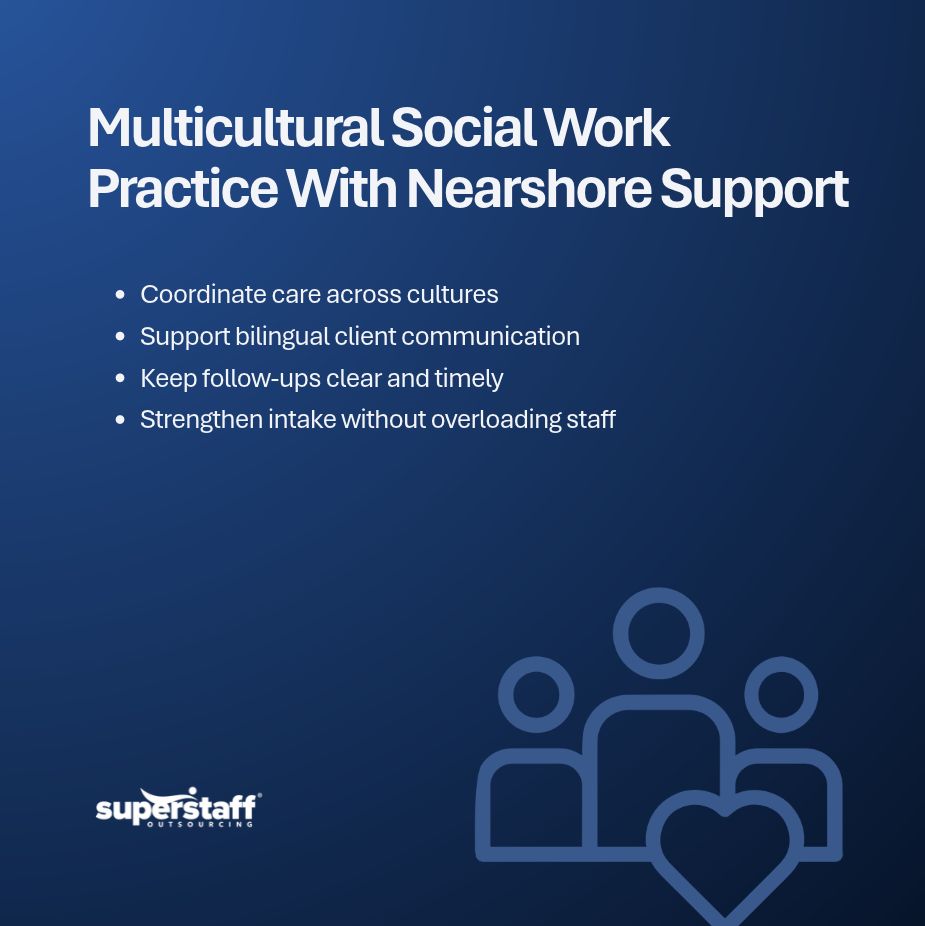
Nearshore teams in Colombia can support this work by helping organizations manage communication-heavy tasks across similar business hours.
Colombia offers a practical nearshore advantage
Colombia is a strong location for U.S. companies that need support teams with closer time zone alignment and strong communication skills. That matters when work involves frequent coordination with internal staff, clients, families, or community partners.
A Colombia-based team can support functions such as:
- Client intake coordination
- Appointment setting and reminders
- Bilingual customer support
- Case documentation assistance
- Referral tracking
- Benefits or eligibility follow-ups
- Patient and member services support
- Administrative support for care teams
These tasks may not require a licensed professional, but they still require training, judgment, and professionalism. Multicultural social work practice reminds leaders that service delivery depends on how people are treated throughout the process.
SuperStaff helps companies build nearshore support teams that can follow client-approved workflows while maintaining a respectful and organized communication style.
The operational side of culturally aware support
Strong support is not based on good intentions alone. It requires systems, role clarity, documentation standards, escalation rules, and quality monitoring.
Multicultural social work practice becomes more effective when frontline and back-office teams know exactly what they are responsible for. A support agent should not make decisions outside their role. However, that same agent can help gather information, confirm details, track pending requirements, and route issues to the right professional.
This structure helps organizations protect service quality while reducing administrative pressure on internal teams.
For example, a healthcare provider may need help following up with patients who missed appointments. A community organization may need assistance confirming documents for a benefits program. A legal support team may need bilingual intake coordination for potential clients.
In each case, the support team does not replace the licensed or internal professional. It helps make the process more responsive, organized, and accessible.
Why U.S. teams need support beyond hiring
Many organizations try to solve service challenges by hiring more internal staff. That can work, but it is not always the most efficient or sustainable answer.
Internal professionals often carry a mix of high-value work and repetitive administrative tasks. They may spend time chasing paperwork, making reminder calls, updating records, or answering basic process questions. Those tasks matter, but they can pull attention away from direct service, decision-making, or relationship-building.
A nearshore outsourcing model can help separate specialized work from support work. This allows organizations to use internal talent more effectively.
Multicultural social work practice supports this idea because it encourages leaders to think about the full service experience. The person receiving help should not feel lost between departments, delayed by paperwork, or confused about what happens next.
A trained nearshore team can help keep communication moving.
How SuperStaff supports multicultural service environments
SuperStaff’s Colombia office gives U.S. companies access to nearshore talent that can support customer care, administrative functions, and bilingual communication. For organizations applying multicultural social work practice, this can create a stronger operational foundation.
SuperStaff can help support roles connected to:
- Intake and screening assistance
- Appointment coordination
- Follow-up calls and messages
- Data entry and record updates
- Customer and member support
- Community outreach assistance
- Back-office documentation
- Recruitment support for service teams
The value is not only labor access. The value comes from building a team around the right process.
SuperStaff works with clients to understand role requirements, communication expectations, reporting needs, and escalation paths. This helps support teams stay aligned with the client’s standards while giving internal staff more room to focus on complex cases and high-priority service needs.
Cultural awareness must be built into workflows
Cultural awareness should not depend on one employee’s personality or background. It should be built into how teams are trained and managed.
For service organizations, that means giving support teams clear guidance on tone, privacy, documentation, and escalation. It also means making sure agents understand the limits of their role.
A team supporting multicultural social work practice should know when to clarify information, when to pause and escalate, and when to avoid making assumptions. This is especially important in conversations involving sensitive family concerns, financial stress, health information, legal questions, or urgent service needs.
A well-designed outsourcing model can help standardize these behaviors. Scripts, knowledge bases, quality reviews, and client feedback loops create consistency without removing empathy from the interaction.
That balance matters. People want accurate answers, but they also want to feel respected.
Recruitment matters in culturally complex roles
The right support model begins with the right hiring process. For multicultural service environments, recruitment should evaluate more than basic communication skills.
Candidates should be assessed for:
- Listening ability
- Professional judgment
- Comfort with structured workflows
- Documentation accuracy
- Bilingual communication when needed
- Patience in service conversations
- Ability to follow escalation rules
- Respect for privacy and client-approved procedures
SuperStaff can support this through recruitment process outsourcing and nearshore staffing solutions. This is especially useful for organizations that need multicultural social work practice support through nearshore outsourcing in Colombia.
Recruitment must connect directly to the service model. A candidate who performs well in general customer service may still need specific training for community support, healthcare coordination, or social service administration.
The stronger the hiring criteria, the stronger the service outcome.
Where nearshore support can create business value
For U.S. decision-makers, outsourcing support functions is not only about reducing workload. It is about improving operational consistency.
A nearshore support team can help organizations respond faster, track follow-ups more reliably, and reduce gaps in client communication. It can also give internal teams more capacity during busy periods or program expansion.
Multicultural social work practice becomes easier to sustain when the operational foundation is stable. Staff members are less likely to miss details when workflows are clear. Clients are less likely to feel ignored when follow-ups happen on schedule. Managers gain better visibility when support activity is tracked properly.
This creates value across the organization. Service teams can focus on complex needs. Administrative work becomes more predictable. Clients experience a more organized process.
For SMEs and midmarket organizations, this can make growth more manageable.
Choosing the right outsourcing partner
Organizations working with diverse communities should choose an outsourcing partner carefully. The partner must understand that support work can affect trust, compliance, and service quality.
A strong partner should provide:
- Clear hiring and screening processes
- Strong training alignment
- Defined communication standards
- Documentation discipline
- Quality monitoring
- Time zone compatibility
- Scalable support
- Transparent collaboration with client teams
Multicultural social work practice requires this level of structure because small communication gaps can create larger service problems.
SuperStaff’s Colombia office offers U.S. companies a nearshore option for building support teams that work closely with internal departments. This makes coordination easier and helps ensure that outsourced roles remain connected to the organization’s service goals.
Build culturally aware support with SuperStaff Colombia
Organizations serving diverse communities need more than additional headcount. They need support teams that can communicate clearly, follow process, protect client experience, and give internal professionals more capacity to do meaningful work.
Multicultural social work practice provides the standard. Nearshore outsourcing provides the operational support to help organizations apply that standard more consistently.
SuperStaff helps U.S. companies build Colombia-based support teams for customer service, intake coordination, back-office work, and recruitment support. If your organization is ready to strengthen service delivery while reducing administrative strain, explore SuperStaff’s services today and see how our Colombia office can help you build a more responsive support operation.