
Data volumes rarely grow at a predictable pace. They expand in bursts driven by new systems, customer touchpoints, compliance demands, and reporting expectations.
For many SMEs and midmarket companies, this growth creates a leadership challenge. Decision-makers want better visibility and faster insights. Internal teams, however, are already operating at capacity.
This tension is where data management outsourcing becomes relevant. When designed correctly, it allows organizations to absorb rising data volumes without compromising control, accuracy, or governance.
The real issue is not whether to outsource. It is how to scale data operations without introducing operational risk.
Why Data Growth Becomes an Operational Risk
Data problems do not begin with analytics. They begin upstream with collection, validation, and maintenance.
As volumes increase, internal teams often compensate by stretching roles. Analysts clean data. Operations teams reconcile records. Managers approve exceptions manually. Over time, this blurs accountability.
The result is predictable: Turnaround times slow. Errors increase. Reporting confidence erodes.
Leadership then faces an uncomfortable reality. The business is data-rich but insight-poor.
Enterprise data management services address this risk by restoring role clarity. Execution-heavy tasks move to dedicated teams. Internal leaders regain time to focus on oversight and decision-making.
What Data Management Outsourcing Actually Includes
Many executives underestimate the scope of data work. It extends far beyond basic data entry.
A mature data management outsourcing model supports structured ingestion, validation, normalization, enrichment, and ongoing maintenance. It also ensures data is prepared for reporting, audits, and system integrations.
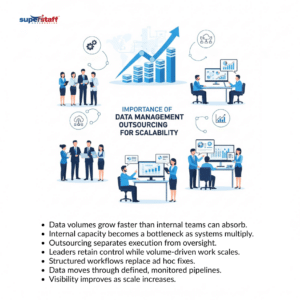
This approach separates ownership from execution. Strategy, rules, and priorities stay with the client. Volume-driven tasks are handled by trained specialists. This distinction is what preserves control at scale.
Scaling Without Losing Visibility
Loss of visibility is one of the most common concerns tied to outsourcing. It is also one of the most avoidable.
Visibility breaks down when workflows are informal. It disappears when quality standards are assumed instead of documented.
Effective data management outsourcing replaces assumptions with structure. Every process is mapped. Every handoff is defined. Performance metrics are visible.
Data flows through monitored pipelines rather than inboxes and spreadsheets. Exceptions are flagged early. Escalations follow clear paths.
This level of transparency ensures leaders remain informed even as workloads grow.
Why the Philippines Is Built for Data Operations
The Philippines has long supported global back-office and data-driven functions. This experience matters when consistency and accuracy are required every day.
Professionals are trained for structured work environments. English fluency supports precise documentation and system alignment. Cultural emphasis on accountability supports process adherence.
Data management outsourcing delivered from the Philippines benefits from this operational maturity. Teams are accustomed to validation rules, reconciliation protocols, and quality benchmarks.
This foundation allows organizations to scale data volumes without creating operational friction.
Maintaining Governance as Data Volumes Expand
Governance often fails quietly. Policies exist, but execution struggles to keep pace with growth.
As datasets expand, manual checks fall behind. Exceptions accumulate, and compliance risks increase.
A disciplined data management outsourcing model embeds governance into execution. Validation steps are standardized, documentation requirements are enforced consistently, and quality checks occur before data reaches reporting layers.
Internal leaders define the rules. Outsourced teams apply them with consistency. This alignment ensures governance remains proactive instead of reactive.
Protecting Analysts From Low-Value Work
Analysts are among the most valuable roles in a data-driven organization. They are also among the most misused.
When analysts spend time correcting records or reconciling discrepancies, insight generation slows. Morale declines. Strategic value diminishes.
Data management outsourcing allows analysts to focus on interpretation and recommendations. Clean inputs arrive ready for analysis. Reporting cycles shorten.
This separation improves both efficiency and output quality. It also supports retention by allowing specialists to operate at their intended level.
Supporting Multi-System Environments
Most organizations rely on multiple platforms. CRMs, ERPs, billing systems, and marketing tools rarely share identical structures.
As data volumes grow, misalignment between systems becomes harder to manage. Duplicate records multiply. Naming conventions drift. Reporting discrepancies emerge.
Data management outsourcing supports consistency across platforms. Records are reconciled systematically. Standards are enforced across systems. Changes are documented.
This coordination becomes more valuable as scale increases. It prevents fragmentation that undermines confidence in reporting.
Managing Risk Through Process Discipline
Risk exposure grows alongside data volumes. More records create more access points and more opportunities for error.
A mature data management outsourcing partner operates within defined security frameworks. Access is role-based. Audit trails are maintained. Handling procedures follow client requirements.
This does not reduce the client’s responsibility. It strengthens execution discipline. For U.S. companies navigating regulatory expectations, this level of control is essential.
Scaling Capacity Without Long-Term Cost Pressure
Data workloads fluctuate. Growth initiatives, acquisitions, and seasonal demand create uneven volumes.
Internal teams struggle to flex without hiring ahead of need. Fixed costs rise. Utilization becomes inconsistent.
Data management outsourcing introduces elasticity. Capacity scales based on demand. Resources adjust without disrupting core teams.
This flexibility supports growth while preserving financial discipline. It allows leaders to plan proactively rather than react to backlogs.
Designing for Control From the Start
Control is not achieved by doing everything internally. It is achieved through clarity: Clear roles, workflows, and accountability.
When data management outsourcing is treated as an operating model rather than a stopgap, it enhances oversight. Leaders retain ownership of decisions. Execution scales without distortion.
For SMEs and midmarket companies, this approach often determines whether data becomes an asset or a liability.
Aligning Data Operations With Business Strategy
Data quality management services should serve business goals, not overwhelm them. As volumes increase, alignment becomes more important.
A well-structured data management outsourcing model supports strategic priorities. Data pipelines reflect reporting needs. Validation rules support decision-making. Outputs align with executive expectations.
This alignment ensures data growth translates into business value rather than operational drag.
Turn to SuperStaff for Data Management Outsourcing Solutions
Scaling data volumes does not require sacrificing control. With the right operating model, data management outsourcing enables organizations to expand data capacity while preserving governance, visibility, and execution discipline.
SuperStaff helps U.S. companies build data operations that scale responsibly. Our teams in the Philippines support data-intensive workflows with consistency, accuracy, and process rigor.
If your data volumes are growing faster than your internal capacity, it may be time to rethink how the work gets done. Outsourcing data processing without losing data control is possible with our BPO team. Explore how we can support your data management goals with confidence.