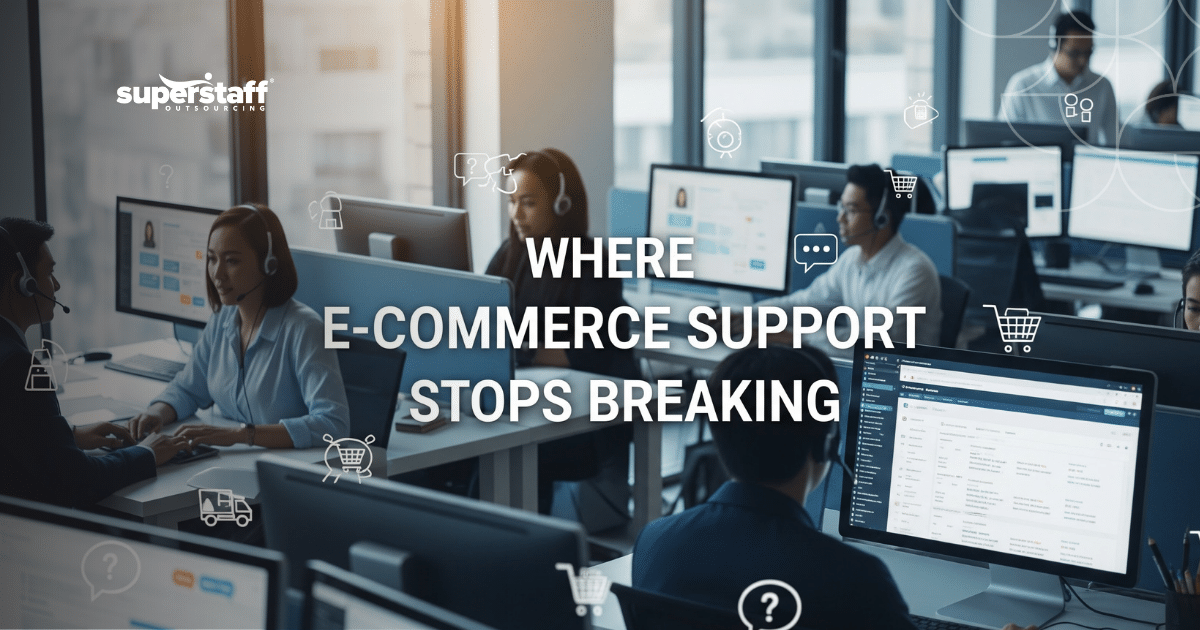
E-commerce growth creates pressure that most internal customer service teams cannot absorb indefinitely. Order volume increases. Support channels multiply. Customer expectations tighten.
At a certain scale, ecommerce customer service BPO becomes a strategic requirement rather than an optional cost lever. Brands that shift customer service operations to the Philippines do so for operational control, not shortcuts.
E-commerce leaders recognize that service performance is tied directly to revenue stability. Missed responses, slow resolution, and inconsistent tone affect retention. These risks push decision-makers to evaluate contact center outsourcing Philippines options that deliver consistency under pressure.
E-Commerce Growth Exposes Customer Service Limits
Rapid growth magnifies service gaps. Support teams struggle to keep pace with tickets, chat queues, and social messages. Hiring locally becomes slower and more expensive. Training cycles stretch while service quality fluctuates.
This reality drives interest in ecommerce customer service BPO models that scale without disrupting daily operations. Leaders want continuity, not constant rebuilding.
Customer Service Performance Drives Revenue Outcomes
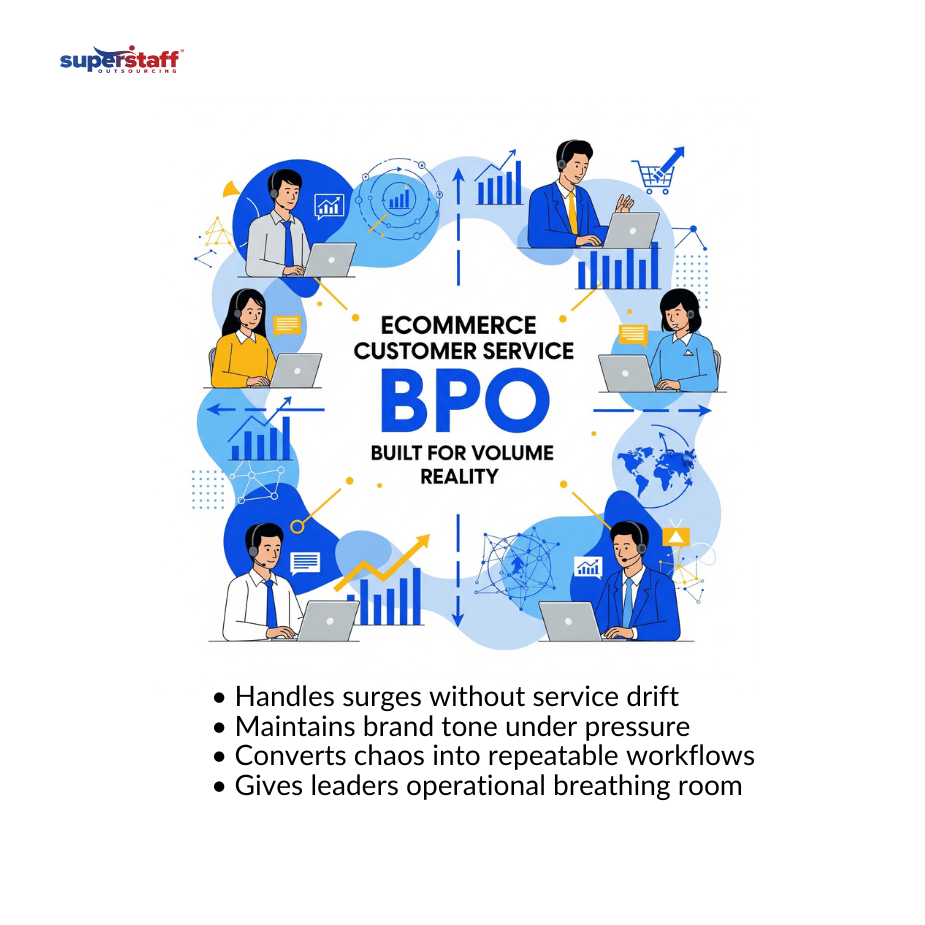
Customer service is not a background function in e-commerce. It influences repeat purchases, reviews, and brand perception. Delays and errors show up immediately in customer behavior.
Retail brands increasingly view ecommerce customer service BPO as a revenue protection mechanism. The goal is consistent resolution quality across every interaction, regardless of volume spikes.
Cost Predictability Matters More Than Cost Reduction
Labor costs matter, but predictability matters more. In-house teams face overtime spikes, turnover risk, and unpredictable hiring timelines. These variables complicate forecasting.
An ecommerce customer service BPO model introduces cost stability. Monthly staffing aligns with volume expectations. Budget planning improves. Leadership gains clearer visibility into service economics.
The Philippines Offers a Mature BPO Environment
The Philippines is not an emerging outsourcing market. It is a mature customer service ecosystem built over decades. Teams are trained for complex workflows, not just scripted responses.
This maturity makes contact center outsourcing Philippines attractive to e-commerce brands with layered operations. Agents understand escalation protocols, documentation discipline, and performance tracking.
Language and Cultural Alignment Reduce Risk
Clear communication protects brands. Philippine agents bring strong English proficiency and familiarity with U.S. consumer expectations. Tone consistency matters when handling refunds, delivery issues, and complaints.
Ecommerce customer service BPO succeeds when agents sound like an extension of the brand. Cultural alignment reduces friction and improves customer trust.
Philippine Teams Integrate with E-Commerce Platforms
E-commerce support depends on technology fluency. Philippine BPO teams work comfortably inside CRMs, order management systems, and omnichannel platforms.
This operational fluency strengthens ecommerce customer service BPO execution. Teams follow workflows, document interactions accurately, and maintain clean customer histories.
Scalability Without Service Disruption
Seasonality defines e-commerce. Promotions, holidays, and product launches trigger sudden volume surges. Internal teams struggle to ramp without service degradation.
Ecommerce customer service BPO enables rapid scaling without retraining cycles. Philippine teams expand coverage while maintaining quality benchmarks.
Outsourcing Frees Leadership Capacity
Customer service management consumes leadership bandwidth. Escalations, staffing gaps, and performance reviews pull focus away from growth priorities.
By shifting to ecommerce customer service BPO, leadership regains time. Internal teams focus on product, marketing, and customer strategy rather than daily service firefighting.
Retail Customer Experience Outsourcing Supports Long-Term Strategy
Retail customer experience outsourcing is not transactional. It supports long-term CX consistency through structured training, quality assurance, and performance reviews.
Philippine teams operate within defined frameworks that reinforce brand standards. Continuous improvement becomes part of daily execution, not an afterthought.
Why E-Commerce Brands Choose the Philippines
The decision reflects disciplined operations thinking. When leaders examine why eCommerce brands outsource customer service to the Philippines, the answer is rarely singular. Stability, execution depth, and operational maturity consistently outweigh short-term labor arbitrage.
Ecommerce customer service BPO delivers these outcomes when built on proven processes and experienced teams.
Building Sustainable Customer Service Operations
E-commerce brands shift customer service operations to the Philippines because the model works. Ecommerce customer service BPO supports predictable costs, scalable delivery, and consistent customer experience. These advantages compound as brands grow.
SuperStaff supports e-commerce companies with Philippine teams built for reliability and CX discipline. Explore how SuperStaff helps brands scale customer service without losing control or quality.