Global supply chains operate under constant pressure. Customers expect real-time updates. Partners demand accurate documentation. Delays trigger financial penalties and reputational risk.
That reality is why many U.S. SMEs and midmarket firms are turning to logistics outsourcing services to strengthen operational control without expanding internal headcount. Filipino support teams have become central to that strategy, helping logistics providers manage complexity while maintaining service standards across time zones.
The Operational Strain Facing Logistics Leaders
Freight forwarders, distributors, and third-party logistics providers face rising service expectations. Shippers want immediate responses to shipment inquiries. Carriers require documentation accuracy. Finance teams need clean billing and reconciliation.
At the same time, labor costs in the United States continue to fluctuate. Talent shortages affect dispatch, customer service, and back-office coordination roles. As a result, leaders are evaluating logistics outsourcing services to stabilize operations and protect margins.
Filipino support teams address these pressures by handling structured, high-volume processes that require consistency and responsiveness.
Real-Time Track and Trace Support
Visibility drives trust in logistics. Clients want to know where their shipments are at every stage.
Dedicated offshore teams manage track and trace functions across ocean, air, and ground shipments. They monitor carrier portals, update transportation management systems, and proactively notify customers of delays or exceptions. These functions are core components of logistics outsourcing services because they demand accuracy, persistence, and around-the-clock attention.
Instead of burdening U.S.-based managers with status inquiries, companies deploy Filipino logistics service providers to:
- Monitor carrier milestones
- Escalate exceptions
- Send proactive shipment updates
- Maintain CRM records
This structure allows domestic teams to focus on strategic accounts and carrier negotiations.
Documentation and Compliance Management
Global shipping involves bills of lading, customs forms, commercial invoices, and compliance documentation. Errors slow shipments and create financial exposure.
Filipino professionals trained in logistics documentation workflows support customs coordination, data validation, and record management. Many U.S. companies integrate these roles into their logistics outsourcing services framework to reduce processing delays.
Clear standard operating procedures guide offshore teams. Managers in the U.S. retain oversight while offshore specialists execute repetitive documentation tasks with precision. This division of labor improves cycle times without compromising compliance.
After-Hours Customer Support Coverage
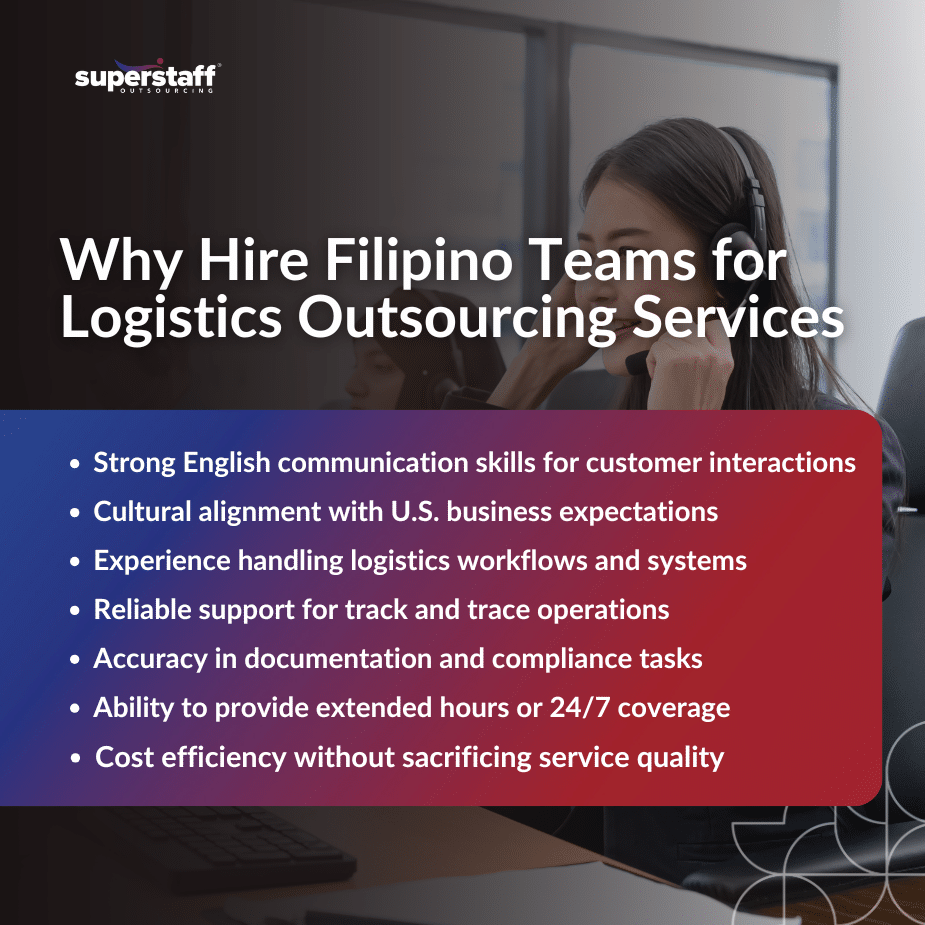
Logistics operations rarely stop at 5 p.m. Eastern Time. Shipment disruptions can occur overnight. International clients may operate in different time zones.
Through logistics outsourcing services, Filipino support teams provide extended-hour or 24/7 coverage. Agents respond to shipment inquiries, update order statuses, and coordinate with dispatch teams while U.S. staff rest.
That continuity improves service-level performance. Moreover, it reduces employee burnout for domestic teams. Structured shift scheduling in the Philippines supports consistent coverage without excessive overtime costs.
Cost Control Without Sacrificing Quality
Expense management remains a priority for midmarket logistics providers. However, reducing headcount domestically can weaken service responsiveness.
Logistics outsourcing services enable cost optimization without compromising output. Labor arbitrage alone is not the objective. Instead, companies gain:
- Predictable operating expenses
- Scalable staffing models
- Reduced hiring cycles
- Access to English-proficient talent
Filipino agents are known for strong communication skills and customer service orientation. When trained in logistics systems and workflows, a third party logistics provider can integrate smoothly into client-facing operations.
Scalable Support During Peak Seasons
Freight volumes fluctuate. Peak retail cycles, seasonal imports, and promotional surges create temporary staffing needs. Hiring full-time domestic staff for short-term spikes often proves inefficient.
Flexible logistics outsourcing services allow companies to scale teams up or down based on shipment volume. Offshore staffing partners recruit, onboard, and train additional agents quickly when volume increases.
Once peak season stabilizes, team sizes can be adjusted. That elasticity protects margins while preserving service standards.
Data Entry and System Administration
Transportation management systems, warehouse management platforms, and ERP tools require accurate data input. Errors create downstream billing disputes and operational inefficiencies.
Filipino support teams frequently manage:
- Shipment data entry
- Rate confirmation uploads
- Proof of delivery verification
- Invoice reconciliation support
These administrative tasks form a significant portion of logistics outsourcing services because they are process-driven and measurable. Performance dashboards track turnaround times and accuracy rates. Leaders maintain visibility into KPIs while reducing domestic workload.
Supporting Carrier and Vendor Coordination
Logistics providers operate within a complex ecosystem of carriers, brokers, and warehouse partners. Communication gaps can disrupt schedules and increase costs.
Offshore teams handle appointment scheduling, carrier follow-ups, and email coordination. They document interactions in shared systems and escalate issues when required. As part of structured logistics outsourcing services, these tasks ensure consistent communication without overwhelming U.S.-based operations managers.
Clear escalation matrices prevent confusion. Offshore agents follow defined workflows, while decision-making authority remains with leadership.
Process Standardization and Documentation
Operational consistency drives profitability in logistics. However, many growing firms rely on tribal knowledge rather than documented workflows.
Implementing logistics outsourcing services often forces companies to formalize standard operating procedures. Offshore teams require clear process documentation, which encourages leadership to define step-by-step guidelines.
That discipline improves internal governance. It also strengthens audit readiness and quality assurance frameworks.
Why the Philippines Remains a Strategic Choice
The Philippines has built a strong reputation in global outsourcing due to language proficiency, cultural alignment with U.S. clients, and service orientation. As such, many companies hire Filipinos for cost-effective logistics outsourcing services for ecommerce and other industries.
Filipino professionals are accustomed to working in customer-facing environments. They understand tone, responsiveness, and accountability. When embedded within logistics outsourcing services models, they become an extension of the client’s operations team rather than a detached third party.
Time zone overlap also supports collaboration. Real-time communication between U.S. managers and Philippine teams ensures fast issue resolution and operational transparency.
Building a High-Performance Offshore Logistics Team
Success in logistics outsourcing services requires thoughtful implementation. Clear onboarding processes, system access protocols, and performance metrics must be defined from the start.
Strong providers focus on:
- Dedicated team structures
- Transparent reporting
- Secure IT infrastructure
- Ongoing skills training
SuperStaff works with logistics clients to design tailored offshore support models. Rather than offering generic staffing, the approach centers on aligning talent with specific operational workflows.
Leadership teams maintain full visibility into performance. Regular check-ins, quality audits, and data-driven reviews ensure that offshore teams consistently meet service expectations.
Strengthen Your Supply Chain With SuperStaff’s Logistics Outsourcing Services
Global logistics demands precision, responsiveness, and cost discipline. Companies that rely solely on domestic teams often struggle to balance these priorities.
Well-structured logistics outsourcing services give midmarket firms the flexibility to scale operations, extend coverage hours, and improve documentation accuracy without expanding fixed overhead. Filipino support teams play a critical role in delivering that stability and operational discipline.
SuperStaff helps U.S. logistics providers design and implement offshore support structures that align with their growth goals. If your organization is evaluating how to strengthen service performance while protecting margins, get in touch with us to see how SuperStaff’s tailored logistics outsourcing services can support your next phase of expansion.