
Healthcare providers face constant pressure to improve patient support, manage costs, and handle daily administrative work without delays. However, many healthcare companies struggle with staffing gaps, rising labor expenses, and heavy workloads. Because of this, many organizations now turn to healthcare services outsourcing to improve operations while keeping service quality consistent.
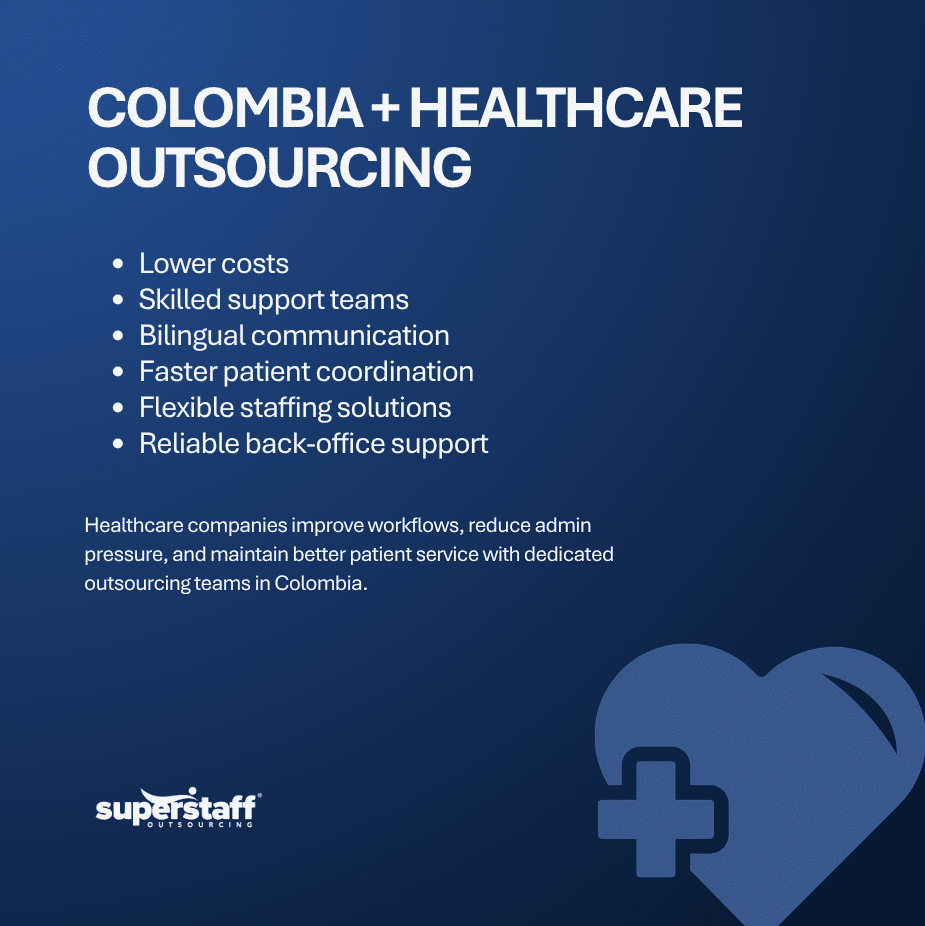
Colombia continues to attract healthcare companies looking for reliable outsourcing support. The country offers a skilled workforce, strong communication skills, and competitive operating costs. At the same time, healthcare teams benefit from flexible staffing solutions that help them manage patient scheduling, billing support, customer service, and back-office tasks.
As healthcare systems continue to grow, healthcare services outsourcing in Colombia gives companies access to dependable support teams without increasing internal workload. Moreover, businesses gain operational flexibility while improving response times and patient experiences.
Why Colombia Stands Out for Healthcare Outsourcing
Many healthcare companies choose Colombia because it offers a strong balance between talent, cost savings, and service quality. Additionally, the country continues to strengthen its outsourcing industry across different sectors, including healthcare. Businesses considering this location can learn more about outsourced healthcare services in Colombia and how nearshore teams can support healthcare operations.
1. Skilled Healthcare Support Professionals
Colombia has a growing workforce with experience in healthcare administration and customer support. Many professionals receive training in medical processes, insurance verification, appointment coordination, and patient communication.
As a result, healthcare services outsourcing providers in Colombia can support daily operations with minimal training time. Furthermore, healthcare companies can quickly scale teams based on operational needs.
2. Strong English Communication Skills
Clear communication matters in healthcare support. Many Colombian professionals working with international clients use English to support patient and administrative interactions.
Because of this, healthcare services outsourcing companies can provide patient communication and coordination with healthcare providers. In addition, bilingual support can help healthcare businesses serve English- and Spanish-speaking patient populations.
3. Competitive Operational Costs
Healthcare organizations continue to search for ways to control expenses without reducing service quality. Colombia provides a nearshore staffing option for North American healthcare organizations.
Therefore, healthcare services outsourcing can allow companies to manage certain overhead expenses while maintaining dedicated support services. At the same time, businesses can allocate internal resources toward patient care and other priorities.
4. Time Zone Compatibility
Colombia’s location supports easier collaboration with companies in the United States and Canada. Teams can work during overlapping business hours, which improves communication and workflow management.
Because of this advantage, healthcare services outsourcing teams can respond to patient inquiries and administrative requests during North American business hours. Real-time coordination can also make it easier to address workflow issues as they occur.
5. Growing Outsourcing Infrastructure
Colombia continues to develop its business process outsourcing sector through workforce development and technology adoption. Healthcare organizations can use this infrastructure for different patient-facing and administrative processes.
Companies exploring the advantages of nearshore healthcare support can also review the benefits of outsourcing healthcare solutions to Colombia when comparing possible outsourcing locations.
Healthcare Tasks Commonly Outsourced to Colombia
Healthcare companies outsource several support functions to improve efficiency and reduce administrative pressure. These services can give internal healthcare teams more time to focus on clinical responsibilities.
1. Appointment Scheduling Support
Scheduling appointments takes time and requires constant coordination. Outsourcing providers can manage calendars, confirm patient visits, and handle routine scheduling requests.
Additionally, healthcare services outsourcing teams can provide dedicated resources for patient inquiries. This helps healthcare providers maintain organized schedules and smoother daily operations.
2. Medical Billing Assistance
Billing support requires accuracy and consistent follow-up. Outsourcing teams can assist with claims processing, payment tracking, and insurance coordination based on the responsibilities assigned by the healthcare organization.
Because of this, healthcare services outsourcing can reduce administrative backlogs and give internal billing teams additional operational capacity.
3. Patient Customer Service
Patients expect clear and professional support when contacting healthcare providers. Outsourcing teams can handle inquiries, follow-ups, appointment-related questions, and other approved non-clinical customer service tasks.
As a result, healthcare services outsourcing provides additional resources for patient communication. At the same time, internal staff can focus more attention on responsibilities that require their direct involvement.
4. Insurance Verification Support
Insurance verification often requires detailed coordination and follow-up. Outsourced support teams can assist with checking eligibility and verifying coverage information based on established processes.
Therefore, healthcare services outsourcing can reduce administrative workloads for healthcare offices and support appointment preparation.
5. Administrative Back-Office Support
Healthcare organizations manage large amounts of paperwork and data every day. Outsourcing teams can assist with data entry, document processing, records management, and other approved back-office functions.
Consequently, healthcare services outsourcing gives healthcare providers additional resources for maintaining organized administrative workflows.
Key Benefits of Healthcare Outsourcing in Colombia
Healthcare organizations may use outsourcing partnerships to address staffing, administrative, and operational requirements. Colombia offers several characteristics that can support this model.
1. Faster Team Scaling
Healthcare demand can change quickly. Outsourcing providers can give companies another way to expand support teams without managing the entire recruitment process internally.
Because of this, healthcare services outsourcing can provide additional capacity during periods of higher administrative or patient support demand.
2. Reduced Administrative Pressure
Administrative overload can affect healthcare employees when internal teams manage patient support, documentation, scheduling, and other responsibilities alongside their main duties.
Healthcare services outsourcing distributes suitable administrative tasks across dedicated support teams. As a result, healthcare staff can spend more time on responsibilities that need to remain in-house.
3. Improved Operational Flexibility
Healthcare companies need support solutions that can adjust to changing operational requirements. Outsourcing providers may offer different staffing models based on workload and service requirements.
Therefore, healthcare services outsourcing can give organizations additional flexibility without requiring every support position to be filled internally.
4. Better Customer Response Times
Patients expect timely responses when contacting healthcare providers. Delays can affect scheduling and the overall patient experience.
Dedicated outsourcing teams can provide additional capacity for inquiries and follow-ups. Consequently, healthcare services outsourcing can support more consistent patient communication.
5. Long-Term Cost Control
Managing in-house support teams involves salaries, recruitment, training, technology, equipment, and other operating expenses.
Healthcare services outsourcing gives organizations another staffing model to compare with internal hiring. Actual cost differences will depend on the provider, service scope, staffing requirements, and operating model.
Important Factors When Choosing an Outsourcing Partner
Selecting the right outsourcing provider plays a major role in operational success. Healthcare companies should evaluate providers carefully before starting partnerships.
1. Industry Experience
Healthcare workflows require accuracy and strong organizational skills. Companies should choose outsourcing providers with relevant healthcare support experience.
Experienced teams may already understand common administrative workflows, patient communication requirements, and escalation procedures.
2. Data Security Standards
Healthcare companies handle sensitive patient information every day. Therefore, outsourcing providers should maintain appropriate privacy, security, access control, and confidentiality procedures.
For U.S. healthcare organizations working with external service providers that handle protected health information, the U.S. Department of Health and Human Services provides guidance on HIPAA requirements involving business associates.
Healthcare organizations should verify the specific security and compliance requirements that apply to their outsourcing arrangement before sharing patient information.
3. Workforce Stability
High employee turnover can affect service consistency. Companies should review how outsourcing partners recruit, train, and retain employees assigned to healthcare accounts.
Consistent staffing can support workflow continuity and reduce the amount of repeated training required during the partnership.
4. Communication Processes
Strong communication supports smoother collaboration between healthcare companies and outsourcing teams. Providers should offer clear reporting systems, escalation procedures, and regular updates.
Defined communication processes also make it easier to identify and resolve operational issues.
5. Scalability Options
Healthcare needs can change throughout the year. Outsourcing providers should explain how staffing can be adjusted when patient volumes or administrative workloads increase.
Businesses should also review staffing lead times, service terms, training requirements, and any costs associated with expanding the team.
Smarter Healthcare Support Starts With the Right Team
Healthcare companies need reliable support systems to manage growing operational demands. Healthcare services outsourcing in Colombia gives organizations another option for accessing administrative and customer service professionals while maintaining flexibility as workloads change.
The right outsourcing arrangement depends on the organization’s workflows, patient needs, data security requirements, and long-term goals. Healthcare companies should evaluate providers based on experience, workforce quality, security practices, communication, and scalability.
Businesses looking for broader healthcare outsourcing support can explore SuperStaff and its healthcare, customer service, and back-office solutions.
SuperStaff supports healthcare organizations with scalable outsourcing solutions for administrative and patient support functions. Teams can be structured around specific workflows, operating hours, and business requirements.
Need additional support for your healthcare operations? Contact SuperStaff to discuss your outsourcing requirements.