Outsource Benefits Administration Team Through EOR for Smarter HR Growth

Published: November 8, 2026
Benefits administration used to sit quietly in the background of HR. Today, it affects employee experience, compliance, retention, payroll accuracy, and operational continuity. For U.S. companies expanding their workforce, especially across multiple states or countries, the work has become too detailed to manage casually. That is why many growing businesses now choose to outsource benefits administration team support through an Employer of Record model. For SMEs and midmarket companies, the challenge is clear. Employees expect timely answers, accurate enrollment, clear documentation, and smooth support during life events. At the same time, HR leaders must manage vendor coordination, compliance requirements, payroll deductions, reporting, and employee communication without adding unnecessary internal headcount. An EOR partnership helps solve that gap. It gives companies access to skilled benefits support professionals who can manage the administrative load while the business keeps control of strategy, culture, and employee decision-making. Why Benefits Administration Has Become Harder to Manage Internally Benefits work is detail-heavy. A missed update, delayed response, or incorrect employee record can create confusion for staff and extra work for HR. As companies grow, those small issues multiply. HR teams often manage several responsibilities at once, including recruitment, onboarding, employee relations, compliance, performance processes, and internal communication. Benefits administration can quickly consume time that should be used for higher-value workforce planning. A company may decide to outsource benefits administration team tasks when internal HR capacity starts to limit the employee experience. Common signs include: • Slow employee response times • Inconsistent benefits documentation • Delayed enrollment updates • Repeated payroll correction requests • Limited HR bandwidth during open enrollment • Too much reliance on one internal HR staff member This is not only an HR issue. It is an operational issue. When employees cannot get clear answers about their benefits, they lose time. Managers get pulled into questions they cannot answer. Finance teams deal with correction requests. Leadership sees HR spending more time fixing process gaps than improving workforce strategy. What an EOR Model Adds to Benefits Support An Employer of Record model allows companies to build or extend a workforce without setting up a local entity in every market. The EOR handles employment administration, payroll, statutory requirements, and related HR support for workers under its legal framework. When companies outsource benefits administration team functions through an EOR, they gain structured support for recurring benefits tasks while reducing the administrative burden on internal teams. This can include: • Employee benefits enrollment support • Benefits documentation management • Employee inquiry handling • Payroll and deductions coordination • Eligibility tracking • Vendor communication support • Renewal and open enrollment assistance • Compliance-related recordkeeping The value is not simply task completion. The value comes from consistency. A trained benefits administration team follows workflows, documents employee interactions, escalates issues properly, and helps keep the process moving. For companies managing distributed or international teams, that consistency matters. Different locations may involve different rules, expectations, documentation needs, and timelines. An EOR partner helps reduce confusion by creating a clearer operating structure. Why U.S. Companies Are Looking Offshore for Benefits Administration Many U.S. businesses want HR support that is reliable, cost-conscious, and scalable. Hiring locally for every administrative function can become expensive, especially when the workload fluctuates throughout the year. A company may need more support during open enrollment, renewal periods, onboarding waves, or post-acquisition workforce transitions. Then demand may normalize again. Maintaining a larger internal team all year can create unnecessary cost pressure. This is one reason companies outsource benefits administration team support to the Philippines. Filipino HR and back-office professionals are known for strong English communication, service orientation, and experience supporting U.S. business processes. For benefits administration, communication quality is critical. Employees often ask sensitive, practical questions. They need accurate guidance, clear next steps, and a support experience that feels organized. Offshore support works best when the team is trained not only on process execution, but also on employee care. SuperStaff helps companies build dedicated HR support teams that can assist with benefits administration, employee coordination, data management, and related back-office functions. Through an EOR structure, businesses can scale support without taking on the same level of direct employment complexity. The Business Case for Outsourcing Benefits Administration Cost savings are often part of the conversation, but they should not be the whole conversation. The stronger business case is about focus, control, and continuity. When HR leaders outsource benefits administration team support, they can redirect internal resources toward more strategic work. That may include workforce planning, manager enablement, retention programs, employee engagement, and leadership support. The outsourced team handles the repetitive but important work that keeps benefits operations running. This creates a better division of labor. • Internal HR focuses on policy, people strategy, vendor decisions, and employee experience design. • The outsourced benefits administration team supports documentation, updates, tracking, inquiries, and recurring coordination. • The EOR helps manage employment administration and compliance requirements tied to the workforce. This structure gives leadership more visibility into the process. Instead of relying on informal handoffs, companies can define service levels, escalation paths, reporting expectations, and quality checks. A well-built model also improves continuity. If one internal HR staff member owns too much benefits knowledge, the company becomes vulnerable when that person is unavailable or leaves. With a documented outsourced process, knowledge stays organized. Where an Outsourced Benefits Administration Team Creates the Most Value The best use cases are usually found in work that is important, repetitive, and process-driven. For example, during onboarding, employees need to understand eligibility, enrollment steps, required forms, and deadlines. If HR is already managing hiring paperwork, manager coordination, and new-hire engagement, benefits questions can slow the process down. An outsourced support team can help organize employee communication, track completion, update records, and escalate special cases to the right internal leader. Open enrollment is another strong use case. HR teams often deal with a temporary spike in questions, document updates, plan reminders, and employee follow-ups. When businesses outsource benefits administration team support, they can add capacity during these high-volume periods without permanently increasing headcount. The same logic applies to employee changes. Marriage, dependents, role changes, location changes, and terminations can all trigger benefits updates. Each update requires accuracy and follow-through. A dedicated support team helps keep these changes from falling through the cracks. Why EOR Support Works for Growing and Distributed Teams Growth often creates HR complexity before leadership expects it. A company may start with a lean internal team that works well for 50 employees. Then hiring accelerates, new locations open, or remote roles expand. Suddenly, the same HR process no longer scales. An EOR-backed model gives companies a more flexible path. Businesses can access talent and HR support without building every operational layer from scratch. This is especially useful for companies that want to hire in the Philippines but do not have a local entity. The EOR can support compliant employment administration while the outsourced team delivers benefits-related support within agreed workflows. For U.S. SMEs and midmarket companies, this model creates a practical middle ground. They can grow with more structure, but without overbuilding internal HR operations too early. When companies outsource benefits administration team functions through SuperStaff, they also gain access to the Philippines’ strong service culture. This matters because benefits support is employee-facing. The team must be detail-oriented, responsive, and able to explain next steps clearly. How to Keep Control While Outsourcing Benefits Administration Some HR leaders worry that outsourcing benefits work means losing control. That concern is understandable, but the right model should do the opposite. It should give internal leaders more control through better process design. Before launching an outsourced team, companies should define: • Which benefits tasks stay internal • Which tasks move to the outsourced team • What the escalation process looks like • Who approves exceptions or sensitive cases • What documentation standards must be followed • How reporting will be shared with leadership • How employee inquiries should be handled The goal is not to hand off accountability. The goal is to create an operating system where routine work is handled consistently and strategic decisions stay with the company. A strong outsource benefits administration team model works best when roles are clear from the start. Internal HR remains the owner of policy and employee experience. The outsourced team becomes the engine that keeps the process moving. Why SuperStaff Is the Right Partner for EOR-Backed HR Support SuperStaff helps U.S. companies build reliable offshore teams in the Philippines, including HR, back-office, customer support, recruitment, and administrative roles. For companies exploring EOR, this means more than filling seats. It means building a support model that fits the business. A benefits administration function needs accuracy, confidentiality, steady communication, and process discipline. SuperStaff understands how to recruit, train, and manage professionals who can support these needs while aligning with U.S. business expectations. For SMEs and midmarket companies, this is especially valuable. They need a partner that can move with their growth, understand their operating pressure, and help them avoid unnecessary complexity. When a company chooses to outsource benefits administration team support, it should look for more than labor savings. It should look for a partner that understands HR operations, employee care, service delivery, and scalable workforce support. That is where SuperStaff’s EOR and offshore staffing experience can help. Build a Smarter Benefits Support Model With SuperStaff Benefits administration will only become more important as companies expand, hire across locations, and compete for talent. Employees want fast answers and a smooth experience. HR leaders need structure, accuracy, and room to focus on bigger workforce priorities. Choosing to outsource benefits administration team support through an EOR model gives growing companies a practical way to improve HR capacity without overextending internal teams. SuperStaff can help you build a dedicated offshore HR support team that strengthens benefits administration, improves employee support, and gives your business more room to grow. Explore SuperStaff’s EOR and offshore staffing services to see how the right team can support your next stage of expansion.

Benefits administration used to sit quietly in the background of HR. Today, it affects employee experience, compliance, retention, payroll accuracy, and operational continuity. For U.S. companies expanding their workforce, especially across multiple states or countries, the work has become too detailed to manage casually. That is why many growing businesses now choose to outsource benefits administration team support through an Employer of Record model.

For SMEs and midmarket companies, the challenge is clear. Employees expect timely answers, accurate enrollment, clear documentation, and smooth support during life events. At the same time, HR leaders must manage vendor coordination, compliance requirements, payroll deductions, reporting, and employee communication without adding unnecessary internal headcount.

An EOR partnership helps solve that gap. It gives companies access to skilled benefits support professionals who can manage the administrative load while the business keeps control of strategy, culture, and employee decision-making.

Why Benefits Administration Has Become Harder to Manage Internally

Benefits work is detail-heavy. A missed update, delayed response, or incorrect employee record can create confusion for staff and extra work for HR. As companies grow, those small issues multiply.

HR teams often manage several responsibilities at once, including recruitment, onboarding, employee relations, compliance, performance processes, and internal communication. Benefits administration can quickly consume time that should be used for higher-value workforce planning.

A company may decide to outsource benefits administration team tasks when internal HR capacity starts to limit the employee experience. Common signs include:

  • Slow employee response times
    • Inconsistent benefits documentation
    • Delayed enrollment updates
    • Repeated payroll correction requests
    • Limited HR bandwidth during open enrollment
    • Too much reliance on one internal HR staff member

This is not only an HR issue. It is an operational issue. When employees cannot get clear answers about their benefits, they lose time. Managers get pulled into questions they cannot answer. Finance teams deal with correction requests. Leadership sees HR spending more time fixing process gaps than improving workforce strategy.
outsource benefits administration team

What an EOR Model Adds to Benefits Support

An Employer of Record model allows companies to build or extend a workforce without setting up a local entity in every market. The EOR handles employment administration, payroll, statutory requirements, and related HR support for workers under its legal framework.

When companies outsource benefits administration team functions through an EOR, they gain structured support for recurring benefits tasks while reducing the administrative burden on internal teams.

This can include:

  • Employee benefits enrollment support
    • Benefits documentation management
    • Employee inquiry handling
    • Payroll and deductions coordination
    • Eligibility tracking
    • Vendor communication support
    • Renewal and open enrollment assistance
    • Compliance-related recordkeeping

The value is not simply task completion. The value comes from consistency. A trained benefits administration team follows workflows, documents employee interactions, escalates issues properly, and helps keep the process moving.

For companies managing distributed or international teams, that consistency matters. Different locations may involve different rules, expectations, documentation needs, and timelines. An EOR partner helps reduce confusion by creating a clearer operating structure.

Why U.S. Companies Are Looking Offshore for Benefits Administration

Many U.S. businesses want HR support that is reliable, cost-conscious, and scalable. Hiring locally for every administrative function can become expensive, especially when the workload fluctuates throughout the year.

A company may need more support during open enrollment, renewal periods, onboarding waves, or post-acquisition workforce transitions. Then demand may normalize again. Maintaining a larger internal team all year can create unnecessary cost pressure.

This is one reason companies outsource benefits administration team support to the Philippines. Filipino HR and back-office professionals are known for strong English communication, service orientation, and experience supporting U.S. business processes.

For benefits administration, communication quality is critical. Employees often ask sensitive, practical questions. They need accurate guidance, clear next steps, and a support experience that feels organized. Offshore support works best when the team is trained not only on process execution, but also on employee care.

SuperStaff helps companies build dedicated HR support teams that can assist with benefits administration, employee coordination, data management, and related back-office functions. Through an EOR structure, businesses can scale support without taking on the same level of direct employment complexity.

The Business Case for Outsourcing Benefits Administration

Cost savings are often part of the conversation, but they should not be the whole conversation. The stronger business case is about focus, control, and continuity.

When HR leaders outsource benefits administration team support, they can redirect internal resources toward more strategic work. That may include workforce planning, manager enablement, retention programs, employee engagement, and leadership support.

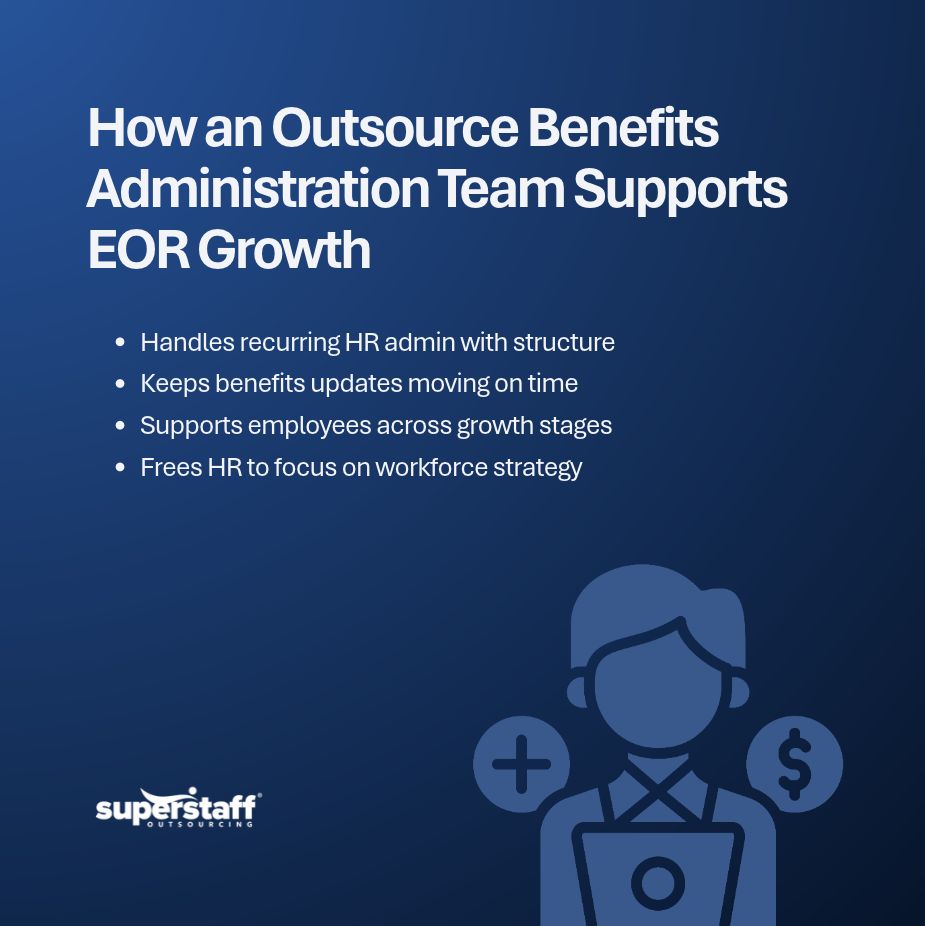
The outsourced team handles the repetitive but important work that keeps benefits operations running. This creates a better division of labor.

  • Internal HR focuses on policy, people strategy, vendor decisions, and employee experience design.
    • The outsourced benefits administration team supports documentation, updates, tracking, inquiries, and recurring coordination.
    • The EOR helps manage employment administration and compliance requirements tied to the workforce.

This structure gives leadership more visibility into the process. Instead of relying on informal handoffs, companies can define service levels, escalation paths, reporting expectations, and quality checks.

A well-built model also improves continuity. If one internal HR staff member owns too much benefits knowledge, the company becomes vulnerable when that person is unavailable or leaves. With a documented outsourced process, knowledge stays organized.

Where an Outsourced Benefits Administration Team Creates the Most Value

The best use cases are usually found in work that is important, repetitive, and process-driven.

For example, during onboarding, employees need to understand eligibility, enrollment steps, required forms, and deadlines. If HR is already managing hiring paperwork, manager coordination, and new-hire engagement, benefits questions can slow the process down.

An outsourced support team can help organize employee communication, track completion, update records, and escalate special cases to the right internal leader.

Open enrollment is another strong use case. HR teams often deal with a temporary spike in questions, document updates, plan reminders, and employee follow-ups. When businesses outsource benefits administration team support, they can add capacity during these high-volume periods without permanently increasing headcount.

The same logic applies to employee changes. Marriage, dependents, role changes, location changes, and terminations can all trigger benefits updates. Each update requires accuracy and follow-through.

A dedicated support team helps keep these changes from falling through the cracks.

Why EOR Support Works for Growing and Distributed Teams

Growth often creates HR complexity before leadership expects it. A company may start with a lean internal team that works well for 50 employees. Then hiring accelerates, new locations open, or remote roles expand. Suddenly, the same HR process no longer scales.

An EOR-backed model gives companies a more flexible path. Businesses can access talent and HR support without building every operational layer from scratch.

This is especially useful for companies that want to hire in the Philippines but do not have a local entity. The EOR can support compliant employment administration while the outsourced team delivers benefits-related support within agreed workflows.

For U.S. SMEs and midmarket companies, this model creates a practical middle ground. They can grow with more structure, but without overbuilding internal HR operations too early.

When companies outsource benefits administration team functions through SuperStaff, they also gain access to the Philippines’ strong service culture. This matters because benefits support is employee-facing. The team must be detail-oriented, responsive, and able to explain next steps clearly.

How to Keep Control While Outsourcing Benefits Administration

Some HR leaders worry that outsourcing benefits work means losing control. That concern is understandable, but the right model should do the opposite. It should give internal leaders more control through better process design.

Before launching an outsourced team, companies should define:

  • Which benefits tasks stay internal
    • Which tasks move to the outsourced team
    • What the escalation process looks like
    • Who approves exceptions or sensitive cases
    • What documentation standards must be followed
    • How reporting will be shared with leadership
    • How employee inquiries should be handled

The goal is not to hand off accountability. The goal is to create an operating system where routine work is handled consistently and strategic decisions stay with the company.

A strong outsource benefits administration team model works best when roles are clear from the start. Internal HR remains the owner of policy and employee experience. The outsourced team becomes the engine that keeps the process moving.

Why SuperStaff Is the Right Partner for EOR-Backed HR Support

SuperStaff helps U.S. companies build reliable offshore teams in the Philippines, including HR, back-office, customer support, recruitment, and administrative roles. For companies exploring EOR, this means more than filling seats. It means building a support model that fits the business.

A benefits administration function needs accuracy, confidentiality, steady communication, and process discipline. SuperStaff understands how to recruit, train, and manage professionals who can support these needs while aligning with U.S. business expectations.

For SMEs and midmarket companies, this is especially valuable. They need a partner that can move with their growth, understand their operating pressure, and help them avoid unnecessary complexity.

When a company chooses to outsource benefits administration team support, it should look for more than labor savings. It should look for a partner that understands HR operations, employee care, service delivery, and scalable workforce support.

That is where SuperStaff’s EOR and offshore staffing experience can help.

Build a Smarter Benefits Support Model With SuperStaff

Benefits administration will only become more important as companies expand, hire across locations, and compete for talent. Employees want fast answers and a smooth experience. HR leaders need structure, accuracy, and room to focus on bigger workforce priorities.

Choosing to outsource benefits administration team support through an EOR model gives growing companies a practical way to improve HR capacity without overextending internal teams.

SuperStaff can help you build a dedicated offshore HR support team that strengthens benefits administration, improves employee support, and gives your business more room to grow. Explore SuperStaff’s EOR and offshore staffing services to see how the right team can support your next stage of expansion.

Share This Story!