
Legal work has become more complex and time-sensitive for U.S. law firms. Cases involve massive documentation, tight deadlines, and rising operational costs. Many firms now outsource litigation support services to stay efficient while maintaining quality and control.
Offshoring litigation support allows legal teams to extend their capabilities without expanding headcount. It creates flexibility, improves turnaround times, and allows attorneys to focus on high-value legal strategy instead of administrative workload.
Rising Litigation Complexity Drives Change
Modern litigation generates large volumes of digital data. Discovery alone can involve emails, contracts, transcripts, and compliance files. Managing this workload internally slows legal teams down and strains billable capacity.
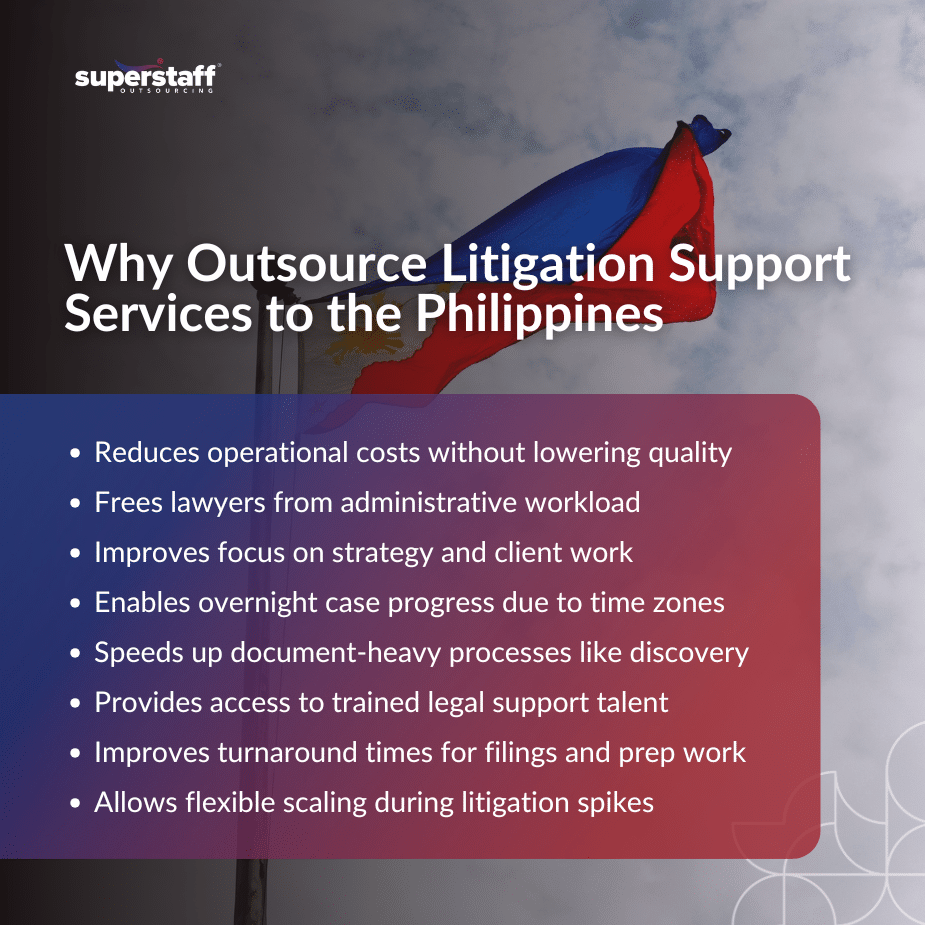
When firms outsource litigation support services, they shift labor-intensive tasks to specialized teams. Attorneys then regain time for case strategy, court preparation, and client engagement. This balance helps firms operate more efficiently without compromising standards.
Cost Control Without Compromising Quality
Legal operations are under pressure to manage costs while delivering premium service. Clients expect transparency and predictable billing. That expectation pushes firms to rethink traditional staffing models.
Offshoring provides a structured way to reduce overhead. Firms that outsource litigation support services can maintain high output while managing budgets more effectively. Instead of hiring additional paralegals locally, they gain access to trained offshore professionals who work within defined workflows.
Around the Clock Case Progress
Time sensitivity defines litigation. Missed deadlines can affect filings, discovery windows, and trial readiness. Offshore support introduces time zone advantages that many firms find valuable.
With global delivery models, work continues even after U.S. business hours. Teams that outsource litigation support services benefit from overnight document processing and faster turnaround cycles. The result is improved responsiveness during critical case phases.
Access to Specialized Legal Skills
Litigation support requires technical knowledge beyond general administrative work. Tasks such as document review, deposition summaries, and legal indexing demand familiarity with legal processes.
Offshore providers invest in legal training and process standardization. Firms that outsource litigation support services gain access to professionals experienced in legal workflows. This ensures consistency and reduces the burden of training in-house staff for repetitive tasks.
Improved Scalability for Growing Firms
Caseloads fluctuate across practice areas. Some months bring trial preparation surges, while others slow down. Fixed staffing models struggle to match this variability.
Flexible outsourcing models solve that challenge. Firms that outsource litigation support services can scale teams up or down based on demand. This approach prevents overstaffing while ensuring capacity during peak litigation cycles.
Reduced Administrative Burden on Attorneys
Lawyers increasingly face non-billable tasks that consume valuable time. Document formatting, indexing, and summarization often fall outside core legal strategy. These activities reduce overall productivity.
Offshore support teams absorb these operational responsibilities. When firms outsource litigation support services, attorneys spend more time on advisory work and client communication. That shift improves both billable output and client satisfaction.
Faster Turnaround for Document-Heavy Cases
Discovery and evidence preparation often determine litigation timelines. Delays in document organization can ripple across the entire case lifecycle. Efficiency in this phase directly impacts outcomes.
Dedicated offshore teams focus exclusively on document workflows. Firms that outsource litigation support services benefit from streamlined review cycles and faster deliverables. This consistency supports stronger case preparation and smoother collaboration with clients.
Stronger Internal Focus on Strategy
Law firms compete on expertise and insight, not administrative throughput. Clients value strategic thinking, negotiation skill, and legal interpretation. Administrative overload distracts from these strengths.
Outsourcing enables clearer role alignment. When firms outsource litigation support services, partners and associates can prioritize legal reasoning and case positioning. This creates a stronger value proposition in competitive legal markets.
Compliance and Process Discipline
Legal work requires strict adherence to confidentiality and process control. Offshore providers that specialize in legal services build workflows aligned with international compliance standards.
Structured delivery models emphasize data security and documentation integrity. Firms that outsource litigation support services often adopt standardized processes that improve internal discipline as well. This strengthens operational consistency across cases.
Better Knowledge Management and Documentation
Litigation produces insights that are valuable beyond a single case. However, knowledge often remains fragmented across teams and files. Without structured documentation, firms lose opportunities to build institutional expertise.
Offshore support teams help standardize documentation practices. When firms outsource litigation support services, they benefit from consistent indexing, archiving, and case organization. Over time, this creates a stronger knowledge base that supports future litigation.
Greater Predictability in Legal Operations
Operational predictability is becoming a differentiator in legal services. Clients want clarity on timelines and deliverables. Firms that run efficient support structures are better positioned to meet those expectations.
Outsourcing introduces repeatable workflows and performance benchmarks. Firms that outsource litigation support services often develop more structured operating rhythms. This predictability strengthens client relationships and supports long-term retention.
Enhanced Collaboration Across Distributed Teams
Many law firms already operate across multiple offices or hybrid work environments. Offshore support fits naturally into distributed delivery models. Collaboration tools make it easier to coordinate work across geographies.
Integrated communication workflows ensure transparency and accountability. When firms outsource litigation support services, offshore teams function as an extension of the internal staff. This continuity maintains quality while improving responsiveness.
Competitive Advantage in a Changing Legal Market
Legal clients are becoming more cost-aware and performance-driven. Firms that optimize operations are better positioned to win and retain clients. Operational efficiency increasingly influences firm reputation.
Forward-thinking firms treat outsourcing as a strategic lever. Those that outsource litigation support services can deliver faster results and maintain competitive pricing. This positioning supports growth without sacrificing quality or client trust.
Why Offshore Locations Continue to Gain Momentum
Offshore destinations such as the Philippines have developed strong reputations in knowledge-based services. The talent pool includes professionals with strong English proficiency and familiarity with Western business practices.
Providers in these regions offer structured onboarding and process alignment. Law firms that outsource litigation support services to established offshore markets benefit from mature delivery ecosystems and reliable performance.
The Role of a Trusted Outsourcing Partner
Choosing the right partner determines outsourcing success. Law firms need providers that understand legal workflows and maintain strict confidentiality. Alignment with firm standards is critical.
A strong outsourcing partner integrates seamlessly into existing operations. Firms that outsource litigation support services with experienced providers gain smoother collaboration and better long-term outcomes. The relationship evolves into a strategic extension of the legal team.
Outsource Litigation Support Services to SuperStaff’s LPO Professionals
The legal industry continues to evolve under pressure from cost constraints and client expectations. Firms that adapt their operating models are better positioned to grow. Offshore support offers a practical way to balance efficiency and quality.
SuperStaff works with legal teams that want dependable offshore support without operational friction. The company brings structured processes, trained professionals, and secure workflows tailored to legal environments. U.S. firms that outsource litigation support services through SuperStaff gain a reliable partner focused on consistency and long-term value.
If your firm is looking to improve efficiency while maintaining legal rigor, now is the time to rethink your support model. Explore how SuperStaff can help you build a scalable litigation support strategy designed for modern legal demands.