
U.S. legal teams are under pressure. Costs keep rising. Case volumes fluctuate. Clients demand speed and accuracy. At the same time, internal teams are expected to do more with fewer resources.
This tension has pushed many firms to rethink how legal work gets done. For many, the answer is outsourcing legal process functions to nearshore teams in Colombia. The shift is not about offloading responsibility. It is about gaining operational control while protecting margins.
Colombia has emerged as a practical, disciplined solution for legal leaders who need scale without chaos.
The Cost Control Problem Facing U.S. Legal Teams
Legal work has always been cost sensitive. That reality is sharper today. Hourly rates are scrutinized. Budgets are capped. Internal headcount approvals are harder to secure.
Traditional responses fall short. Hiring more paralegals increases fixed costs. Overworking internal teams raises risk. Automation helps but only for narrow tasks.
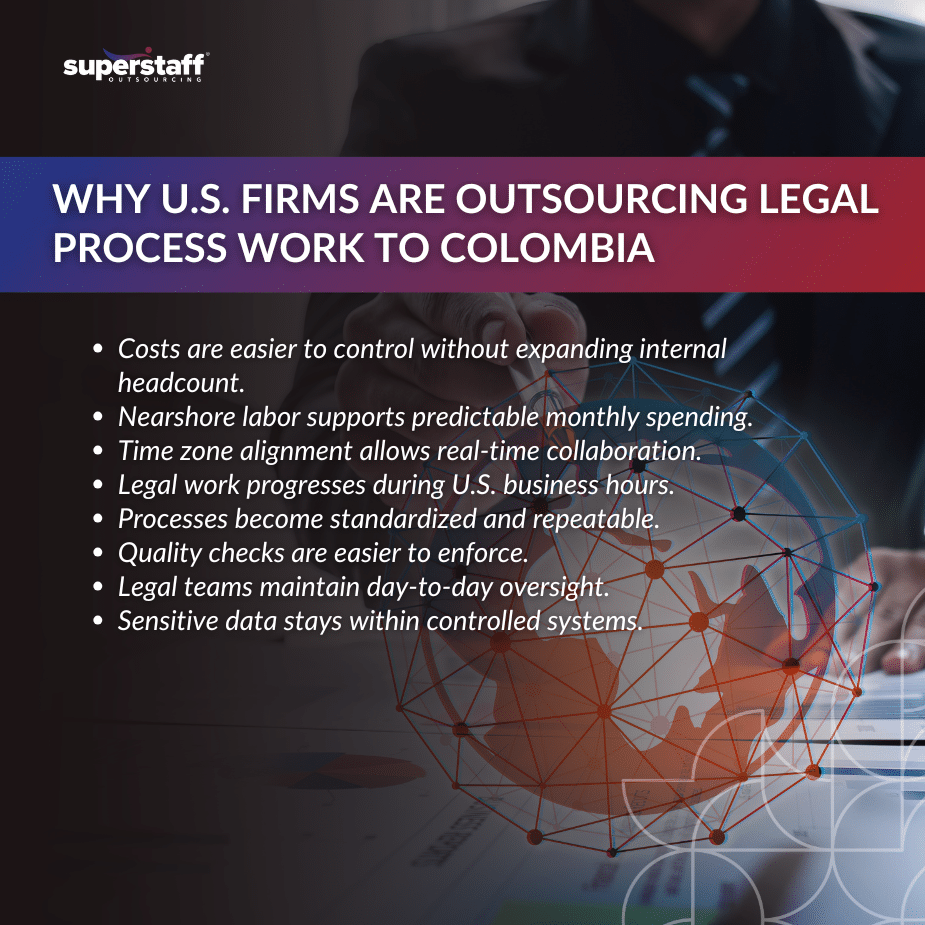
Outsourcing legal process work introduces flexibility into a rigid cost structure. It allows firms to align staffing levels with real demand. Costs become predictable. Resources expand or contract without internal disruption.
Colombia fits this model because nearshore labor economics support savings without compromising oversight.
Why Colombia Aligns With U.S. Legal Operations
Geography matters in legal outsourcing. Time zones matter even more. Colombia operates on U.S.-aligned business hours, which changes how legal teams collaborate.
Work does not pause overnight. Questions are resolved in real time. Reviews happen the same day. Escalations move quickly.
This alignment gives outsourcing legal process initiatives a level of control that offshore-only models struggle to match. U.S. attorneys stay in the driver’s seat. Colombian teams operate as an extension of in-house staff.
Cultural compatibility also plays a role. Legal process outsourcing Colombia teams are accustomed to structured workflows and formal documentation. Their work demands consistency, not improvisation.
Legal Process Tasks That Are Ideal for Outsourcing
Not all legal work should be outsourced. Strategic decision-making remains in-house. Judgment-heavy analysis stays with attorneys.
Operational legal tasks are different. These processes follow defined rules. They rely on accuracy, timeliness, and documentation discipline.
Common outsourcing legal process functions include:
- Document review and indexing
- Contract abstraction and clause extraction
- Litigation support preparation
- Case file organization and maintenance
- Legal data entry and validation
- Compliance documentation support
These activities consume significant time but do not require bar admission. When handled offshore, they free attorneys to focus on higher-value work.
Control Improves When Processes Are Centralized
Many legal teams assume outsourcing reduces control. The opposite is often true.
When LPO services for U.S. law firms are fragmented across internal teams, vendors, and freelancers, visibility suffers, standards vary, and documentation becomes inconsistent.
With a dedicated Colombian team, outsourcing legal process work becomes centralized. Processes are standardized. Training is repeatable. Performance metrics are easier to track.
Teams operate under defined service levels. Turnaround times are measured. Quality checks are embedded into daily workflows.
Control improves because work moves through a single, accountable delivery structure.
Risk Management and Compliance Discipline
Here’s another reason why U.S. firms outsource legal process to Colombia: Legal work tolerates little margin for error. Confidentiality and data handling are non-negotiable.
Colombian legal outsourcing teams operate under strict security protocols. Access controls, documented workflows, and role-based permissions are standard practice.
Effective outsourcing legal process models emphasize process governance. Tasks are logged. Changes are documented. Reviews are traceable.
This structure reduces operational risk compared to ad hoc staffing solutions. It also supports internal audits and client reporting requirements.
Scaling Without Hiring Delays
Hiring legal support staff in the U.S. is slow. Recruitment takes time. Training takes longer. Demand often shifts before teams are fully onboarded.
Colombia offers a faster scaling path. Legal process professionals can be added incrementally. Capacity expands without restarting hiring cycles.
This elasticity makes outsourcing legal process work especially valuable during litigation spikes, regulatory changes, or seasonal workload surges.
Firms avoid long-term commitments while maintaining service continuity.
Communication That Supports Legal Precision
Legal work depends on clarity. Miscommunication creates rework. Delays increase risk.
Colombian legal teams working nearshore communicate during U.S. business hours. Questions are addressed immediately. Feedback loops are tight.
English proficiency supports accurate documentation and reporting. Written communication meets professional standards expected by U.S. legal teams.
These factors strengthen outsourcing legal process outcomes by reducing friction between onshore and nearshore staff.
Nearshore Versus Traditional Offshore Models
Traditional offshore outsourcing often introduces time lag. Reviews happen a day later. Corrections stack up. Urgency gets lost.
Nearshore delivery changes that dynamic. Colombia’s proximity supports faster iteration. Work moves forward continuously rather than in batches.
For outsourcing legal process initiatives, this difference matters. Legal deadlines are unforgiving. Responsiveness protects client trust.
Nearshore teams allow legal leaders to maintain momentum without sacrificing oversight.
Financial Predictability for Legal Leadership
Budgeting legal operations is difficult when workloads fluctuate. Fixed headcount creates rigidity. Variable staffing creates uncertainty.
Outsourcing introduces cost transparency. Monthly rates are defined. Capacity is visible. Adjustments are planned, not reactive.
With outsourcing legal process work handled by a partner, legal leaders gain clearer financial forecasting. This supports better pricing decisions and client negotiations.
Predictability strengthens both profitability and planning discipline.
How SuperStaff Supports Legal Process Outsourcing
SuperStaff applies its operational expertise to legal process delivery through structured nearshore teams in Colombia. The focus is on consistency, accountability, and client control.
Teams are trained on client-specific workflows. Documentation standards are enforced. Reporting is transparent.
SuperStaff understands that outsourcing legal process work is not transactional. It requires alignment with how legal teams operate under pressure.
Delivery models are designed to support attorneys, not replace them.
A Strategic Shift, Not a Tactical Shortcut
Legal outsourcing succeeds when treated as an operating model, not a cost hack. Colombia enables that shift by combining proximity, talent, and discipline.
U.S. firms that adopt outsourcing legal process strategies gain flexibility without losing authority. Costs stabilize. Control improves. Teams focus on what matters most.
This approach reflects how modern legal operations are evolving.
Considering Outsourcing Legal Process Work to Colombia? Partner With SuperStaff!
As legal teams face rising demands and tighter margins, outsourcing legal process work to Colombia offers a practical path forward. It balances cost efficiency with operational control while supporting real-time collaboration.
SuperStaff helps U.S. firms implement this model with disciplined teams and clear governance. Are you seeking cost-effective legal process outsourcing in Colombia? Explore how our BPO team can support your legal operations and help your firm scale with confidence.