

First impressions in healthcare often happen before a patient ever sees a clinician. They start with a phone call, a voicemail, or a scheduling request. These early interactions quietly shape how patients judge competence, reliability, and care quality.
At this stage, customer service in healthcare becomes a defining operational function. It influences whether patients feel confident moving forward or hesitate before committing to care.
The first appointment is a trust checkpoint
Patients often reach out when something feels urgent or uncertain. They may be dealing with pain, anxiety, or confusion about next steps. The way their call is handled signals how seriously their concerns are taken.
Here’s why healthcare customer service matters: A calm, informed response builds reassurance. Meanwhile, a rushed or disorganized exchange introduces doubt.
Healthcare leaders who view the first appointment as a trust checkpoint design customer service in healthcare to support clarity and confidence from the start.
Scheduling conversations carry emotional weight
Scheduling is often treated as a routine task. In reality, it carries emotional weight for patients who may already feel vulnerable.
They want clear answers. They want to know what to expect. They want to feel heard.
Effective customer service in healthcare balances efficiency with attentiveness. Agents must manage time without sounding transactional or dismissive.
Intake accuracy protects patient experience
Errors at intake create downstream issues. Incorrect appointment details, missing information, or unclear instructions lead to frustration and repeat calls.
Each correction chips away at trust. Patients begin to question reliability.
Strong customer service in healthcare emphasizes accuracy during intake. Clear confirmation of details reduces friction and sets expectations early.
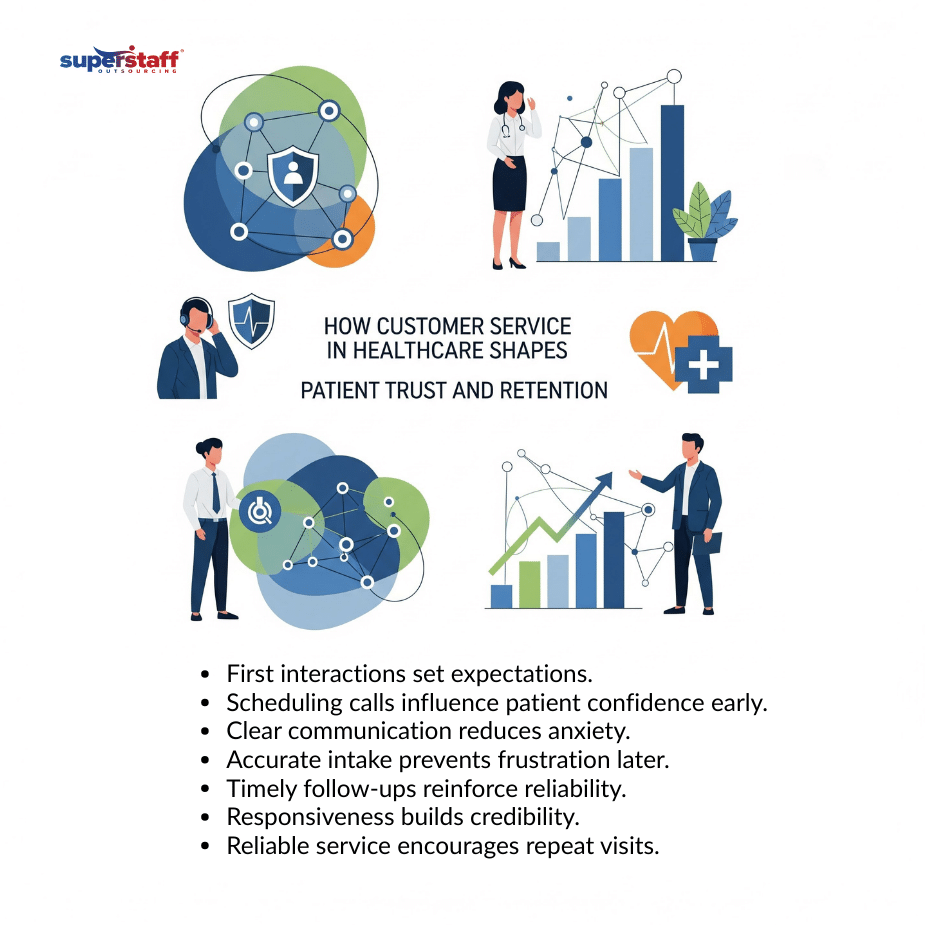
Follow-ups close the experience loop
Care does not end when the appointment does. Healthcare companies must prioritize the following patient retention strategies: Confirm next steps through follow-up calls, clarify instructions, and ensure continuity.
Patients notice when follow-ups are delayed or inconsistent. They also notice when communication feels coordinated and timely.
Healthcare organizations that prioritize follow-ups strengthen customer service in healthcare by reinforcing reliability after care is delivered.
Reminder calls reduce uncertainty
Appointment reminders are more than operational safeguards. They are reassurance touchpoints.
A clear reminder confirms that the appointment is valued. It gives patients space to ask last-minute questions or address concerns.
When reminder calls are handled by trained agents, customer service in healthcare supports both attendance and satisfaction.
Responsiveness signals operational discipline
Patients expect responsiveness, especially when navigating healthcare systems. Long hold times and unanswered calls suggest internal strain.
Responsiveness communicates discipline. It shows that systems and staffing are aligned with patient demand.
A scalable customer service in healthcare model ensures responsiveness even during peak periods.
Missed calls affect care continuity
Every missed call represents a potential gap in care. Patients may delay treatment, seek alternatives, or disengage altogether.
Healthcare organizations often underestimate how many patients do not call back. Silence is not neutral. It signals lost opportunity.
By strengthening customer service in healthcare coverage, providers reduce missed connections and protect care continuity.
Consistency builds familiarity
Patients interact with multiple representatives across their journey. Consistent tone, messaging, and process reduce cognitive load.
Inconsistency creates confusion. It forces patients to re-explain their situation.
A unified customer service in healthcare approach ensures patients feel recognized and supported, even when speaking with different agents.
Training defines service quality
Healthcare conversations require more than basic call handling skills. Agents must understand terminology, workflows, and privacy boundaries.
Training should reinforce:
- Clear communication without clinical overreach
- Proper documentation and handoffs
- Calm handling of anxious or frustrated callers
- Respect for patient confidentiality
Well-trained teams elevate customer service in healthcare by reducing errors and improving confidence.
Offshore teams support service stability
Staffing challenges remain a constant pressure for U.S. healthcare organizations. Hiring locally for non-clinical roles is increasingly difficult.
Offshore support offers stability when structured correctly. Philippine-based teams are known for communication clarity and service orientation.
When integrated properly, offshore teams strengthen customer service in healthcare without compromising standards or compliance.
Time zone coverage improves access
Patients do not operate on office schedules. Many call before work, after hours, or during weekends.
Limited availability creates access barriers. Patients may delay care or abandon attempts to schedule.
Extended coverage through offshore teams expands customer service in healthcare availability while protecting internal staff from burnout.
Documentation supports operational insight
Every patient interaction contains insight. Questions asked, complaints raised, and delays encountered reveal systemic issues.
Accurate documentation turns conversations into operational intelligence. Leaders gain visibility into recurring friction points.
Customer service in healthcare becomes a feedback engine when data flows back into process improvement.
Follow-ups support long-term retention
Retention is not driven by a single positive interaction. It is built through repeated signals of reliability.
Follow-up calls demonstrate accountability. They show patients that the organization remains engaged after the visit.
Consistent follow-ups strengthen customer service in healthcare by reinforcing trust beyond the appointment itself.
Reducing administrative strain on care teams
When front-end service functions falter, clinical teams absorb the fallout. They answer scheduling questions, chase missing information, and manage frustrated patients.
This diverts focus from care delivery. It increases fatigue across roles.
A strong customer service in healthcare operation protects clinical capacity by resolving issues before they escalate.
Aligning service with care values
Healthcare organizations often articulate patient-centered values. Those values must be visible in service interactions.
Tone, patience, and clarity reflect organizational culture. They influence how patients interpret care quality.
Customer service in healthcare becomes a visible extension of care values when agents are empowered and supported.
Measuring what matters
Service metrics should reflect patient experience, not just call volume. Resolution quality and first-contact accuracy matter.
Healthcare leaders benefit from reviewing service trends alongside clinical outcomes. Patterns often overlap.
When customer service in healthcare is measured thoughtfully, it becomes a strategic lever rather than a cost center.
The SuperStaff healthcare delivery model
SuperStaff partners with healthcare organizations to provide dedicated call center teams in the Philippines. These teams support appointment scheduling, reminders, and follow-ups with consistency and care.
Our agents are trained to follow U.S. healthcare workflows, respect privacy requirements, and communicate clearly. We align service delivery with your internal processes.
By strengthening customer service in healthcare, SuperStaff helps providers improve patient trust while maintaining operational stability.
Designing for scale without losing quality
Growth often exposes service gaps. As patient volumes increase, small inefficiencies compound.
Scalable service design ensures quality holds as demand grows. Offshore teams provide capacity without sacrificing control.
Customer service in healthcare must scale intentionally to protect patient experience during expansion.
Building predictable patient experiences
Patients value predictability. They want to know what will happen next and when.
Predictable service interactions reduce anxiety and confusion. They make healthcare systems feel manageable.
A disciplined customer service in healthcare approach creates this predictability through clear workflows and communication standards.
Supporting patient loyalty through reliability
Loyalty in healthcare is rooted in trust. Trust grows when organizations consistently meet expectations.
Service interactions shape those expectations daily. They influence whether patients return or look elsewhere.
Customer service in healthcare plays a direct role in loyalty by delivering reliable, respectful experiences.
Preparing for future expectations
Patient expectations around access and communication will continue to rise. Digital tools help, but human support remains essential.
Healthcare leaders who invest in service infrastructure prepare their organizations for future demand.
Customer service in healthcare becomes a resilience factor when systems are designed to adapt.
Trust SuperStaff for Reliable Customer Service in Healthcare
Strengthening service operations requires focus, training, and capacity. It also requires a partner who understands healthcare realities.
Are you wondering how customer service in healthcare builds patient trust and retention? Find out by partnering with SuperStaff. Our team supports healthcare organizations by delivering reliable offshore customer service teams that integrate seamlessly with U.S. operations.
If you are ready to improve patient trust, retention, and access through stronger customer service in healthcare, explore how SuperStaff can support your goals today.