Healthcare organizations operate in one of the most documentation-heavy environments in modern business. Every process, interaction, and decision must be recorded with clarity and accuracy. That pressure is why many providers are turning to technical writing outsourcing as a strategic way to improve compliance while maintaining operational efficiency.
Regulatory requirements continue to evolve across clinical, operational, and digital workflows. At the same time, documentation expectations from auditors, partners, and patients are increasing. Leaders must ensure accuracy without slowing down innovation or overburdening internal teams.
Why healthcare documentation is becoming more complex
Healthcare documentation is no longer limited to policy manuals and clinical guides. Organizations now manage layered requirements across privacy laws, digital platforms, and payer documentation. Each layer increases the risk of inconsistency.
This complexity is pushing executives to rethink documentation models. Many are exploring technical writing outsourcing to maintain quality without expanding internal headcount. External specialists bring process discipline that is often difficult to scale internally.
Compliance risk often starts with unclear documentation
Compliance failures are frequently rooted in miscommunication. Policies may exist, but if they are hard to understand, teams struggle to follow them consistently. That gap creates exposure during audits.
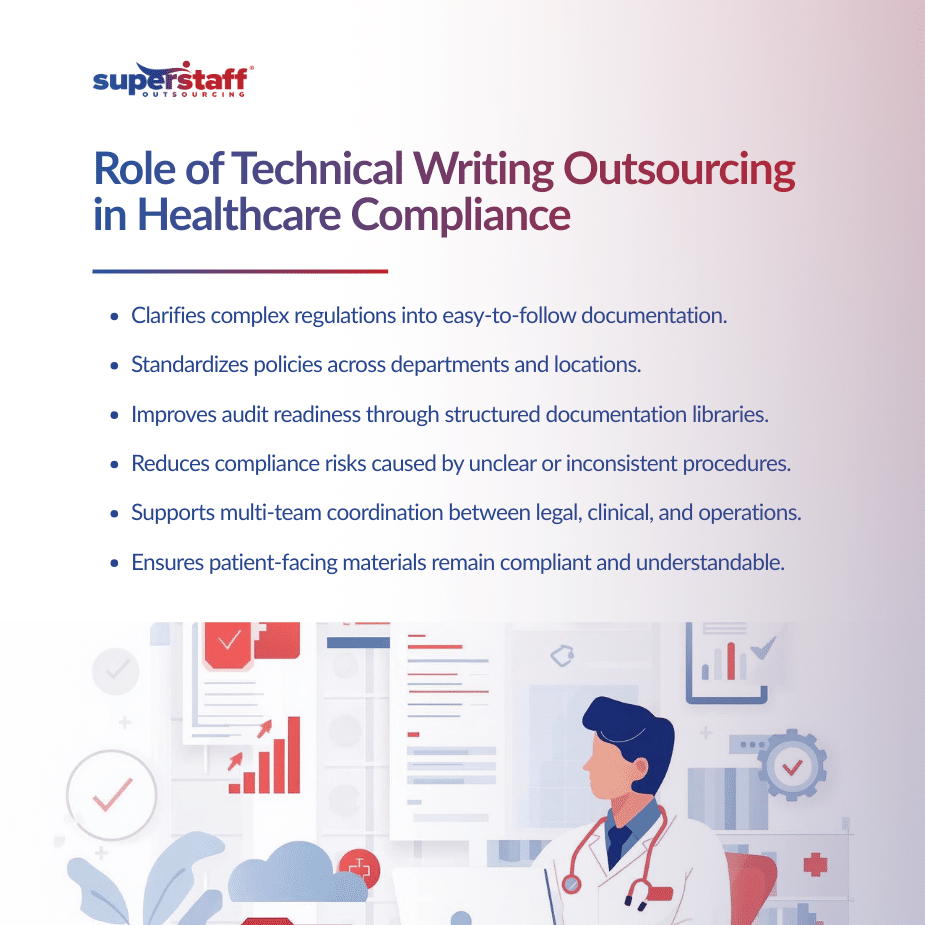
Clear writing reduces ambiguity across departments. Through technical writing outsourcing, healthcare organizations can standardize how procedures are documented and communicated. Structured language makes it easier for clinicians and administrators to align with regulatory expectations.
Supporting multi-department coordination
Healthcare compliance rarely sits in a single department. Legal teams, clinical leaders, operations managers, and IT stakeholders all contribute to documentation. Without coordination, inconsistencies quickly emerge.
External writing partners bring neutrality and structure. With technical writing outsourcing, organizations can unify documentation across departments while maintaining a consistent tone and format. This alignment simplifies internal reviews and external audits.
Improving audit readiness without adding internal workload
Audit preparation is often reactive. Teams scramble to locate documents, clarify revisions, and reconcile versions. That reactive model drains resources and increases stress.
A proactive approach is becoming more common. Many organizations use technical writing outsourcing to maintain audit-ready documentation throughout the year. External writers help create version-controlled libraries that support faster validation during regulatory reviews.
Enhancing clarity in patient-facing materials
Compliance is not limited to internal documentation. Patient instructions, consent forms, and care guides must also meet regulatory standards while remaining easy to understand. Poorly written materials create legal and reputational risks.
Professional writers specialize in simplifying complex concepts. Through technical writing outsourcing, healthcare providers can ensure patient-facing materials are both compliant and accessible. This clarity strengthens trust and reduces misinterpretation.
Clear communication also improves adherence. When patients understand instructions, outcomes tend to improve. That alignment benefits both care quality and organizational risk management.
Supporting digital transformation initiatives
Healthcare systems are rapidly adopting new platforms for telehealth, patient portals, and electronic records. Each new system introduces new documentation requirements. Without clear guidance, adoption slows.
Digital rollouts benefit from structured communication. Organizations often rely on technical writing outsourcing to create user guides, workflows, and compliance documentation for new technologies. Clear documentation accelerates adoption and reduces support burden.
Well-documented systems also reduce training time. Employees learn faster when instructions are structured and consistent. This advantage becomes especially valuable during large-scale system rollouts.
Standardizing knowledge across distributed teams
Many healthcare organizations now operate across multiple locations or hybrid work models. Distributed teams make documentation consistency harder to maintain. Version control becomes a major challenge.
Centralized documentation strategies help solve this issue. With technical writing outsourcing, organizations can build standardized repositories that keep all teams aligned. Consistent documentation improves training outcomes and reduces operational friction.
Standardization also supports continuity. When staff turnover occurs, structured documentation preserves institutional knowledge. This stability reduces operational disruption during transitions.
Strengthening collaboration with external partners
Healthcare ecosystems involve insurers, vendors, and regulatory bodies. Documentation must often be shared externally, which raises the bar for clarity and professionalism. Poor documentation can delay partnerships or approvals.
Professional documentation supports stronger collaboration. Many providers use technical writing outsourcing to produce partner-ready materials that reflect operational maturity. Clear documentation speeds onboarding and reinforces credibility.
Strong documentation also signals operational discipline. Partners are more confident working with organizations that demonstrate clarity and consistency in their processes.
Enabling scalability during growth or transitions
Healthcare organizations frequently undergo mergers, expansions, or service diversification. Growth introduces new documentation requirements almost overnight. Internal teams may struggle to keep up.
Flexible documentation support becomes essential during these periods. Leaders increasingly adopt technical writing outsourcing to scale documentation without long hiring cycles. External teams provide continuity during periods of rapid change.
This flexibility allows leaders to move faster. Instead of delaying expansion due to documentation gaps, organizations can maintain compliance while scaling operations.
Reducing the burden on clinical and operational leaders
Subject matter experts often carry documentation responsibilities despite already heavy workloads. Clinicians and operations leaders may be forced to write manuals or policies outside their core expertise. This creates inefficiencies and inconsistencies.
Delegating documentation tasks creates better alignment. With technical writing outsourcing, healthcare organizations allow experts to focus on patient care and strategy while trained writers handle structured documentation. This division of labor improves both accuracy and productivity.
It also improves morale. Removing administrative strain helps professionals stay focused on high-value work. Over time, that shift supports stronger retention and engagement.
Turning documentation into a strategic advantage
Many organizations still view documentation as a compliance requirement rather than a strategic asset. However, clear and structured documentation supports scalability, partnership readiness, and operational resilience. Strong documentation frameworks can even accelerate innovation.
Forward-thinking leaders are reframing their approach. Through technical writing outsourcing, documentation becomes a foundation for growth rather than a reactive obligation. Structured knowledge enables faster decision-making and smoother expansion.
Organizations with strong documentation maturity often respond better to change. Whether facing regulatory updates or operational shifts, clarity allows teams to adapt quickly.
Building a sustainable documentation model
Sustainability is becoming a key concern for healthcare operations. Documentation strategies must withstand regulatory changes, technological shifts, and workforce transitions. Short-term fixes rarely hold up under long-term pressure.
A hybrid model is gaining traction. Organizations are combining internal oversight with technical writing outsourcing to maintain continuity and flexibility. This model ensures institutional knowledge is preserved while allowing documentation capacity to scale as needed.
Sustainable models also support long-term governance. With structured documentation ownership, updates become routine instead of reactive. That consistency reduces compliance risk over time.
Strengthen healthcare compliance through technical writing outsourcing
Healthcare documentation will only become more complex as regulations and technologies evolve. Organizations that invest in clarity today position themselves for smoother audits, stronger partnerships, and better patient communication tomorrow.
Adopting technical writing outsourcing allows healthcare leaders to maintain compliance while improving operational agility. With the right partner, documentation shifts from a compliance burden into a strategic enabler.
SuperStaff supports healthcare organizations with structured documentation services designed for regulated environments. Our teams help standardize workflows, improve clarity, and support compliance across departments. Explore how SuperStaff can strengthen your documentation strategy and build a more resilient foundation for growth.