Outsourcing decisions are becoming less about finding the lowest hourly rate. Business leaders also consider working hours, talent, communication, service quality, and how easily an external team can fit into existing operations.
This puts Colombia outsourcing vs offshore markets into a useful comparison for US businesses. Traditional offshore destinations still offer large talent pools and competitive pricing. Colombia offers a different mix, with geographic proximity, overlapping US business hours, and a growing BPO sector. Neither model fits every function, making the right choice dependent on what a business needs from its outsourced team.
Where Colombia Fits in the Outsourcing Market
Colombia has developed into a notable nearshore destination for North American businesses. Its location gives it advantages that traditional offshore hubs cannot offer, while its labor market can provide an alternative to domestic hiring.
1. Is Colombia Nearshore or Offshore Outsourcing?
For US businesses, Colombia is considered a nearshore outsourcing destination. Its location in Latin America places teams much closer to US operations than major outsourcing markets in Asia.
This proximity makes Colombia suitable for functions that require frequent interaction between internal and external staff.
2. Overlapping Hours Support Real-Time Work
One of Colombia’s main advantages is its alignment with US working hours. Managers can speak with outsourced staff, review work, answer questions, and address problems during the same business day.
For customer-facing or collaborative functions, this can simplify daily management.
3. Bilingual Talent Supports US Accounts
English proficiency is an important factor when outsourcing customer service, sales support, technical assistance, and other communication-heavy roles.
Colombia has a growing bilingual workforce, particularly in major business centers. Providers can recruit professionals based on the language level and industry knowledge required for each account.
4. Established BPO Locations Offer Wider Talent Access
Bogotá, Medellín, Cali, Barranquilla, and other Colombian cities support business services and outsourcing operations. This gives providers access to talent beyond a single location.
A wider recruitment base can also help businesses build teams across customer service, finance, IT, healthcare support, and back-office functions.
5. Pricing Sits Between Cost and Accessibility
Colombia may not always match the lowest rates available in large offshore markets. However, hourly cost is only one part of an outsourcing budget.
Businesses also need to consider training, management time, rework, staff turnover, communication, and service performance. These factors can change the actual cost of an outsourced operation.
Why Businesses Compare Nearshore and Offshore Models
Nearshore and offshore outsourcing solve different operational problems. The better choice depends on the work being transferred, how often teams need to interact, and how much price influences the decision.
1. Offshore Can Offer Lower Labor Costs
Large offshore markets remain attractive for businesses that need substantial staffing at competitive rates. They can be particularly useful for standardized processes that do not require constant interaction with an internal US team.
However, the lowest hourly rate does not automatically produce the lowest total operating cost. Management requirements, training, rework, and delays should also be considered.
2. Nearshore Makes Same-Day Communication Easier
A similar schedule allows questions and problems to be addressed while both teams are working.
An offshore setup with a large time difference may work well for processes designed around overnight handoffs. For tasks that require frequent conversations, nearshore locations can be easier to manage.
3. Communication Requirements Vary by Role
Not every outsourced position needs the same level of interaction.
Data processing may work effectively across distant time zones. Customer service, account management, sales support, and complex back-office work may benefit from closer contact with internal staff.
This distinction should influence location decisions.
4. Operational Flexibility Can Be Important
Priorities can change during the workday. A customer issue may need escalation, a manager may request a revision, or a client may need an immediate response.
Shared working hours make these changes easier to manage without waiting for another shift to begin.
5. Visibility Can Affect Management
Some organizations want frequent contact with their outsourced staff. Others prefer a provider to manage operations with limited daily involvement.
Nearshore arrangements can make direct interaction easier when managers need greater visibility into workflows, performance, or customer issues.
What Is Driving Colombia’s Nearshore Growth?
Colombia combines several features that appeal to organizations looking for an outsourcing location close to the United States.
1. Real-Time Collaboration
Among the main nearshore outsourcing benefits Colombia offers is the ability to collaborate during regular US business hours.
Internal and outsourced staff can attend the same meetings, exchange information, and handle urgent requests without relying heavily on overnight handoffs.
2. Talent Across Different Business Functions
The country’s workforce supports roles in customer experience, back-office operations, finance, technology, sales, and other business functions.
This variety allows organizations to consider Colombia for work beyond traditional call center services.
3. Developing Outsourcing Ecosystem
Colombia has attracted international BPO providers and companies serving overseas clients. Its outsourcing ecosystem includes recruitment, training, technology, office infrastructure, and professional services that support international operations.
For buyers, an established ecosystem can make expansion easier than entering a market with limited BPO experience.
4. Digital and Telecommunications Infrastructure
Modern outsourcing depends heavily on stable connectivity and secure systems. Major Colombian business centers have telecommunications and office infrastructure designed to support service operations.
Buyers should still assess each provider’s technology, security measures, backup systems, and business continuity plans before signing an agreement.
5. Access to North America
Travel between Colombia and major US cities is another practical benefit. When in-person visits are necessary, shorter travel distances can make site visits, training sessions, and management meetings easier to arrange.
This may be particularly useful for complex accounts that require closer client-provider interaction.
Why Companies Choose Nearshore Over Offshore in 2026
Nearshoring is not replacing offshore outsourcing. Instead, businesses are becoming more selective about which functions belong in each model.
1. Some Roles Need Faster Decisions
Processes involving customers, sales, operations, or complex cases may require quick input from US-based managers.
When teams share working hours, decisions can be made without waiting until the following day.
2. Customer-Facing Work Requires Careful Alignment
Customer experience depends on communication skills, product knowledge, service standards, and access to supervisors.
For businesses serving US customers, nearshore operations can align working hours, making escalations and management support easier.
3. Collaboration Is Simpler During Shared Hours
Departments such as operations, finance, customer experience, and IT may need regular contact with outsourced staff.
A similar schedule makes it easier to include external employees in meetings, training, coaching, and routine discussions.
4. Value Matters Alongside Price
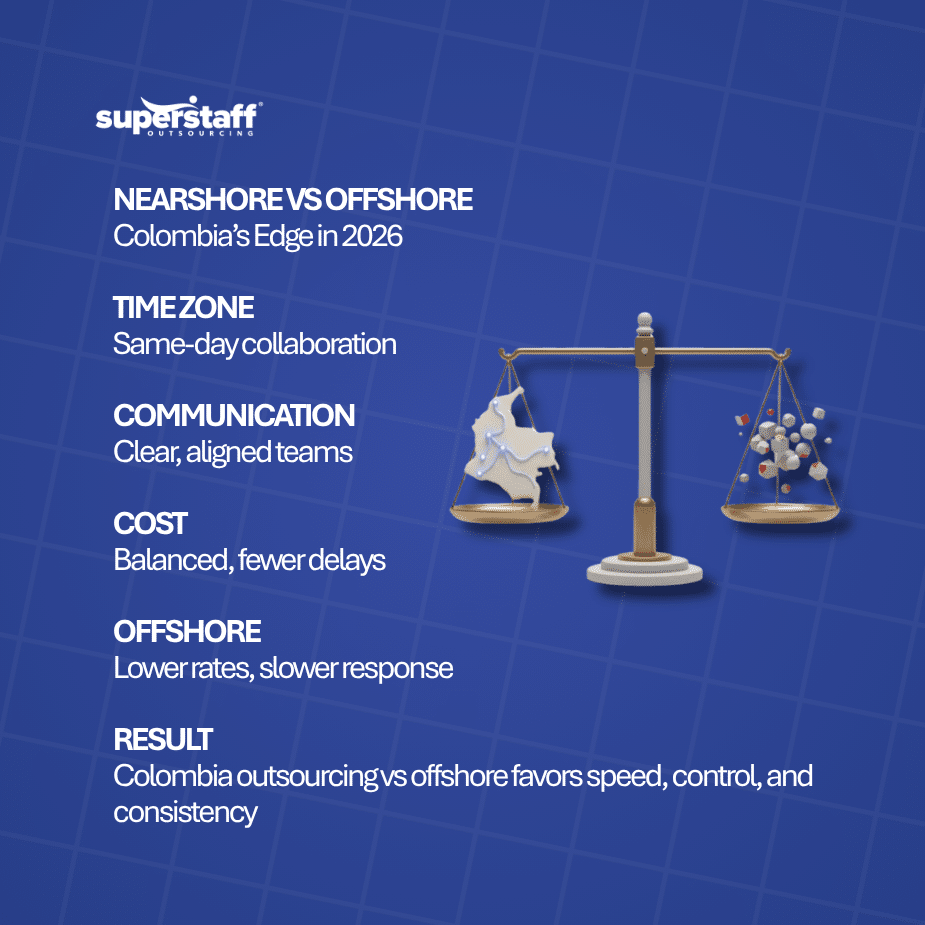
The Colombia outsourcing vs offshore decision should consider total value rather than hourly rates alone.
A lower rate can be attractive for high-volume work. For other functions, businesses may value response times, communication, accuracy, and management access more.
5. Proximity Can Support Complex Accounts
Some outsourcing relationships involve site visits, face-to-face training, or regular leadership meetings.
Colombia’s location can make these activities easier for North American clients compared with destinations that require longer travel.
Colombia vs Offshore Markets in 2026
The answer is not that one model is better than the other. Each serves different business needs.
Offshore destinations remain important for large-scale operations, round-the-clock coverage, and cost-sensitive processes. Their mature outsourcing sectors give buyers access to deep talent pools and established delivery models.
Colombia becomes particularly relevant when work requires overlapping hours, regular interaction, bilingual talent, or easier access from the United States. These features can make nearshoring suitable for customer-facing and collaborative functions.
Hybrid models are also an option. A business could place high-volume processing with an offshore team while using a Colombian operation for work that requires closer coordination. Location can then be selected according to the needs of each function rather than applying one model across the entire organization.
Build the Right Outsourcing Strategy With Colombia
Choosing between Colombia outsourcing vs offshore locations comes down to the work being outsourced. Offshore markets may be suitable when scale, around-the-clock operations, and lower labor costs are the main priorities. Colombia can be a better fit when shared working hours, communication, accessibility, and collaboration carry greater weight.
SuperStaff helps businesses evaluate outsourcing options across customer support, back-office operations, and specialized services. We help clients build teams based on their operational requirements rather than relying on a single outsourcing model.
Talk to SuperStaff to explore whether Colombia fits your outsourcing plans for 2026.