
Clear and steady operations help a business stay productive. However, daily tasks can pile up and take time away from planning, customer service, and other important work. This is where operations outsourcing becomes a practical option. It allows companies to assign selected processes to skilled external teams while maintaining oversight of performance and results.
Businesses can use operations outsourcing to handle repetitive and time-consuming tasks, improve workflows, and add resources when demand changes. With the right outsourcing structure, companies can reduce pressure on internal teams while maintaining consistent processes across departments.
Why Businesses Choose Operations Outsourcing
Companies use operations outsourcing for different reasons depending on their size, workload, and business goals. For many organizations, the main objective is to improve how resources are used without adding unnecessary work to internal teams.
1. Better Focus on Core Tasks
Routine administrative and operational tasks can take employees away from work that requires internal knowledge and decision-making. Outsourcing selected processes allows employees to spend more time on planning, client relationships, product development, and other core responsibilities.
Companies considering this approach can review the benefits of back-office outsourcing and determine which routine functions could be assigned to an external team.
2. Better Cost Management
Recruiting, onboarding, training, equipment, and employee benefits can add to operating expenses. Operations outsourcing gives businesses another staffing option without requiring them to build every function internally.
The actual savings depend on the type of work, location, service model, and provider agreement. Companies should compare the full cost of internal operations with the proposed outsourcing arrangement before making a decision.
3. Access to Skilled Professionals
Outsourcing providers can give businesses access to people with experience in customer support, finance, IT, data management, and other operational areas. This can reduce the time required to recruit and train employees for certain roles.
4. Faster Process Completion
External teams can work within defined workflows, service levels, and timelines. When processes are documented clearly, outsourcing can reduce backlogs and keep routine tasks moving without placing additional work on internal employees.
5. Flexible Scaling Options
Business demand can change throughout the year. Companies may need additional people during product launches, peak sales periods, or seasonal increases in customer inquiries.
Operations outsourcing allows businesses to adjust external staffing based on workload and contract terms instead of relying only on permanent internal hiring.
Key Processes Handled Through Outsourcing
Operations outsourcing can cover a wide range of front-office and back-office functions. The right processes to outsource depend on the company’s internal resources, security requirements, and business priorities.
1. Customer Support Services
Customer service teams handle inquiries, complaints, order questions, technical concerns, and follow-ups. Outsourcing can provide additional coverage when internal teams cannot manage growing contact volumes.
Businesses can also use customer service outsourcing to expand their support capacity and provide assistance across different customer communication channels.
2. Data Entry and Management
Business records need to remain accurate and organized. External teams can assist with data entry, record updates, database maintenance, document processing, and other repetitive data tasks.
Companies should establish validation procedures and access controls to maintain accuracy and protect sensitive information.
3. Finance and Accounting Tasks
Businesses may outsource selected finance functions such as bookkeeping, billing, accounts payable, accounts receivable, and payroll administration.
However, companies should maintain appropriate internal oversight, approval procedures, and financial controls for outsourced processes.
4. IT and Technical Support
Technical problems can affect employee productivity and business operations. Outsourced IT teams can handle selected support requests, troubleshooting, system monitoring, and other technical tasks based on the agreed service scope.
5. Supply Chain Coordination
External teams can also assist with inventory records, shipment tracking, supplier communication, order processing, and logistics administration. This can provide internal supply chain teams with additional operational support.
How to Implement Operations Outsourcing Successfully
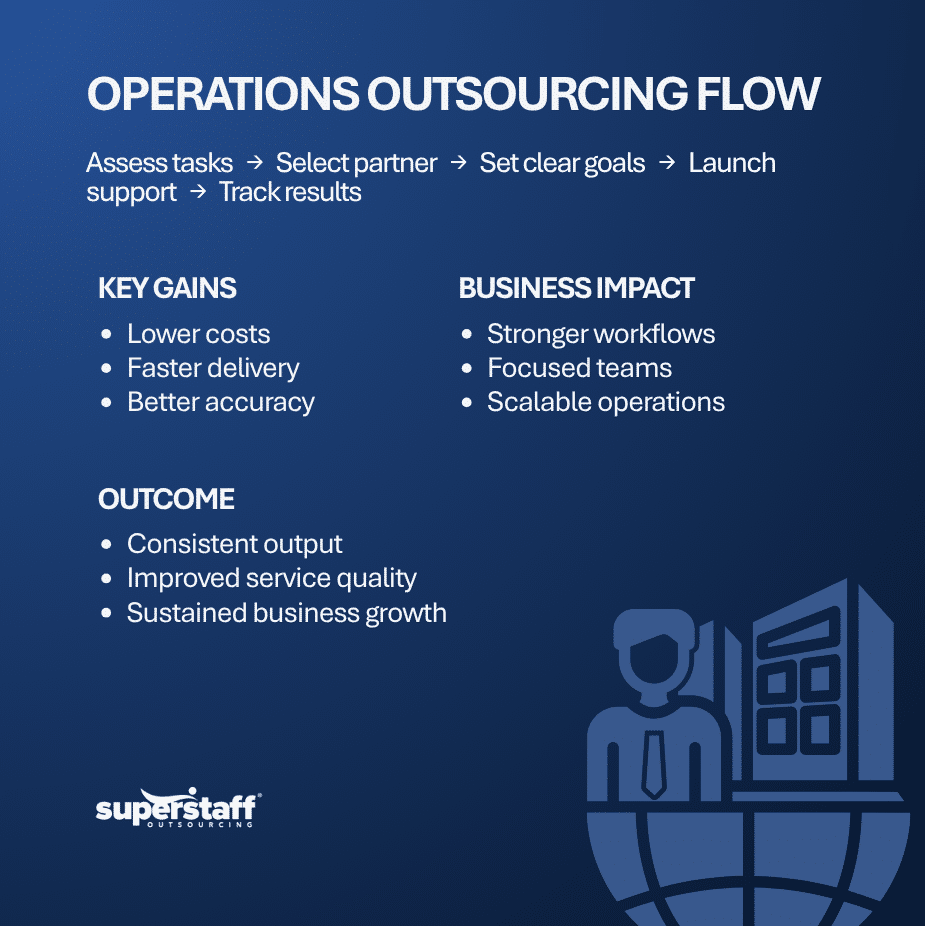
Successful outsourcing requires more than transferring tasks to another team. Companies need clear responsibilities, documented processes, measurable goals, and regular communication.
1. Identify Tasks to Outsource
Start by reviewing existing workflows. Look for repetitive tasks, growing backlogs, skill gaps, and processes that consume significant employee time.
Companies should also identify functions that need to remain internal because of strategic, regulatory, security, or operational requirements.
2. Choose the Right Outsourcing Partner
Evaluate potential providers based on their experience, staffing capabilities, security practices, technology, communication processes, and ability to meet your requirements.
Businesses exploring external operational support can learn more about SuperStaff and the different front-office and back-office outsourcing solutions available.
3. Set Clear Expectations
Define the scope of work before operations begin. This should include responsibilities, timelines, quality requirements, reporting procedures, escalation processes, and key performance indicators.
Clear expectations give both internal and external teams a common standard for measuring performance.
4. Maintain Regular Communication
Scheduled meetings, progress reports, and shared communication channels can keep both teams informed. Businesses should also establish clear points of contact so employees know who to approach when questions or problems occur.
5. Monitor Performance Consistently
Performance should be reviewed throughout the outsourcing relationship. Businesses can use reports, quality checks, customer feedback, and operational data to identify areas that require improvement.
Common Challenges and How to Address Them
Operations outsourcing can provide additional resources, but companies still need to manage several potential challenges.
1. Communication Gaps
Different teams, locations, and schedules can affect communication. Defined channels, meeting schedules, escalation procedures, and documentation can reduce confusion.
2. Quality Control Concerns
Quality standards should be established before work begins. Businesses can use sample reviews, audits, performance targets, and regular feedback to maintain consistency.
3. Data Security Risks
External teams may require access to company or customer information. Businesses should review provider security practices, access controls, confidentiality requirements, and data-handling procedures.
The National Institute of Standards and Technology Cybersecurity Framework provides guidance that organizations can use when managing and reducing cybersecurity risks.
4. Cultural and Time Differences
Time zones and communication styles may affect collaboration. Companies can address these differences by defining working hours, response expectations, meeting schedules, and communication standards before operations begin.
5. Dependence on External Teams
Businesses should maintain internal ownership of important decisions and processes. Documentation, knowledge transfer, backup plans, and clear governance can reduce excessive dependence on one provider.
Measuring the Success of Outsourcing Efforts
Businesses need measurable indicators to determine whether operations outsourcing is meeting its objectives.
1. Cost Efficiency
Compare the total cost of the outsourced process with its previous internal cost. Include staffing, training, technology, management, and other related expenses when making the comparison.
2. Task Completion Time
Track turnaround times before and after outsourcing. Faster completion can indicate improved efficiency, provided quality standards remain consistent.
3. Quality of Output
Review accuracy, error rates, rework, compliance with procedures, and other quality measures relevant to the outsourced function.
4. Customer Satisfaction
For customer-facing processes, companies can monitor customer satisfaction scores, response times, resolution rates, and customer feedback.
5. Internal Team Productivity
Businesses should also assess whether outsourcing has reduced internal workloads. If employees have more time for strategic and specialized work, the outsourcing arrangement may be supporting its intended purpose.
Build Stronger Workflows With Outsourcing Support
Operations outsourcing can support businesses that need additional resources without expanding every function internally. A structured outsourcing model can:
- Reduce repetitive workloads for internal teams
- Improve turnaround times for routine processes
- Provide access to specialized skills
- Support changing staffing requirements
- Maintain consistent service across defined workflows
The results depend on selecting suitable processes, setting clear expectations, and maintaining regular oversight. Outsourcing works best when external teams operate as part of a defined business process rather than as a separate function with limited visibility.
Improve Your Operations With the Right Support
Operations outsourcing gives businesses another way to manage workloads, control resources, and maintain consistent processes. From customer service and data management to finance and technical support, companies can choose which functions make sense to handle externally while keeping important decisions under internal control.
SuperStaff provides skilled outsourcing teams for businesses that need front-office and back-office operational support. Services can be structured around specific processes, staffing needs, and business requirements.
Ready to discuss which processes could be outsourced? Contact SuperStaff to explore an outsourcing solution based on your operational needs.