Many U.S. SMEs and midmarket companies know they need better document workflows, but they often struggle to decide when, what, and how much to outsource. An outsourcing maturity model gives leaders a practical way to evaluate where their operations stand today and what kind of support they need next. For companies serving U.S. customers while expanding through Colombia, document management outsourcing can turn scattered files, manual reviews, and delayed processing into a more structured, accountable operating system.
This matters because documents sit behind many business-critical activities. Client onboarding, claims support, legal intake, billing, compliance reviews, HR records, vendor documentation, and customer service follow-ups all depend on accurate document handling. When teams lose time searching, rechecking, renaming, routing, and validating files, growth slows down.
For many companies, the issue is not a lack of effort. The issue is maturity. Some businesses still rely on email threads and shared drives. Others have tools but lack consistent workflows. More advanced companies already track document cycle times, exceptions, quality checks, and compliance steps. Each stage needs a different outsourcing approach.
Why document management outsourcing needs a maturity lens
Document management outsourcing works best when leaders understand their current level of operational readiness. A company with no standard filing rules should not outsource the same way as a company with defined workflows and measurable service levels.
The maturity lens helps executives answer practical questions.
- Which document tasks create the most bottlenecks
• Which processes need cleanup before outsourcing
• Which roles should stay internal
• Which workflows can be handled by an offshore or nearshore team
• Which performance measures should guide the partnership
This keeps outsourcing from becoming a quick labor fix. It becomes a structured move toward better visibility, consistency, and control.
For U.S. businesses exploring Colombia support, this approach is especially useful. Colombia offers strong time zone alignment for North American teams, making it easier to collaborate during business hours. When paired with the Philippines for scale and continuity, SuperStaff can help companies build a blended support model that fits their maturity stage.
Stage one means reactive document handling
At the first stage, companies handle documents only when problems appear. Files arrive from different channels. Naming rules vary. Approvals depend on individual follow-ups. Managers spend too much time checking whether work has been completed.
At this level, document management outsourcing should begin with process stabilization. The goal is not to transfer chaos to an external team. The first priority is to map common document types, define intake channels, set basic naming standards, and identify recurring exceptions.
For example, a healthcare company may receive patient forms, insurance documents, authorizations, and billing files across several systems. An outsourced support team can help sort, tag, route, and validate those documents. However, the company must first agree on what counts as complete, urgent, incomplete, or escalated.
At this stage, outsourced document management services create the most value when they reduce administrative drag and give internal teams more breathing room.
Stage two creates repeatable workflows
The second stage begins when a company moves from informal handling to documented workflows. Teams know where files should go. They understand which documents require review. They follow basic quality checks.
This is where document management outsourcing becomes more scalable. External teams can take on recurring tasks with clearer instructions and stronger accountability.
Common workflows may include:
- Document indexing
• Data extraction support
• File classification
• Records updating
• Form validation
• Customer or patient file completion
• Invoice and purchase order processing
• Compliance checklist support
At this level, leaders should focus on accuracy, turnaround time, escalation rules, and communication rhythm. The outsourcing partner should not only process tasks. The partner should also help identify patterns in delays, missing information, and avoidable rework.
For companies in legal, healthcare, finance, logistics, and insurance, this stage is often where business document processing outsourcing starts to show strategic value. It helps teams move from scattered admin work to reliable operational throughput.
Stage three improves visibility and governance
The third stage is where document management outsourcing becomes more performance-driven. The company already has repeatable workflows. Now the priority shifts to reporting, quality governance, and process improvement.
Executives at this stage want better answers. How many files are pending? Which document types create the most exceptions? Where do handoffs slow down? Which teams need clearer requirements? Which work can be automated later?
An experienced BPO partner can support this level by creating structured reporting and helping managers see operational trends. This does not require invented complexity. It requires disciplined execution.
For example, a logistics company may need proof of delivery records, customs documents, shipment updates, and billing support handled within defined timelines. A mature document team can track completion status, flag missing details, and escalate urgent cases before delays affect customers.
Document management outsourcing at this stage gives leaders a cleaner view of operational health. It also helps internal teams focus on decision-making instead of constant manual coordination.
Stage four supports cross-functional integration
The fourth stage happens when document workflows connect across departments. Sales, operations, customer service, finance, compliance, and leadership all rely on the same information being accurate and accessible.
At this level, document management outsourcing must fit into a broader operating model. The work may still involve indexing, validation, and file updates, but the purpose becomes larger. The team helps protect customer experience, revenue flow, audit readiness, and business continuity.
For U.S. companies using Colombia-based support, this stage can be practical because nearshore teams can coordinate closely with internal stakeholders during the same workday. A Colombia team can handle live coordination, client-facing follow-ups, or time-sensitive document reviews. A Philippine team can support volume-based processing, after-hours coverage, or specialized back-office workflows.
This blended model allows companies to design document support around business need rather than location alone.
Stage five turns document operations into strategic capacity
At the highest maturity stage, document management outsourcing becomes part of enterprise capacity planning. Leaders no longer view it as an isolated back-office function. They see it as a way to support growth, compliance, customer experience, and operational resilience.
At this level, teams use clear documentation, stable service levels, quality audits, exception tracking, and continuous improvement. Internal leaders stay focused on policy, risk, strategy, and customer relationships. The outsourced team handles structured execution with discipline and transparency.
This is also where companies can evaluate automation more responsibly. Clean workflows make automation easier to adopt. Poor workflows only make automation harder to manage. A mature outsourcing partner can help prepare the operational foundation before a company invests in more advanced tools.
Document management outsourcing supports this path because it gives businesses trained people, defined processes, and scalable execution before technology becomes the next layer.
How leaders can assess readiness
Companies do not need a perfect system before they start. They need an honest view of their current state.
A leadership team can begin with a few practical questions.
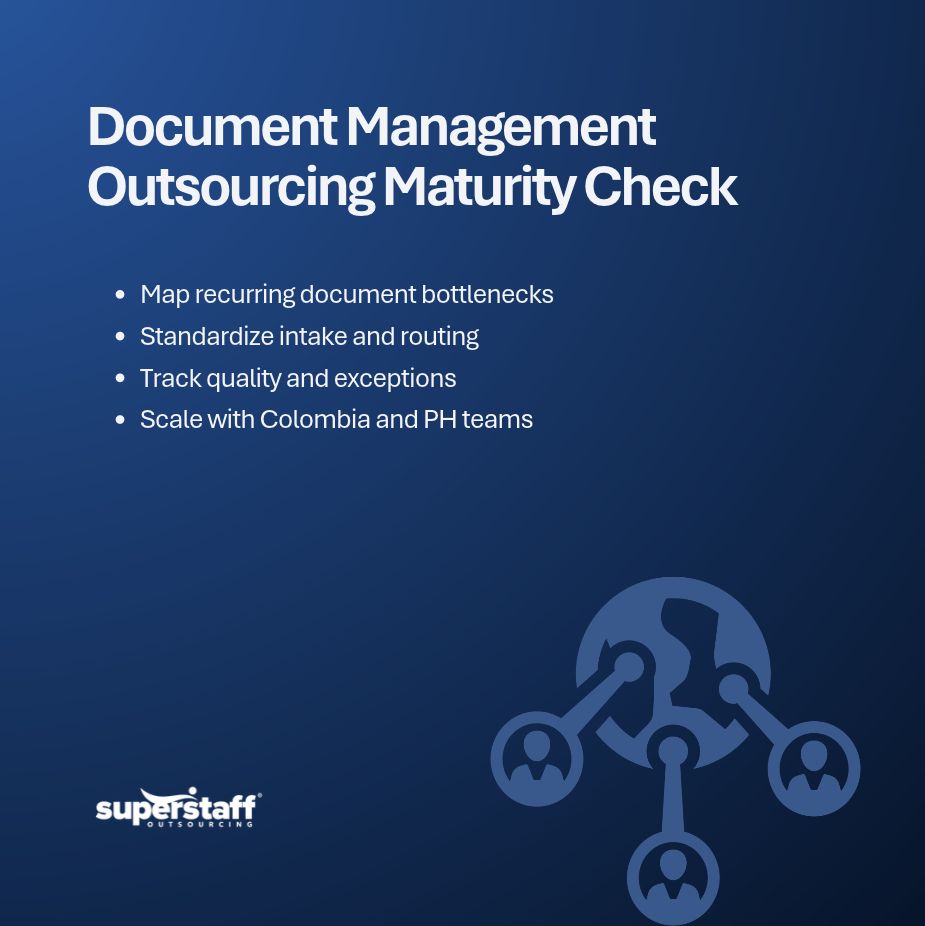
- Are document types clearly defined
• Are intake channels consistent
• Are quality rules documented
• Are turnaround expectations realistic
• Are exceptions tracked
• Are internal teams spending too much time on repeatable tasks
• Are document delays affecting customers, cash flow, or compliance
These questions help leaders decide how to outsource document management for businesses without overextending the partnership too early.
For early-stage teams, the right move may be cleanup and standardization. For growing teams, it may be dedicated processing support. For mature teams, it may be a hybrid model across Colombia and the Philippines with reporting, governance, and scale.
Why SuperStaff fits the Colombia market need
SuperStaff understands that U.S. companies need more than extra hands. They need reliable teams that can support customer-facing and back-office operations with structure, care, and accountability.
For companies exploring Colombia, SuperStaff can help design support around time zone alignment, bilingual or nearshore collaboration needs, and process visibility. For companies that also need scale, Philippine offshore teams can complement Colombia operations with strong back-office support and extended coverage.
This matters in document management outsourcing because document work touches many business outcomes. A missed file can delay onboarding. A wrong data entry can create billing issues. An incomplete record can slow down compliance reviews. A delayed update can frustrate customers.
SuperStaff helps businesses build the right level of support for where they are now and where they want to go next.
Build document operations that match your growth stage
The right outsourcing maturity model helps leaders make smarter decisions about process, people, governance, and scale. It shows that document management outsourcing should not begin with a generic task list. It should begin with a clear view of operational maturity.
Whether your company needs basic document cleanup, structured processing, better reporting, or a Colombia-supported nearshore model, SuperStaff can help you build a practical path forward.
Explore SuperStaff services today and see how our Colombia and Philippines teams can support your next stage of document operations.